Robot Vacuum with Legs and Wheels: Roboroch Learns to Storm Stairs
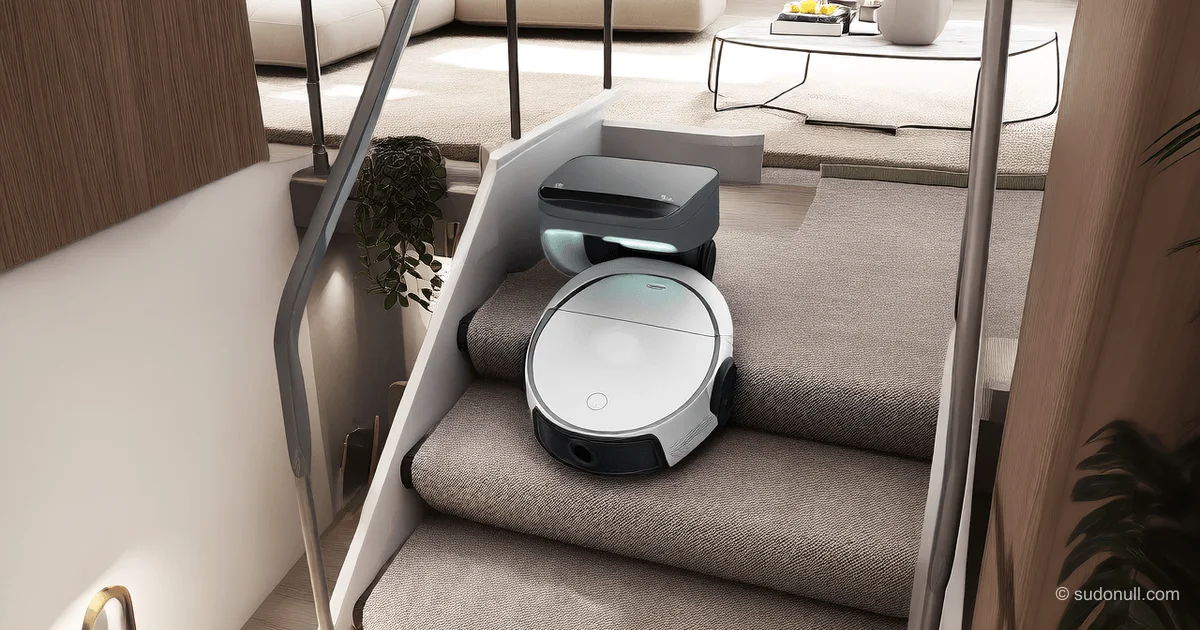
Forget about robot vacuums that helplessly beep at the bottom of stairs. The new Saros Rover with a hybrid chassis uses AI algorithms to cross thresholds and climb carpeted stairs with manic precision, cleaning where only a mop used to reach.
Five steps in 30 seconds. A robot vacuum balancing on one leg while the other feels for the next step. Carpet with a rounded edge — no problem. A curved staircase — no problem. January 2026, CES in Las Vegas: Roborock unveiled the Saros Rover and in one fell swoop overturned the main compromise we've put up with for twenty years. The staircase is no longer a wall.
CNN journalists watched the live demo. Correspondent Chelsea Stone described how the Rover climbed a test staircase, cleaning each step — something no other robot vacuum can do. She also noted the machine's ability to control speed on the descent and even turn around mid-ramp. CNET awarded the device Best of CES in the "Best Smart Home Technology" category.
Chicken Legs, Frog Jumps
The Saros Rover's form factor breaks all preconceptions of what a home robot should look like. Two limbs with wheels at the ends — journalists compare them to frog legs or heron legs. Each "leg" raises and lowers independently. When the rover isn't tackling obstacles, the limbs retract into the body, and the machine behaves like a regular vacuum.
But as soon as sensors detect a change in height, the biomechanical theater begins. The robot braces one leg on the lower step, pulls the body up, places the second leg on the step above, balances, cleans the surface, then repeats the cycle. CNET timed it: five large steps in 30–40 seconds. Not a sprint, but every second is purposeful work, not blind scrambling.
A special feature is jumping. The Rover can jump to clear small thresholds and stabilize itself on the descent. During the demo, the machine even danced to music alongside other Saros Z70 robots — synchronized arm movements and a Rover swaying to the beat.
The key point: it doesn't just climb. It cleans. Competitors Dreame CyberX and Eufy Marswalker, shown at IFA 2025, used external tracked transport platforms: such a system delivers the vacuum upstairs but doesn't clean the stairs themselves. The Rover does exactly what no one has done before: it mops or vacuums each step individually.
Three Floors Without Dead Zones
The technical foundation rests on three pillars. First, the AdaptiLift Chassis 3.0, a height-adjustable chassis that raises ground clearance to 8.5 centimeters on double thresholds. Second, a 3D spatial mapping system with motion sensors: the robot understands where the edge of a step is, the angle of the climb, and whether the surface drops away. Third, AI algorithms optimized for real-time decision-making: balance, jump, stop, turn around.
For owners of three-story townhouses, this is a tectonic shift. Until today, the scenario was stupid: either buy a robot for each floor or carry the machine by hand. Now the Rover decides its own route, climbs the stairs to the second floor, cleans it, and descends back. No magnetic strips, no virtual walls on the steps.
The cherry on top is obstacle avoidance at speed. Roborock engineers threw tennis balls at the Rover during the press demo. The machine dodged them, recalculating its trajectory in real time. Journalist Andrew Gebhart described it as "the most impressive avoidance demo I've ever seen." In real life, tennis balls are children and pets suddenly darting under the wheels.
Who This Disrupts
The robot vacuum market in 2026 resembles Formula 1: technology changes every season, yesterday's flagship is half the price today. But truly innovative products are few. The conveyor belt of Dreame and Eufy with their tracked transporters is a crutch: an additional device carries the main one, like a kangaroo mother carrying her joey. Narwal has a concept Flow 2 with its own legs, but it hasn't been shown publicly yet. The Rover currently has no direct competitors.
Roborock wins twice. First, reputationally: the Best of CES award and a flurry of publications position the brand as a technology leader. Second, financially: Roborock methodically raises the price ceiling, training consumers that a robot vacuum can cost as much as a good laptop. For comparison, the Z70 model with a robotic arm launched at $2,599 in 2025. The Rover will start at least at that level, likely higher.
Losers are owners of single-story apartments — they don't need this technology but will have to pay for it: flagship prices pull the entire segment upward. Conservative competitors like iRobot, which hasn't offered anything fundamentally new for years, also lose. The Roomba still can't climb stairs.
The question of wet mopping remains open. Roborock representative Ruben Rodriguez confirmed at CES: the Rover currently only vacuums. The company is considering which mopping system to integrate into the final version, and that decision will determine the launch timeline.
When Will It Be Available
Roborock insists: the Saros Rover is not a concept. It's a real product in development, and it will hit the market. But there's no specific date yet. Most likely, the second half of 2026 to early 2027. The price is projected in the range of $2,000–$2,600, plus or minus a hundred dollars depending on the final configuration.
One thing is certain: when the Rover appears in stores, owners of multi-story homes will, for the first time in twenty years, stop carrying a vacuum up and down stairs by hand. The mop and dustpan on the second floor will be relegated to the closet. And the industry will gain a new standard: from now on, any flagship robot vacuum must have legs.
— Editorial Team









No comments yet.