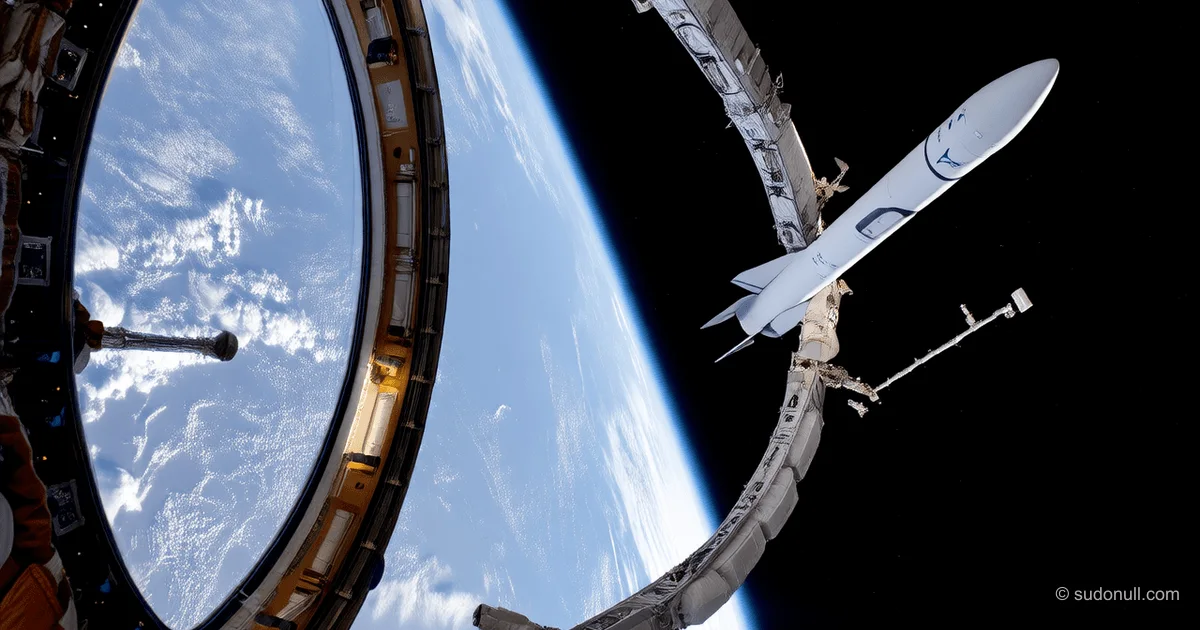
Haven-1 Station by Vast Space: To Orbit Without the Queue
While the giants prepare their projects, Vast Space is surging ahead with plans to launch the private module Haven-1 as early as May 2026. This commercial orbital station promises to open the season of "space startups," giving scientists and businesses their own platform beyond the ISS.
Startup vs. Giants: Vast Space Promises a Private Orbital Station Sooner Than Anyone Expected
Forget about government monopolies in orbit. In May 2026, a SpaceX Falcon 9 rocket will launch Haven-1 into space — a ten-meter white cylinder that will become the first commercial space station in history. Neither NASA, nor Roscosmos, nor the Chinese space agency have any direct involvement. It was built by Vast Space — a California startup founded by billionaire Jed McCaleb in 2021.
While Boeing and Lockheed Martin have been absorbing budgets for decades and competitors were rendering future orbital outposts, Vast's team of 500 engineers simply built the station — with their own money and in record time. "If we do this before getting a NASA contract, we will become not only the first commercial space station but also the only contender to have launched a project without government funding," said CEO Max Haot.
What is Haven-1 and Why It's Not Just a "Tin Can in Orbit"
Haven-1 is not a scaled-down copy of the ISS. It is a completely reimagined living environment, designed around humans rather than engineering specifications. The living space volume is 45 cubic meters, roughly the size of a double-decker bus interior. Diameter is 4.4 meters. It can accommodate four astronauts, with each mission lasting 10 to 30 days.
The interior breaks all stereotypes about spartan space conditions. Instead of cramped sleeping bags bolted to the walls, there are four private cabins with queen-size beds and a patented sleep system for weightlessness. Instead of bare metal, the finish is maple veneer. The common area of 24 cubic meters houses a foldable table and a panoramic window 1.1 meters in diameter with a 180-degree view.
The scientific module Haven-1 Lab is already sold out. Ten payload slots are occupied by research partners: Redwire, Yuri, Japan's JAMSS, Luxembourg's Exobiosphere with equipment for high-throughput drug screening in microgravity, and Interstellar Lab with its automated greenhouse Eden 1.0. The European Space Agency, through partner Yuri, has signed a contract for biological experiments.
A separate story is the partnership with Cedars-Sinai Medical Center. In April 2026, Vast announced joint research on stem cells, organoids, and bioproduction technologies in weightlessness. This is not PR but a concrete scientific program that will start as soon as the station reaches orbit.
The Space Race They Don't Talk About on TV
Haven-1 does not appear in a vacuum. The International Space Station is living its last years — NASA plans to deorbit it in 2031. The agency has allocated over $500 million for the Commercial LEO Destinations (CLD) program to have private companies build a replacement.
Four teams are competing for this money. Blue Origin with its Orbital Reef project. Voyager Technologies with Starlab — an 8-meter diameter station to be launched entirely by SpaceX's Starship. Axiom Space is building its own five-module station, with the first module promised by 2028. And Vast — the only company designing, building, and launching a station without government contracts.
The stakes are high. Vast has already spent about $1 billion. In March 2026, the startup raised another $500 million: $300 million through equity sales and $200 million through debt financing. Investors include Japan's Mitsui, Nikon, Space Capital, and the Qatar Investment Authority.
In November 2025, the company launched Haven Demo — a 515-kilogram demonstration satellite on a Falcon 9 rocket. Over six months in orbit, it collected data critical for the final refinement of the main station. By that time, the primary structure of Haven-1 had already passed load testing and pressure checks in California's Mojave.
Why Competitors Are Nervous
Vast's strategy scares the giants precisely because of its simplicity. The company embraces a "hardware-rich stepping stone" approach — lots of hardware tests, fast iterations, immediate error correction. Haven-1 is a "minimum viable product," a technology demonstrator for Haven-2, a full-fledged multi-module station that Vast plans to launch by 2028.
And beyond. By 2035, the company aims to build a station with artificial gravity by spinning the module to the required RPM. It sounds like science fiction, but the first step — testing technologies on the uncrewed Haven-1 between crew missions — is already in the flight plan.
Starlab responds with gigantism: their 400 cubic meters of pressurized volume in a single Starship launch looks impressive. But Starship is still undergoing test flights, while Falcon 9 is a proven workhorse with hundreds of successful missions. Vast chose reliability over records, and so far this choice is paying off.
The financial front is also buzzing. Vast hints at a possible IPO — in the March 2026 press release, the phrase "privately funded to date" in italics looks like a direct signal to investors. Yahoo Finance analysts call the race "open" but acknowledge: Starlab offers more public companies for investment, Vast offers more concrete results.
First Crew, First Hours, First Business
Vast is not building a station just for show. The business model is tailored to three revenue streams: government space agencies, private research missions, and space tourism. The first crew of the Vast-1 mission will launch in June 2026, one month after the station's launch. The four astronauts will be selected by Vast itself, and SpaceX will train them at its facilities.
Swiss watchmaker IWC Schaffhausen has become the official timekeeper of the project and developed the Pilot's Venturer Vertical Drive watch, tested by Vast engineers for vibration resistance and pressure changes. At the April Space Symposium in Colorado Springs, the company showcased a full-scale mockup of Haven-1, an astronaut spacesuit, and a standard large docking adapter — an open architecture that other developers can use.
Haot thinks pragmatically: "Priority number one for Haven-1 as a demonstrator is safety. Priority number two is to meet an unprecedentedly tight schedule. A fast timeline means lower costs." The simplicity of the architecture — a single-module station without complex on-orbit assembly — allows them to move at that speed.
What Will Change After May 2026
Even if Haven-1 fulfills its minimum program — three years in orbit, four crewed missions, experiments with artificial gravity — a precedent will be set. A private company has proven that an orbital station is a product, not a national project. With its own timeline, budget, and customers.
In the end: the ISS is fading into history, NASA is choosing successors, and Vast is launching a station a year ahead of its nearest competitor. If Haven-1 operates without a hitch, the conversation about "commercialization of space" will shift from future tense to present. Scientists, pharmaceutical companies, and space tourists will get something they never had before — the ability to buy a ticket to orbit without queuing at a government agency. And yes, with a queen-size bed and a view of Earth through a panoramic window.
— Editorial Team









No comments yet.