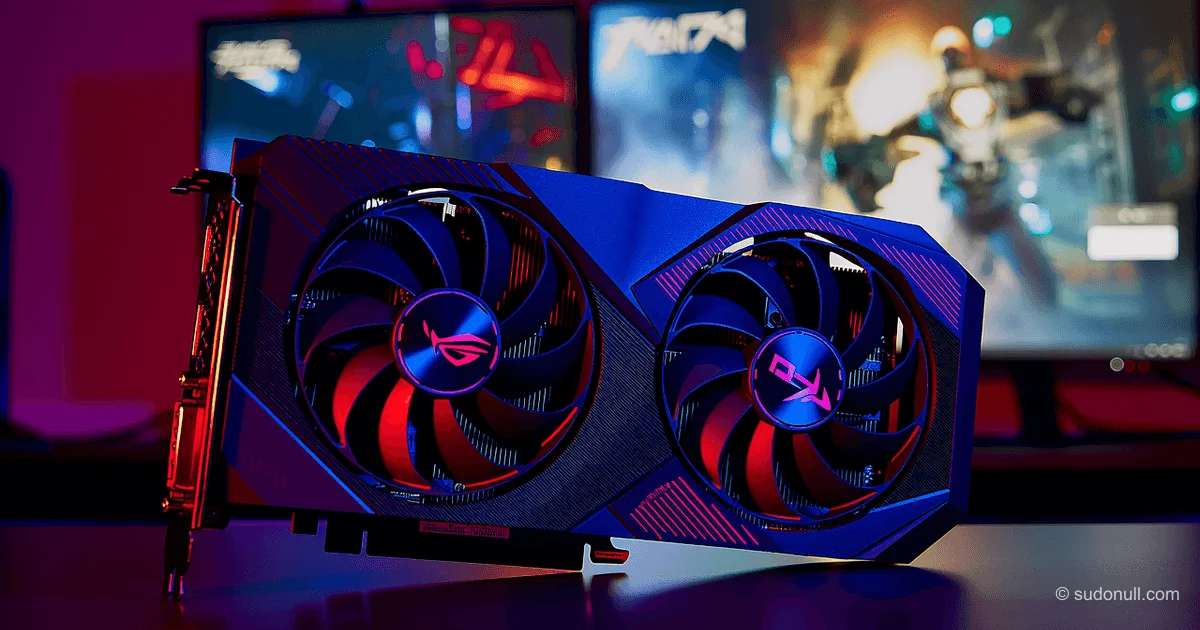
AMD expands FSR 4.1 support to older Radeon RX 7000 and 6000 graphics cards
The image scaling technology will become available on previous GPU generations. This decision delighted owners of older graphics card models.
FSR 4.1 on older cards: why this isn't AMD's generosity, but a forced capitulation
The gist: not a gift, but a belated recognition of reality
On May 13, 2026, AMD Senior Vice President Jack Huyn announced that the FSR 4.1 upscaling technology will officially come to Radeon RX 7000 (RDNA 3) graphics cards in July, and to RX 6000 (RDNA 2) in early 2027. Headlines report the company's "generosity," but this reading is incorrect. AMD didn't "decide to support" older GPUs — it was forced to do so under pressure from three forces: the modding community, a source code leak, and a catastrophic lag behind NVIDIA in game coverage.
The main signal here is not technological, but strategic. AMD admitted that its bet on RDNA 4 exclusivity failed. The RX 9000 user base is too small to retain developers. The only way to keep FSR as a technology that anyone actually implements in games is to expand its availability to the tens of millions of GPUs that people actually use.
Timeline and context: from exclusivity to leak to capitulation
To understand the scale of the failure, we need to reconstruct the timeline:
- Early 2025: FSR 4 launches as exclusive to RDNA 4 — Radeon RX 9000. AMD claims the technology requires FP8 accelerators not present in older chips.
- August 2025: AMD accidentally publishes part of the FidelityFX SDK source code. The leaked files reveal an FSR 4 version using INT8 instructions — a format natively supported by RDNA 2 and RDNA 3.
- Fall 2025: the community compiles a DLL file. FSR 4 runs on RX 6000 and RX 7000. The OptiScaler tool simplifies installation. Image quality clearly surpasses FSR 3.1. The only issue is a performance penalty of around 10-20% compared to FSR 3.1.
- 2025-2026: AMD remains silent for months, only increasing user frustration as they see the technology working "unofficially."
- May 2026: announcement — FSR 4.1 arrives officially. Timelines are stretched: July for RX 7000, 2027 for RX 6000.
Key point: technologically, AMD could have released the INT8 version back in 2025. The leak proved the code exists. The delay was not engineering-related but marketing-driven — a desire to preserve RDNA 4 exclusivity at all costs. A cost that, as it turned out, was a widening gap with NVIDIA.
Who wins and who loses
RX 7000 and RX 6000 owners win. Around 300 games will support FSR 4.1 at launch — ten times more than the 30 games at FSR 4's launch for RX 9000. For a user with an RX 6800 XT, this means upscaling quality close to DLSS without replacing the graphics card. Device lifespan extends by 1-2 years.
Valve wins. The Steam Deck and upcoming Steam Machine use RDNA 2 and RDNA 3 respectively. FSR 4.1 on these devices is a critically important tool for maintaining playable frame rates on weak portable hardware. Valve gets a free user experience improvement without investment.
The OptiScaler community and modders win. They proved that reverse engineering and bottom-up pressure work. User protest forced one of the largest semiconductor corporations to change its strategy.
AMD loses — but not for long. Short-term: RDNA 4 exclusivity is undermined. Medium-term: this is the right decision. According to Hardware Unboxed research, DLSS is present in 97% of new games, FSR only in 88%, and FSR 3.1+, required for FSR 4 compatibility, in only 72%. Even worse: only 17% of older games have FSR 3.1, while DLSS is supported in 90% of games that use any upscaler. Without expanding coverage, FSR risked becoming a niche technology that developers simply ignore.
RX 5000 (RDNA 1) owners lose. These cards do not support INT8 instructions. FSR 4.1 will remain forever unavailable for them — AMD confirmed this. Users of the RX 5700 XT, a 2019 card, are stuck with FSR 3.1.
What the media isn't telling you
First insight: AMD openly talks about open-sourcing FSR 4 — this changes the game.
In official statements, the company hinted at "open-sourcing FSR4" after the leak incident. This is not charity. It's an admission that the ecosystem war against NVIDIA using traditional methods is lost. Open-sourcing will allow FSR 4.1 to be integrated into DXVK, Proton, and other Linux compatibility layers, where the Steam Deck is the flagship device. AMD is betting on openness as the only weapon NVIDIA doesn't have. DLSS remains proprietary. If FSR 4.1 becomes an open standard, it could be used by Intel, ARM, and — hypothetically — even NVIDIA.
Second insight: performance is a hidden trap.
The 10-20% penalty compared to FSR 3.1 is not just a "price for quality." It means that on weak GPUs, where upscaling is needed most, FSR 4.1 may be non-functional. Paradox: RX 6600 users benefit most from quality improvement, but they will face the greatest performance drop. Hardware Unboxed research showed that even Intel XeSS on Arc cards surpasses older FSR versions in quality. AMD risks offering an upscaler that looks better but performs worse exactly where it's needed.
Third insight: FSR 4.1 is a testing ground for next-generation consoles.
Steam Deck, PlayStation 5, Xbox Series X/S — all use RDNA 2. When AMD promises FSR 4.1 on RDNA 2 by early 2027, it directly prepares the ground for PS6 and the next Xbox. The technology, refined on PC, will migrate to consoles, where AMD is the exclusive GPU supplier. This is not supporting old cards out of kindness — it's R&D for contracts worth tens of millions of chips with Sony and Microsoft.
Forecast: next 30 days and 90 days
30 days (until mid-June 2026). Expect technical previews from bloggers. AMD didn't specify an exact date within July, but the driver with FSR 4.1 for RX 7000 will likely be released in mid-July, right after the July patch cycle. Before that, insiders and testers will get beta versions. The key point will be comparing the quality and performance of the official version with community builds on OptiScaler. If AMD shows better results, it will be an argument for "official is better than unofficial." If not, a reputational blow.
Also possible: an announcement of the source code opening date. If AMD announces a specific repository and license within the next 30 days, it will attract the developer community and accelerate integration into the Linux ecosystem.
90 days (until mid-August 2026). FSR 4.1 will launch on RX 7000 and go through the first two weeks of public testing. The main success indicator will be the number of games that receive FSR 4.1 support within the first 60 days after launch. AMD claims 300 games "from day one," but these are games already supporting FSR 4. Catalog growth will show whether AMD convinced developers to implement the new version in 2026 projects.
By September, it will become clear whether FSR 4.1 closes the quality gap with DLSS. If independent reviews show parity in quality with comparable performance, AMD will achieve a long-awaited victory. If DLSS 4 maintains its advantage, FSR 4.1 will remain a "technology for those without NVIDIA," not a choice based on superiority.
Bottom line. FSR 4.1 on older cards is not AMD's generosity. It's a strategic retreat dictated by defeat in the ecosystem war. The company is putting a brave face on a bad situation: admitting that RDNA 4 exclusivity was a mistake and pivoting to the only strategy that can work against DLSS — openness and maximum coverage. Good news for users: their hardware will last longer. Bad news for AMD: this is an admission not of strength, but of weakness. When community modders force a multi-billion-dollar corporation to change strategy, it's not a company victory — it's a user victory despite the company.
— Editorial Team










No comments yet.