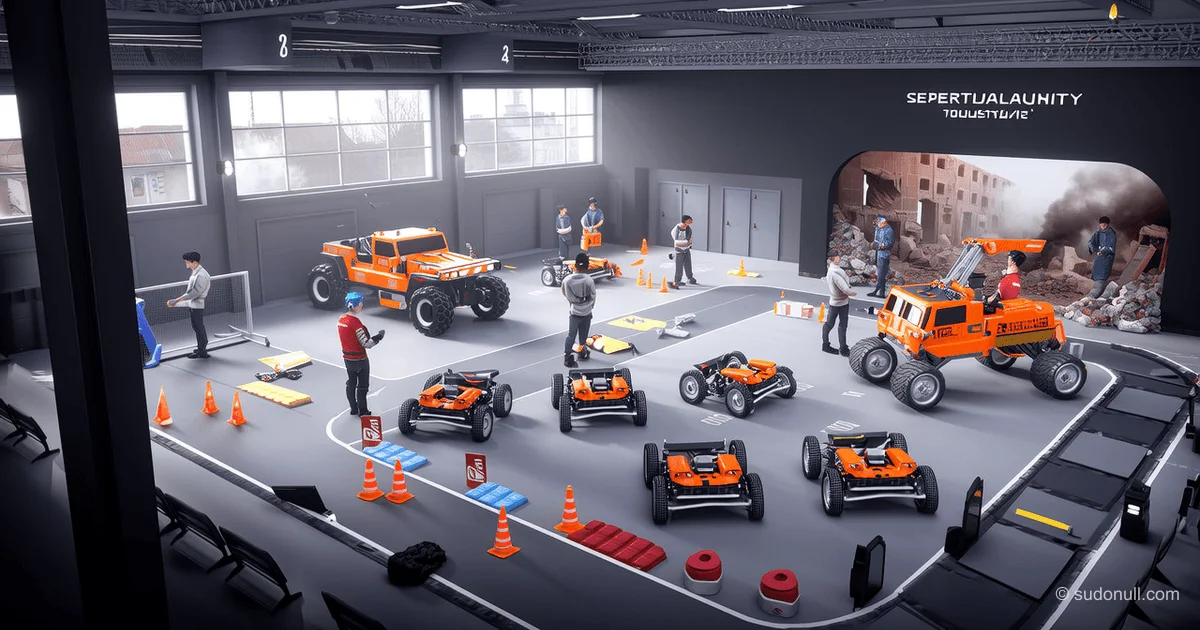
XI RoboCup Russia 2026 Championship Launches in Tomsk
The competition features over 150 teams of school and university students from across Russia and Belarus. Participants compete in robot football, maze navigation, and autonomous car races.
Not a kindergarten, but a talent special forces: what really happens at RoboCup Russia 2026
The Essence: A Forge for Technological Sovereignty, Not a Hobby Club
On May 14, the XI RoboCup Russia 2026 championship kicked off in Tomsk. Officially: 150 teams, school and university students, robot football, and autonomous vehicle races. The picture for regional media: talented kids, bright eyes, high technology.
Reality is much tougher and more interesting. The Tomsk RoboCup is not about education in a vacuum. It is the only legal channel for Russian teams to enter the international robotics arena via the Asia-Pacific track. Amid sanctions and technological isolation, this is not a festival but an operation to preserve competencies. Each team here is a mini-laboratory solving problems of GPS-free navigation, computer vision on low-end hardware, and autonomous decision-making. Exactly the challenges facing Russian manufacturers of UAVs and ground robotic platforms.
Timeline and Context: Ten Years of Upgrades Amid Isolation
The story didn't start yesterday. Tomsk has hosted the Russian stage since 2016. Over this time, the championship has evolved from a niche event into a national filter. Look at the chain: regional qualifiers in March-April (Krasnoyarsk, Dombai, Yekaterinburg, Novosibirsk, Nizhny Novgorod) — the final in Tomsk in May — the international RoboCup Asia-Pacific in fall 2026 in China. This is a deliberately built talent funnel.
The key turning point was 2024, when Russian and Belarusian teams, after a long break, again went to Asia-Pacific. In 2025, 23 teams traveled to Abu Dhabi and brought back 19 sets of awards. These are not just medals — they validate the level of training. Foreign judges and engineers see that competencies in Russia have been preserved despite everything.
2026 is a logical continuation. A league for younger schoolchildren, "RoboCup Kids," was added. Formally, it develops interest in technology. In reality, it's an attempt to lower the entry age because the "funnel" at the top is already working, but the bottom needs more filling.
Who Wins and Who Loses
TUSUR and the Tomsk cluster win. The University of Control Systems and Radioelectronics is not just an organizer; it is the selection operator. Winners receive up to 10 additional points for admission to TUSUR and other leading universities. Thus, the university channels the best applicants from across the country to itself. Then comes master's, postgraduate studies, and laboratories. For a regional university in Siberia, this is a matter of survival in competition with capital institutions.
The Ministry of Emergency Situations (EMERCOM) wins. This year, rescuers are participating as partners for the first time. They brought their own drones and equipment. Why? They need computer vision algorithms with pattern recognition — exactly what is honed in the rescue robot league. Children get access to real cases, EMERCOM scouts for talent and solution prototypes. A symbiosis.
Regions that haven't integrated into this system lose. The geography of participants is impressive: Moscow, Kazan, Vladivostok, Yuzhno-Sakhalinsk, Krasnodar Krai, Yekaterinburg. But this means that where there are no regular qualifying stages, schoolchildren lose access to the international track. Educational inequality in robotics is cemented at the geographic level.
What the Media Doesn't Tell
The main insight everyone misses: the "Robotraffic" discipline is a proving ground for autonomous navigation, not toy cars. Autonomous car models compete in conditions as close to urban traffic as possible: sign recognition, obstacle avoidance, predicting other participants' behavior. The same algorithms needed for real autonomous vehicles in closed areas — factory, warehouse, military. And these are competitions among school and university students.
The second non-obvious point: parallel to the main competitions, on May 16, a Youth Symposium on Robotics and AI will be held. This is not just a "scientific section for show." It is a platform where students and postgraduates present research results. Essentially, a mini-conference where you can find future employees or interns. Talent hunters from tech companies understand this and quietly monitor the presentations.
The third point: RoboCup's mission is to create a team of robots capable of beating the world football champions by 2050. It sounds fantastic, but behind it is a concrete engineering goal: to achieve a level of autonomy, situational awareness, and physical interaction that no system has yet reached. Every RoboCup is a step toward this goal, and Russian teams are not just extras in this race.
Forecast: The Next 30 Days and 90 Days
Next 30 days (until mid-June 2026). Winners will be determined today, May 16. After that, preparation for the Asia-Pacific in China will begin. Organizers will form a delegation and start seeking funding. Given the 2025 experience and 19 awards, we can expect at least 25 Russian teams this time. Participating universities will start an information wave about their students' victories — this will become a tool to attract applicants in the 2026 admissions campaign.
Next 90 days (until mid-August 2026). Key process: winning teams will start upgrading their robots based on the final results. Those who lost due to weak hardware will seek sponsors for new components. Those who lost algorithmically will sit down to rewrite code. In July-August, universities will likely hold summer robotics schools, using the championship's success as advertising. And EMERCOM, having gained experience interacting in Tomsk, may expand cooperation with universities to other regions — the format proved effective. If Asia-Pacific takes place in October-November, intensive training and test runs will begin by the end of August.
The stakes are higher than they seem. Today's schoolchild from Tomsk or Vladivostok programming a rescue robot will become an engineer developing navigation for industrial drones in five years. Or won't — if they go where their competencies are monetized in USD and EUR, not local currency. RoboCup Russia is an attempt to create an ecosystem that retains these minds here by showing them a career trajectory from school league to the real sector. Not everyone succeeds yet, but Tomsk's chances are above average.
— Editorial Team








No comments yet.