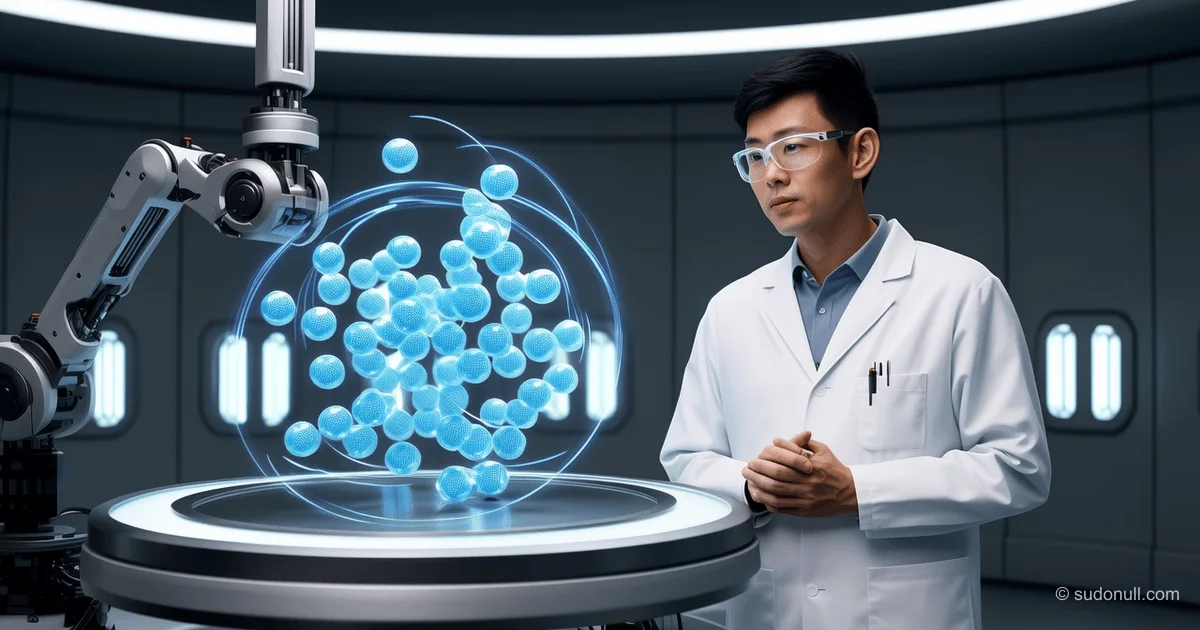
AI Drug Discovery Startup from DeepMind Founder Raises $2.1 Billion in Funding
A spin-off from Alphabet, founded by Demis Hassabis, has secured $2.1 billion in funding. The ambitious project aims to build an AI system capable of solving all known medical diseases.
Here, in the quiet of London labs and venture capital offices, something far more significant than another funding round is unfolding. I see the Isomorphic Labs deal as a point of no return for the entire pharmaceutical industry. $2.1 billion is not just a record sum for AI biotech; it's the price of believing that a pill can be computed, not discovered.
The Core: What's Really Happening
Formally, we see a classic venture cycle: $600 million in March 2025, now $2.1 billion at an undisclosed valuation. Investors led by Thrive Capital are funding a startup with no clinical trial candidates and a timeline that has slipped from late 2025 to late 2026. Hassabis calls it a "caveat" about preclinical tests, but we know that in pharma, the devil is always in the details of staging.
However, the focus should be not on delays but on the deal's architecture. The investor lineup—Thrive Capital, MGX (Abu Dhabi), Temasek (Singapore), UK Sovereign AI Fund—indicates this is not company financing but funding for an infrastructure project of national scale. The UK is directly involved through its sovereign fund. This is the key signal: states have realized that whoever builds a working AI Drug Design Engine first will control not just the market but the very right to access modern medicine.
Timeline and Context
Dates matter here. 2021: spin-off from DeepMind. 2024: Hassabis and Jumper win the Nobel Prize for AlphaFold. 2025: AlphaFold 3's closed source sparks criticism, but open-source alternatives emerge: Boltz-2, OpenFold3, Chai-1. The community tries to catch the departing train, but the problem is that by the time they clone AlphaFold 3, Isomorphic is already testing IsoDDE—a system unofficially called "AlphaFold 4" that, by key benchmarks, doubles its predecessor's accuracy on complex targets.
Meanwhile, a tectonic shift is underway in the competitive landscape. In early 2026, Eli Lilly and NVIDIA invest $1 billion in a joint AI lab, and in April 2026, OpenAI launches GPT-Rosalynd, its own biology model. Thus, Isomorphic Labs' round is a response to the tool market turning into an arms race. Traditional pharma giants are terrified: Novartis, Johnson & Johnson, and Eli Lilly are already paying Isomorphic Labs under partnership agreements, yet they realize their own R&D departments are rapidly becoming obsolete.
Who Wins and Who Loses
Alphabet wins. Essentially, the corporation is building a dual monopoly: Google DeepMind controls foundational models, and Isomorphic Labs controls their applied use in biology. Meanwhile, Alphabet retains an option to fully spin off Isomorphic Labs in the future. This is a classic value-maximization strategy: pump the asset with money and talent under the holding's wing, then take it public with a tens-of-billions market cap.
Traditional CROs and early AI startups lose. Recursion Pharmaceuticals, once a star in this market, has lost nearly 90% of its market cap since 2021, and NVIDIA fully exited its stake in February 2026. BenevolentAI has delisted. The reason is simple: Isomorphic's platform approach targeting "all diseases at once" devalues niche players. Investors no longer need ten different companies for each cancer type; they need one computational pipeline. Money is flowing from many small AI biotechs to one giant.
What the Media Isn't Saying
Non-obvious insight: $2.1 billion is raised not for future drugs but for a data play.
Mainstream media writes about "AI-created drugs" and the "mission to cure all diseases." But an experienced analyst sees a different asset here: closed-loop experimental data. Let me explain. IsoDDE is not just a program; it's a feedback mechanism. The company owns labs in London and Lausanne. Every time their model predicts a protein structure and experimental chemists confirm or refute it in a wet lab, the model is retrained on unique, unpublished data. This data—including information about "hidden binding pockets" that science hasn't seen for decades—is not publicly available. It is the company's private property. This corpus of physically validated protein-ligand interactions, not lines of code, is the main barrier to entry. In 18–24 months, this corpus will become critically large, leaving competitors without their own labs behind forever. It is for the right to own this unique "prediction-synthesis-test" loop that investors are paying a fortune.
Forecast: Next 30 Days and 90 Days
30 days. The market will start to wobble. Expect a sharp rise in investments in companies producing automated lab equipment for synthesis and screening. If Isomorphic Labs scales its pipeline, "iron hands" for wet labs will become scarce. Simultaneously, we'll see leaks along the lines of "former DeepMind employees criticize IsoDDE's closed nature," which will put short-term pressure on the narrative but not on valuation. Hassabis himself will give several interviews, carefully shifting focus from "curing all diseases" to "first clinical trials," preparing the market for a pragmatic rather than fantastical scenario.
90 days. The moment of truth for big pharma will arrive. I expect at least one more giant on the level of Pfizer or Roche to form an alliance with Isomorphic Labs worth over $2 billion or attempt to buy exclusive access to the platform for specific therapeutic areas. Simultaneously, regulators will step up: the FDA and EMA will issue joint statements on the need to validate AI models for preclinical trials. This won't stop progress but will create an additional filter that benefits Isomorphic Labs as the richest and best-prepared player. The question is no longer whether AI will replace synthetic chemists, but whether the industry can retrain these specialists before screening millions of molecules a day becomes a standard procedure costing pennies per hypothesis.
— Editorial Team






No comments yet.