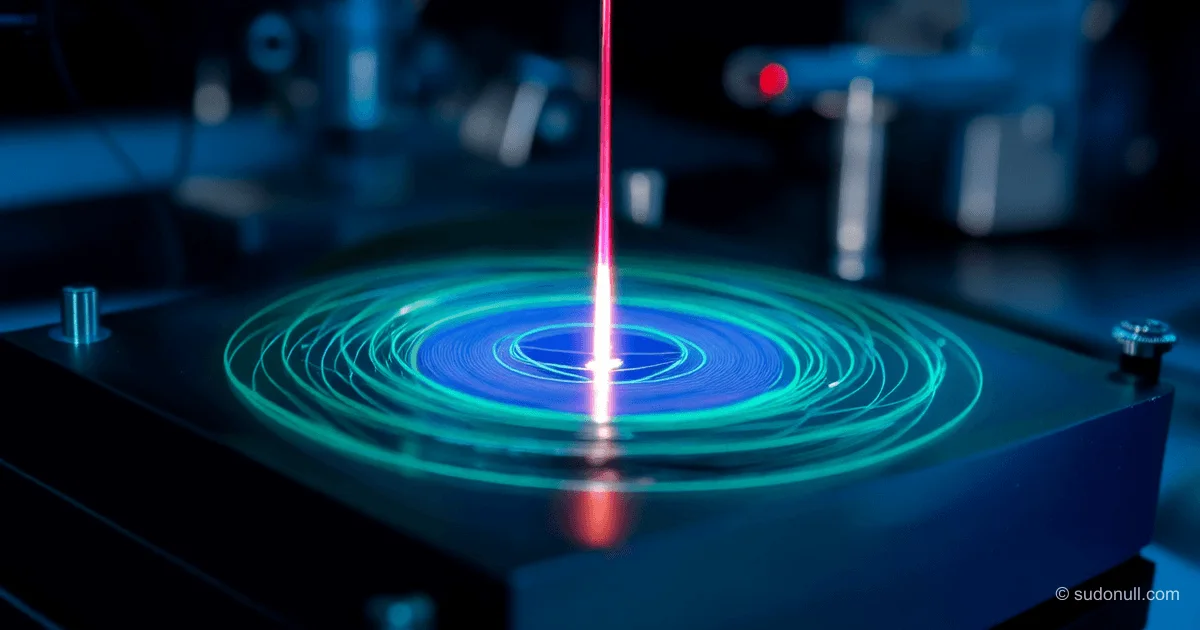
Powerful and Efficient Optical Amplifier Created with Energy Recycling
Stanford scientists have developed a compact optical amplifier based on a ring resonator that repeatedly amplifies light signals with minimal energy consumption.
The news about the creation of an ultra-compact optical amplifier at Stanford is a classic case where academic work published back in February turns into media hype only by May, when the industry realizes the scale of the implications. I have been following the Safavi-Naeini lab since their first publications on lithium niobate resonators, and what they have done now is not just "another amplifier." It is an architectural breakthrough that changes the game for all of integrated photonics.
[The Core]: What is Really Happening
Contrary to the headlines, the main innovation here is not "100x amplification." A gain of 20 dB can be achieved with standard methods. The essence of the work, published in Nature on January 28, 2026, lies in the method of "energy recycling" through second-harmonic resonance.
Let me explain without formulas. A conventional optical amplifier takes a powerful "pump" beam and uses it to boost a weak signal. The efficiency of such a process rarely exceeds 10-15% — the rest of the energy is lost as heat. Amir Safavi-Naeini's group did it differently: they confined the pump light in a ring resonator on thin-film lithium niobate (TFLN), where it circulates thousands of times around a "racetrack resonator," gradually building up intensity. When the circulating power peaks, nonlinear conversion to the second harmonic comes into play, and it is this harmonic that efficiently amplifies the signal. The key word is "efficiently": the device consumes only a few hundred milliwatts, which is tens of times less than traditional counterparts.
Timeline and Context
January 28, 2026: The paper is accepted in Nature. The scientific community receives formal proof of concept.
February 2026: First reprints in industry publications like Photonics Spectra and SciTechDaily. Emphasis is on fundamental physics — low-noise, broadband, energy recycling.
May 2026: Media explosion. Headlines shift from "physicists create amplifier" to "internet will become 100 times faster." This is the classic hype cycle, but it is now, in May, that the industry begins real licensing negotiations.
Who Wins and Who Loses
Winners: lithium niobate platform manufacturers. HyperLight, Liobate Technologies, and other startups that have invested years in TFLN technology gain a powerful argument for attracting new funding rounds. If before they were asked "why your expensive niobate?", now the answer is ready: only TFLN allows creating such efficient nonlinear resonators.
Winner: DARPA. The agency funded this work, and now they have a technology that could radically reduce the energy consumption of optical interconnects in military data centers and satellite communication systems. The project clearly fits into the Department of Energy's Green ICT program.
Losers: traditional semiconductor amplifier manufacturers. If TFLN amplifiers can be fabricated on standard fabs using CMOS-compatible processes, this begins to threaten the market for SOAs (semiconductor optical amplifiers) from companies like Thorlabs and QPhotonics. The threat is not direct yet, but the direction is set.
Paradoxically, loser: silicon photonics. Silicon is a poor nonlinear material. If the industry pivots toward TFLN, the multi-billion dollar investments in silicon photonic platforms from Intel and GlobalFoundries could partially depreciate.
What the Media Isn't Saying
The media writes about "smartphones with optical amplifiers," but that's nonsense. A smartphone doesn't need an optical amplifier inside — there are no optical signals there. The real target is optical interconnects between chips in data centers. Currently, connections between GPUs or CPUs use copper wires, and at high speeds, the energy consumption of these lines grows exponentially. Replacing copper with optics using TFLN amplifiers is not about "faster internet" but about reducing the electricity bill for Amazon, Google, and Microsoft by $150-200 million per year for each large data center.
A second non-obvious point: this technology solves the LiDAR problem. LiDARs for autonomous vehicles require powerful yet compact optical amplifiers. The fact that Safavi-Naeini's group demonstrated operation specifically on lithium niobate, which also allows electrical modulation of the signal, hints at a future chip combining amplification and beam scanning. That would be a breakthrough for a market estimated at $5 billion by 2027.
A third point concerns the date. The Nature publication came out in January, but the buzz arose in May. This is no coincidence. Key industry conferences (CLEO, OFC) take place in April-May, and the Safavi-Naeini team clearly coordinated the media release with presentations at these events. We are seeing a well-planned campaign to attract industrial partners, not spontaneous press interest.
Forecast: Next 30 Days and 90 Days
30-day forecast (by mid-June 2026):
We will see an announcement about the creation of a startup or, more likely, a strategic partnership between the lab and a major player — my bet is on NTT Research (they already funded the work) or Hewlett Packard Enterprise (HPE has invested billions in photonic interconnects). The deal size will be modest — around $15-20 million at seed stage, but the company valuation will immediately jump to $80-100 million. In parallel, the group will publish a follow-up demonstrating amplification at a specific telecom wavelength (1550 nm), which is critical for data centers.
90-day forecast (by end of August 2026):
The key moment is demonstrating the device's operation outside the lab. Currently, all measurements were performed on an optical table with vibration isolation. Industrial partners need data on stability under cyclic temperature changes from 0 to 70°C. If the team shows such stability (and TFLN has known issues with this), a patent race will begin. Major players will start buying up IP in TFLN resonators. If stability proves insufficient, the hype will collapse as quickly as it arose — and we will return to discussing a "promising but not yet commercializable" technology.
The main takeaway: the Stanford amplifier is not a finished product but a proof of principle. However, the principle is so elegant and physically sound that the industry cannot ignore it. The only question is how many years it will take to turn a lab prototype into a chip that can be ordered from TSMC. My estimate is 3-4 years for first commercial samples and 5-7 years for mass adoption in data centers. But for investors, this window of opportunity is opening right now.
— Editorial Team








No comments yet.