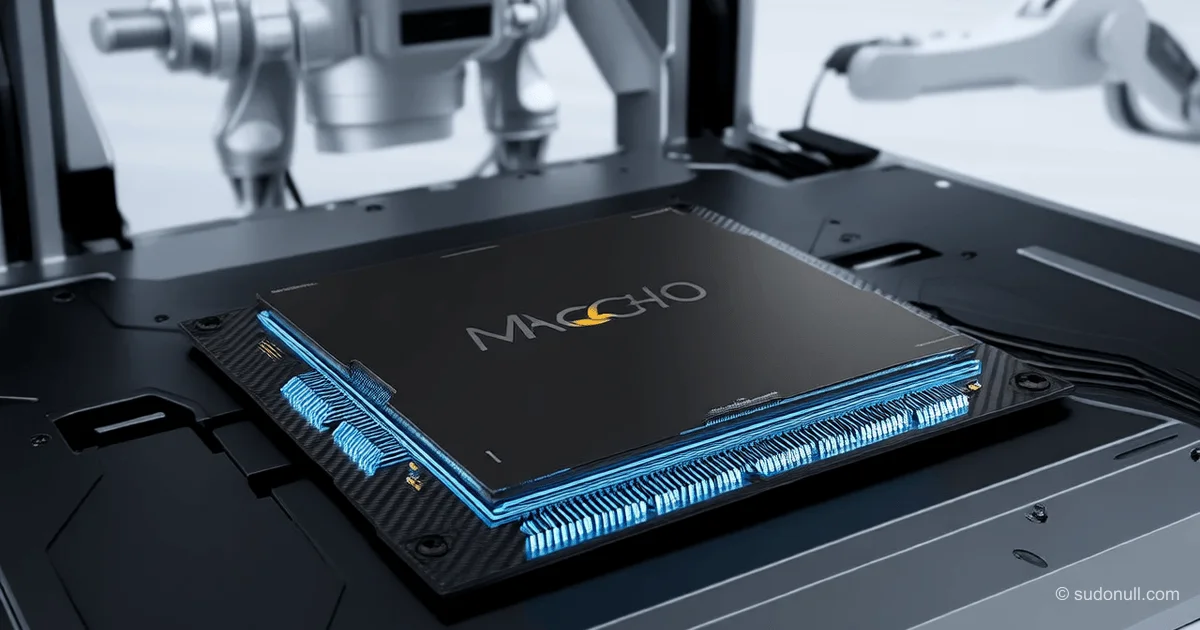
Li Auto Unveils Custom Mach M100 Chips and Motherboards, Following Apple's Lead
Chinese EV maker Li Auto has taken a step toward vertical integration by unveiling its own processors and motherboards for its vehicles.
Okay, let's break down the story of the Li Auto Mach M100 chip without emotion, but with surgical precision. As someone who has seen the internals of dozens of autopilot systems and knows the real cost of hardware in a car, I'll say this: this isn't news about a chip. It's news about the end of the Jensen Huang era in the Chinese automotive industry. And it's not about competition—it's about survival.
[The Core]: What's Really Happening
The bottom line is that Li Xiang (CEO of Li Auto) just put a definitive end to the question of who will control the "brain" of Chinese EVs. This isn't "following Apple's lead" for aesthetics. It's a forced exodus from the NVIDIA ecosystem, disguised as a technological breakthrough.
Everyone is talking about the 2560 TOPS figure. But no one is asking the key question: why now, in May 2026, when Li Auto's margins are squeezed to the limit, are they rolling out a product that took four years and, by conservative estimates, $80 to $120 million just on R&D and masks? The answer lies not in the technical documentation, but in geopolitics. At a closed-door meeting in January 2026, Li Xiang directly told management: betting on NVIDIA is technological suicide, because physical access to next-gen chips (the next iteration of Thor) for Chinese companies could soon be cut off. The Mach M100 is not an upgrade—it's a lifeboat.
The second non-obvious layer: this isn't just an autopilot chip. The Dynamic Dataflow architecture is honed not so much for pedestrian detection as for computing physical interactions. The chip's launch coincided with a restructuring of Li Auto's R&D department, where the hardware division is now overseen by Lan Xianpeng, former head of autonomous driving, and his main task is not cars, but robots. The Mach M100 is the first stone in the foundation of their future humanoid robot.
Timeline and Context
4 years ago (2022): The project's inception. The automotive industry was in a boom of "kamikaze chips." Many startups were drawing renders. But Li Xiang hired just two (!) people. They didn't build a "small simple chip"; they immediately set course for a 5nm process and Dataflow architecture, which at the time had no mature automotive ecosystem. It was a risk on the level of "downside—bankruptcy, upside—immortality."
January 30, 2026: Li Auto confirms a massive R&D restructuring. Teams are split into three directions: base models (LLM), software, and hardware (including chips and robots). This is the day the company de facto ceased to be a pure automaker and became an AI corporation.
May 11, 2026: Li Xiang publishes a photo of the Mach M100 die. This is not a leak; it's a calculated move. A few days before the launch of the L9 Livis, he creates an information vacuum so that at launch, everyone discusses not the radiator grille design, but "NVIDIA's global hegemony."
May 13, 2026 (today): We have confirmed data: 5nm TSMC process, 1280 TOPS per die, dual configuration in the car. But the key figure is a 40% reduction in latency. It's this parameter, not the "parrot TeraOps," that kills the competition.
Who Wins and Who Loses
TSMC wins. While everyone is chasing 2nm smartphones, Li Auto quietly loaded a 5nm line with automotive chips (N5A). For Taiwan, this is diversification. For TSMC, it's critical that major EV players have started migrating to auto nodes; otherwise, the fab giant is too dependent on Apple.
Their own win, but smarter. Note that the "exclusive club" with their own chips now includes NIO, Xpeng, and Li Auto. Who lost? Baidu and its Apollo division. Why would customers pay huge sums for Baidu solutions when Li Auto's hardware delivers 3-5 times more efficiency for running their own VLA models (Vision-Language-Action)? Li Auto is becoming a self-sufficient island.
NXP unexpectedly loses. All the hype is about "beating NVIDIA," but the real blood will flow from microcontroller manufacturers and traditional automotive SoCs. The Mach M100, with its bandwidth, aims to unify functions: autopilot, multimedia, and chassis control (Drive-by-Wire). Li Auto claims the new L9 is a "single brain." This is a death sentence for the zoo of dozens of small chips that Europeans have profited from for decades.
What the Media Isn't Saying
The media revels in comparisons to the Apple A-series, but that's a rookie mistake. A much more accurate analogy is Huawei Ascend. This is an attempt to replicate Ren Zhengfei's maneuver: create a walled garden around their AI ecosystem. Insider information: inside the company, this project is called not "chip" but "Project Mach"—and its key metric is not TeraOps, but a parameter called "Bandwidth-to-Latency Ratio." Why? Because for running large language models (LLMs) directly in the car, the bottleneck is not matrix multiplication speed, but the speed of feeding data to those matrices. NVIDIA, with its GPU-type architecture, still "wastes" over 60% of energy and time moving data between memory and cores. The Mach M100, thanks to its pipeline Dataflow architecture, minimizes this idle time.
The second "dirty secret": this is a chip for war, not peace. Note the anomalous figure: 2560 TOPS in the car. For city driving at a maximum speed of 60 km/h, this is overkill—5-7 years of redundancy. This power is needed for two tasks not yet in the commercial field: 1) Fully autonomous humanoid robots, where sensor latency is critical. 2) Instant 3D terrain mapping with output to augmented reality (XR) displays for military or rescue operations. Li Auto is now a "dual-use technology supplier," no matter how much they deny it.
Forecast: Next 30 Days and 90 Days
30-day forecast (by mid-June 2026): A witch hunt will begin. Within two to three weeks, some US tech blogger with lab access will tear down the L9 Livis and find that the chip runs hotter than expected in idle mode, or the software doesn't deliver the claimed performance in third-party benchmarks. There will be a scandal in the vein of "Tesla FSD vs Reality." This is a normal market defensive reaction. But the main thing is that Li Auto's Nasdaq shares (ticker LI) will start to slowly creep up on expectations of platform licensing. Because for small Chinese automakers, their chip is a ready-made ticket to the future without paying the "Jensen tax."
90-day forecast (by end of August 2026): I expect an announcement of a strategic partnership between Li Auto and one of the major multimodal AI labs (possibly DeepSeek or a new "dark horse" from Shenzhen). They will announce that they have created an "operating system for agents" based on the Mach M100. This will legitimize the chip not as an automotive one, but as a de facto robotics standard. And then the most interesting game will begin: NVIDIA will try to dump prices to regain the favor of Chinese automakers, but it will be too late—the supply chain and trust will be severed forever. Li Auto's entry cost was about $100 million; NVIDIA's exit cost is the loss of the fastest-growing market segment outside the US.
— Editorial Team









No comments yet.