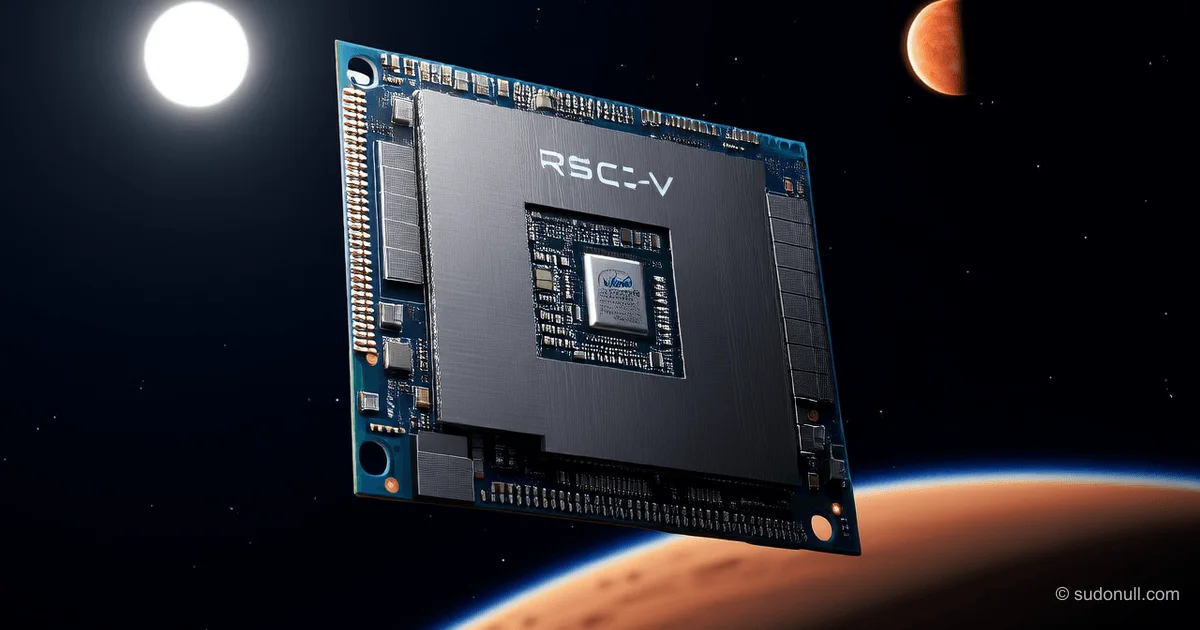
NASA and Microchip to Create Processor 100 Times More Powerful for Lunar and Mars Missions
New space processor will be 100 times more powerful than current solutions, which is critical for future missions to the Moon and Mars.
Let's break down this NASA and Microchip deal without illusions. Headlines are full of flashy numbers about "100x improvement" and "Mars missions." But if you know the anatomy of the space industry, the true essence of this project lies far beyond flights to the Moon or Mars. This is an operation not so much about creating a processor as it is about rewriting the rules of the game in the US defense procurement market.
[The Core]: What's Really Happening
The essence of this announcement is a quiet but unprecedented architectural revolution in space electronics. We are witnessing the final dismantling of the POWER and SPARC architecture era, on which NASA has relied for decades. The real subtext is that the US Federal Government, through NASA and the Missile Defense Agency (MDA), is finally creating a unified hardware standard capable of permeating all segments: from low Earth orbit satellites to Martian bases and strategic warheads.
Pay close attention to the choice of processor architecture. They rejected x86 and ARM, owned by Intel and SoftBank. The choice is the open and free RISC-V architecture. This is not so much a matter of technological superiority as it is of sovereignty, licensing purity, and complete independence from the whims of private corporations. They are placing it on a trusted GlobalFoundries fab in New York State using 12nm LP+ technology. NASA no longer needs the top-management trap of Silicon Valley.
The second non-obvious point is that this is not just a processor. It is a system-on-a-chip (SoC) built on a chiplet architecture with an integrated high-speed Ethernet switch capable of data transfer rates up to 240 Gbps. This means future spacecraft will cease to be expensive and fragile "handcrafted creations" and will become modular networks. Onboard LAN in open space is something JPL engineers have dreamed of for the last 20 years, but they ran into the lack of radiation-tolerant network fabric.
Timeline and Context
2011: The HPSC project is officially launched, but at the time it was perceived as another academic fantasy to replace the ancient RAD750, which has been in use since the debut of the Apple iPod.
August 2022: The contract moves into the implementation phase. NASA selects Microchip Technology. This was a shocking moment because Boeing had long been the favorite with developments based on the ARM Cortex-A53. Microchip's victory with SiFive (RISC-V) was a game-changer for the latter.
February 2026: NASA's cFS Symposium at Goddard Space Flight Center. Microchip shows not "renders" but live silicon—engineering samples. There is a closed demonstration of AI processing capabilities at the edge without involvement of the main control center.
May 2026 (today): The Jet Propulsion Laboratory (JPL) publishes the first test results. The figure is no longer just 100 times, but an astronomical 500 times. But it's important to understand: this is a multiple advantage in specific tasks per watt of energy, not just clock frequency. The media misses this. The current chip is undergoing thermal cycles and radiation guns at JPL.
Who Wins and Who Loses
SiFive wins. This California-based company develops the RISC-V X280 cores inside this space monster. SiFive's market capitalization is not yet overvalued. The NASA contract is not about revenue; it's a seal of quality that opens the door to $15 billion in US defense sector contracts over the next 5 years. Their vector extensions for artificial intelligence are now considered the "gold standard" of reliability.
GlobalFoundries wins. While everyone chases trendy 2nm and 3nm processes for smartphones, GlobalFoundries gains the status of a "classified facility" for US critical infrastructure. Their fab in Malta, New York, is booked for years ahead.
Boeing loses. Quietly, without much fanfare, they lost this tender back in 2022, but now that HPSC has gone to silicon, their position as a system integrator for space platforms is weakening. Defense customers are increasingly looking at the off-the-shelf chip from Microchip rather than Boeing's custom developments.
Paradoxically, SpaceX loses. Sounds heretical, but it's true. The main advantage of Starship and Starlink is their low cost and ability to use commercial chips, tolerating their failures. If NASA and the Pentagon get a cheap, mass-produced, fault-tolerant, and 500 times more powerful chip for open space, it will kill SpaceX's unique selling proposition in the military satellite segment. Elon Musk loses his monopoly on "fast and mass-produced."
What the Media Isn't Saying
Headlines talk about the Moon and Mars, but that's just a disguise. The real customer this chip is aimed at is the "Iron Dome for America" project and the US Space Force. The HPSC processor has a built-in hardware cryptographic core and a hardware root of trust. This is not for collecting lunar regolith—it's for hypersonic interceptors that need to instantly identify targets in a nuclear war scenario when communication with Earth is destroyed.
Here's the most scandalous part: the 240 Gbps performance for the onboard Ethernet switch is not needed for scientific instruments. It is needed to build a space-based Aegis system. The chip can connect a network of sensors on different satellites to create a unified battlefield picture. We are talking about creating an autonomous combat network in orbit capable of making decisions on weapon use without a signal from Earth.
And the funniest part is the 12nm process. It's 2026. It seems like "yesterday's technology." However, it is precisely this mature FD-SOI process that provides phenomenal resistance to single-event upsets. Moreover, only this process is available in the US on a 100% "clean" line, inaccessible to China or even Taiwan. This is the price of technological sovereignty in a world where TSMC becomes a hostage to geopolitics.
Forecast: Next 30 Days and 90 Days
30-day forecast (by mid-June 2026):
Don't expect loud announcements about flights. Expect a leak from the Pentagon or the Missile Defense Agency that the HPSC architecture has been included in the technical specifications for the space echelon of the "Golden Dome" missile defense system. NASA will announce the creation of a unified open-source software repository, finally tying thousands of developers to the Microchip and RISC-V ecosystem. Simultaneously, JPL will release a demonstration of a neural network running directly on the chip in a thermal vacuum chamber.
90-day forecast (by end of August 2026):
The key moment is certification. The chip will achieve TRL-7 status. But the main thing—I predict that Microchip Technology will announce a commercial version of this chip for the urban air mobility market. If it withstands space radiation, it automatically solves the electromagnetic interference problem for air taxis. We will see space technology begin to migrate into civilian UAVs, making them virtually indestructible in terms of electronics. And then the real war for this chip will begin between civilian and military customers, and Microchip's stock price will decouple from the market.
— Editorial Team










No comments yet.