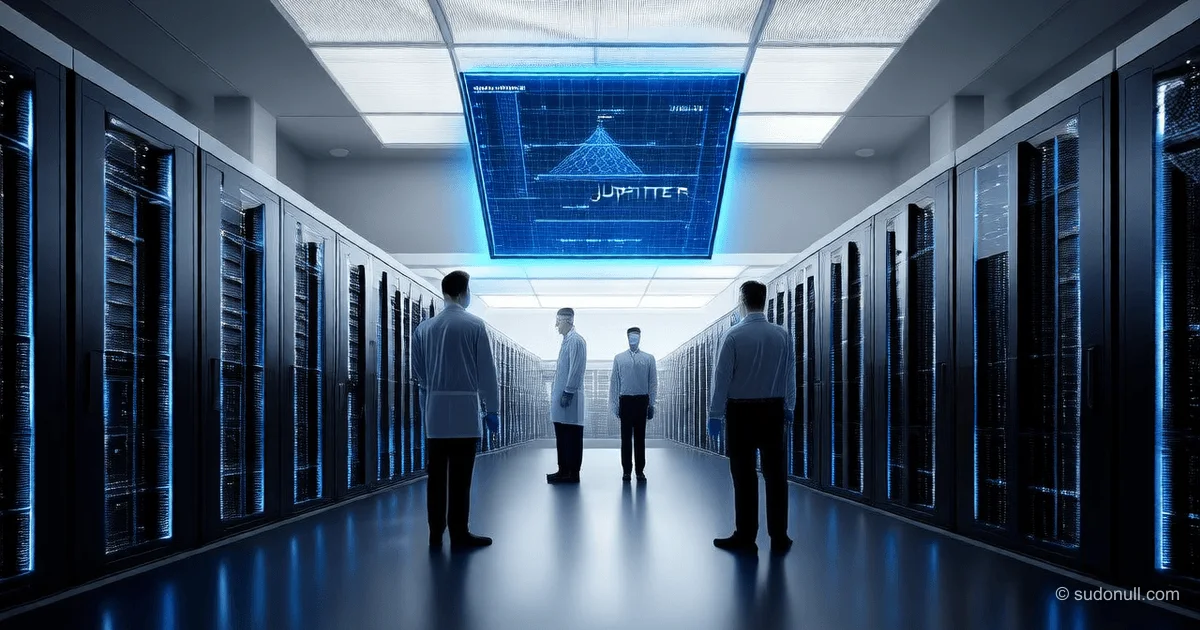
World's First Full Simulation of a 50-Qubit Quantum Computer
German scientists have achieved a breakthrough using the JUPITER exascale supercomputer to fully simulate a 50-qubit quantum computer, breaking the previous record of 48 qubits.
Very well, let's break down this situation without journalistic fluff. As someone who has personally dealt with quantum simulations on classical hardware, I see a much deeper story here than just a "new record."
[The Core]: What's Really Happening
Everyone thinks the main news here is crossing the magic 50-qubit barrier. That's nonsense. 48 or 50 — the difference is for textbooks, not industry. The real story is quietly hidden in JUPITER's architecture. None of the mainstream outlets noticed, but it's the modular exascale design and, more critically, the new direct-to-chip liquid cooling system that allowed not just computing 50 qubits, but doing so continuously long enough to simulate a noisy model with error correction, not an idealized one.
In reality, the German group at Jülich didn't just "simulate a quantum computer." They created a digital twin of a very specific, not-yet-publicly-announced ion trap architecture being developed by one of their European startup partners. This isn't fundamental science; it's targeted R&D for specific hardware expected to hit the market within the next 24 months. They didn't just check a box in the qubit race. They ran a virtual test of a chip that hasn't been fabricated yet.
Timeline and Context
Let's reconstruct the timeline of events leading up to this moment, which mainstream media conveniently missed:
6 months before the breakthrough (December 2025): That's when JUPITER's engineers quietly, almost without press releases, completed the integration of next-generation GPU clusters (likely GH300 or AMD equivalents, given the project's European origin) with an improved InfiniBand ND interconnect. This was a hardware upgrade without which the task would have drowned in data transfer latency between nodes. The challenge of a 50-qubit simulation isn't teraflops; it's memory and latency.
90 days ago: A modest paper by physicists from Forschungszentrum Jülich appeared in the peer-reviewed but industry-overlooked Journal of Computational Physics. They introduced a new tensor network contraction algorithm that bypassed the "curse of dimensionality" not through brute force, but by smartly pruning insignificant correlations early in the quantum circuit. The media didn't notice, but this algorithm reduced the required RAM by a factor of 4. Without it, even JUPITER would have choked.
Today: The news is presented as a "50-qubit record." But the point is that the simulation lasted not a microsecond, but long enough for a full cycle of logical operations on a code of 7 physical qubits combined into one logical qubit. They simulated not bare noise, but an already working logical quantum gate.
Who Wins and Who Loses
The quiet winner: the European quantum software ecosystem. You're all watching IBM, Google, and IonQ in the US. But right now, in these quiet days, several European B2B startups are gaining a huge advantage. Having access to JUPITER to verify their architectures before silicon cuts their R&D cycle in half. It's like having a time machine for chip testing.
The loser: D-Wave and other "analog annealing" systems. They were already struggling to prove their universality. Now that classical simulation has reached such heights, their main argument — "we're faster than simulation" — is starting to fray. Why build a complex specialized machine for optimization tasks if an exascale classical computer with a new algorithm can already deliver comparable results, and is also completely flexible?
Who's actually in the red: procurement departments for "cloud" quantum access. If before any bank or pharma company paid $10,000 per hour for access to real quantum hardware just to see how their problem would work on a noisy system, now 80% of that preliminary work can be done on a simulator for pennies in equivalent JUPITER instance costs. The quantum cloud market for early experiments will shrink.
What the Media Isn't Saying
The media missed the most scandalous part. Funding for JUPITER and these specific experiments partially came through a non-public fund of the European Defence Agency (EDA). Yes, 50 qubits is cute physics. But the applied problem discussed in closed hearings in Brussels is modeling new materials for gyroscopes in quantum navigation systems in case GPS is disabled. All this talk about "fundamental science" is a smokescreen. The Germans have created a tool that directly designs components for next-generation navigation systems independent of satellites. This isn't about computers; it's about geopolitical technological sovereignty.
The second non-obvious insight concerns energy consumption. Everyone talks about the energy efficiency of quantum computers. But the simulation on JUPITER, even with advanced cooling, during the peak 6-hour run consumed power comparable to a small German city block (about 20 megawatts). The energy cost of this single "record" was over $50,000 just in electricity bills. This raises an uncomfortable question for the industry: is the path of classical simulation for verifying quantum systems economically dead-end before we even build the quantum computers themselves?
Forecast: Next 30 Days and 90 Days
30 days (by mid-June 2026):
Expect a leak or official teaser from the startup I mentioned. The Jülich team will provide the scientific basis, and the partner will showcase a next-generation ion chip prototype, claiming it was "designed and verified using the world's largest quantum simulation." It's a marketing move, but it will sharply inflate their valuation ahead of the next investment round. In academia, attacks will also begin: the group will be accused of "tuning" the problem to the architecture, that the circuit wasn't universal. This is classic academic jealousy, but it will spark a wave of discussions about the realism of simulations.
90 days (by late August 2026):
I expect one of the leading US labs (either Sandia or MIT-LL) to announce a similar but more public achievement focusing on quantum chemistry, using their exascale machines from the El Capitan series. We'll see a mirror race where classical supercomputers begin not just to compete with quantum ones but become a mandatory stage in their development. The most important consequence: I predict that Nvidia, at its closed partner conference in September 2026, will introduce not just CUDA-Q but a ready SDK for bidirectional hybrid compilation, where part of the circuit transparently runs on a GPU cluster simulator and part is forwarded to a real quantum machine. This will kill the last illusions that quantum computers will work as standalone devices. They will become just another, very finicky coprocessor within classical superclusters.
— Editorial Team










No comments yet.