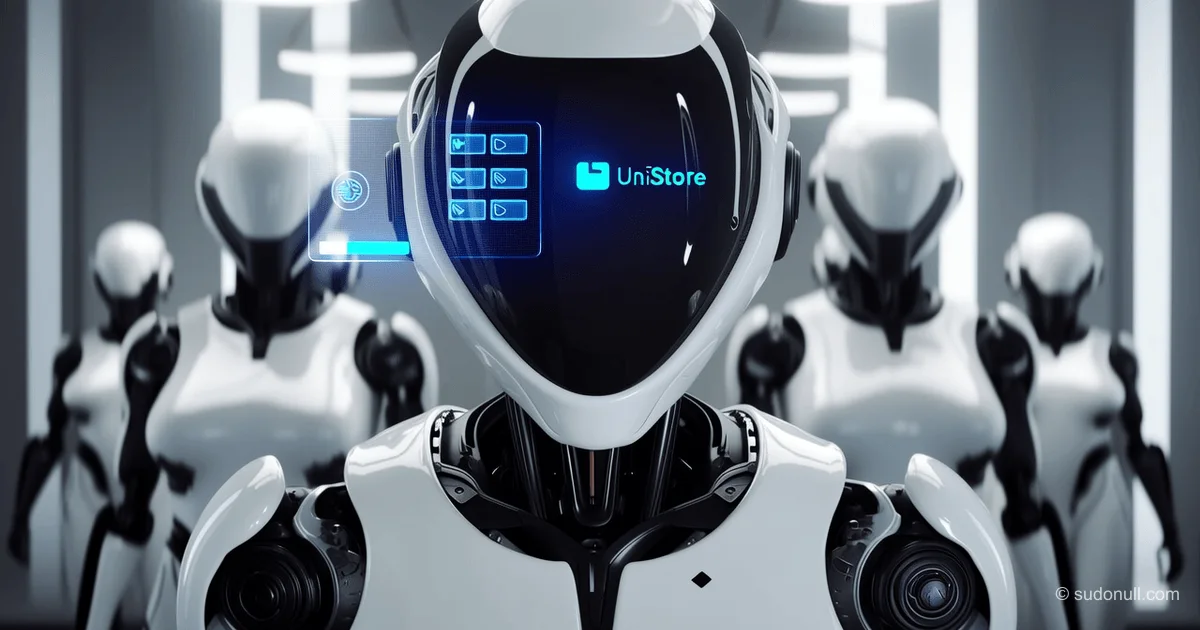
Unitree Robotics Launches App Store for Humanoid Robots
Chinese Unitree Robotics has created an App Store equivalent for its humanoid robots. Users can now download and install new skills and movements just like apps on a smartphone.
Unitree's Robot App Store: Why This Isn't About Dancing, But the First Shot in the Ecosystem War
The Gist: What's Really Happening
On May 12, 2026, Unitree Robotics officially opened UniStore — a platform quickly dubbed the "App Store for robots." Users can download movement packages — from dances to kung fu moves — onto G1, H1 humanoids and B2, Go2 quadrupeds with a single click. At launch, 24 free packages are available, and third-party developers have gained access to publish their own skills.
It sounds like a cute tech toy. In reality, it's a tectonic shift.
Humanoid robots have suffered from a fundamental ailment for decades: every new action required reflashing in a lab. You bought a robot that could walk and wave. If you wanted it to open a door, you paid engineers, wrote code, and tested. UniStore breaks this model. The robot becomes a platform that gains functionality after purchase, without manufacturer involvement.
This mirrors the 2008 iPhone story — but with one key difference. A smartphone remains a smartphone regardless of the apps you install. A robot with a downloaded "warehouse logistics" skill ceases to be an entertainment toy and becomes an industrial asset. The boundary between consumer and industrial devices blurs with a click of the "install" button.
Timeline and Context
December 2025: Unitree launches a beta version of the developer platform. At that time, 237 apps are available, with 1,200 developers in the community, and skill distribution already shows a serious industrial tilt: 38% logistics and warehousing, 29% industrial manufacturing, 17% service robots.
January 2026: TrendForce publishes a report stating the global humanoid robot market in 2026 will surpass 50,000 shipped units, with annual growth exceeding 700%. The Beijing AI Academy places Unitree in the first tier of Chinese robotics companies — alongside UBTECH, Zhiyuan Robotics, and Galbot. Order volume for first-tier companies approaches 1 billion yuan (approximately $140 million).
May 2026: UniStore exits beta and opens globally. The platform consists of four modules: User Square, Motion Library, Dataset, and Developer Center.
Key event most observers missed: the UniStore launch coincided with the final phase of Unitree's IPO preparation. The company is deliberately following Apple's 2008 trajectory — first hardware, then platform, then ecosystem, then stock exchange. Opening an app store is not a product announcement but an investment signal: "We're not selling hardware; we're selling a platform business with network effects."
Who Wins and Who Loses
Unitree wins. The company is the first in the world to create a skills marketplace for humanoid robots, and now every new developer publishing an app strengthens the ecosystem. More apps make Unitree robots more valuable to buyers. More robots sold make the platform more attractive to developers. A classic flywheel that burned Apple and Google's competitors.
Independent developers win. Unitree promises a reward system. If the platform takes off, early developers of industrial skills will cream the profits. A team that creates an "autonomous warehouse inspection" skill and sells it to a thousand G1 owners will outpace competitors for years.
China as an industrial hub wins. UniStore is not just a platform. It's a data crowdsourcing infrastructure. The Dataset section provides access to digitized movements — from ballet to taekwondo. Every developer uploading a new dataset trains not only Unitree robots but also foundational embodied AI models for free. Chinese companies gain access to the world's largest movement library, built by a global community.
Boston Dynamics loses. The company, historically betting on closed proprietary systems, finds itself in the role of Nokia in 2008. Superior hardware, but a completely closed software ecosystem. Atlas can do everything — but only what Boston Dynamics engineers have hard-coded, and only after another costly firmware update.
AgiBot, Xiaomi, and other second-tier competitors lose. They lack the time and resources to build a competing ecosystem from scratch. AgiBot bet on no-code movement creation tools (LinkCraft), but that's a developer solution, not a distribution channel for ready-made skills. They missed the distribution stage — and distribution creates the network effect.
Western robotics as a whole loses. No American or European company has either a hardware base of 50,000+ devices or an open developer platform. The gap shifts from quantitative to qualitative: while Western companies compete at the individual model level, China is building an industry.
What the Media Isn't Saying
Insight one: UniStore's main asset isn't apps, it's data. At launch, the library includes datasets like "Taekwondo" and "Ballet" — high-quality digitized movements from professional athletes and artists. Each such dataset costs tens of thousands of dollars and months of work. Unitree opens access to developers, stimulating new skill creation — while simultaneously collecting data on how robots perform these skills in the real world. A feedback loop unavailable to any competitor without a comparable device fleet in the field.
Insight two: security will be a catastrophe that's being ignored. An open code store for physical devices creates unprecedented risks. A malicious app on a smartphone steals passwords. A malicious skill on a humanoid robot standing next to a human causes physical harm. No security standards for "robo-apps" exist. The first incident — and it will happen within the next 90 days — will force the industry to build a regulatory framework from scratch.
Insight three: 24 skills at launch is a smokescreen. The number isn't important; the structure is. The beta had 237 apps and 1,200 developers. A full launch with 24 skills is a deliberate limitation, focusing on quality and moderation before the IPO. The numbers show the platform is already working and scaling, but the company is consciously not revealing its full arsenal, saving cards for the roadshow.
Insight four: Unitree is repeating Apple's mistake, and it's intentional. Apple tightly controlled the App Store in 2008, drawing criticism. Unitree does the same: pre-moderation, centralized distribution, commission. But for robots, this isn't a bug; it's the only viable model. Open installation of apps from third-party sources on a device capable of physical action is a direct path to lawsuits and government regulation. A closed ecosystem is insurance against chaos.
Forecast: Next 30 Days and 90 Days
30 days (by mid-June 2026). In the next month, we'll see explosive growth in developers on UniStore — from 1,200 at the end of beta to 3-4 thousand. The driver won't be enthusiasm but money. Unitree will announce a developer funding program with seed grants ranging from $10,000 to $50,000 for promising industrial skills. That's pocket change by venture standards, but for small robotics teams, it's a ticket into the ecosystem.
Simultaneously, at least one patent lawsuit from a competitor will challenge the "movement store" format. Most likely plaintiffs are UBTECH or AgiBot, who will try to slow UniStore's expansion legally before Unitree's IPO.
90 days (by mid-August 2026). The key indicator will be the emergence of the first paid skills. If UniStore remains a free store for entertainment dances, it's a niche toy. If by August industrial skills appear for $100-500 — automated inspection, sorting, warehouse navigation — Unitree will prove this is a business, not a showcase.
I expect: Unitree will hold an IPO on the Hong Kong Stock Exchange with a valuation of at least $8-10 billion by the end of summer 2026. UniStore will be the centerpiece of the roadshow — like the App Store for Apple in 2008, when the market didn't yet understand the scale but felt the trend.
Boston Dynamics and other Western players will take countermeasures. The most likely scenario is an emergency partnership with NVIDIA or Google to create an alternative ecosystem based on a Western stack. The problem is that none of them have an installed base of tens of thousands of robots. The partnership will look like "me too," not a competitor.
The most important shift by August: the first insurance products specifically designed for "robot owners with third-party apps" will appear. Physical risks associated with downloadable skills will force the insurance industry into territory that doesn't yet exist in regulation. And then the real battle will begin — not technological, but legal, over the right to determine who is responsible for the actions of a robot executing code written by an unknown developer and downloaded from a Chinese company's store. Unitree didn't just launch a platform. Unitree launched a chain reaction whose consequences will extend far beyond robotics.
— Editorial Team









No comments yet.