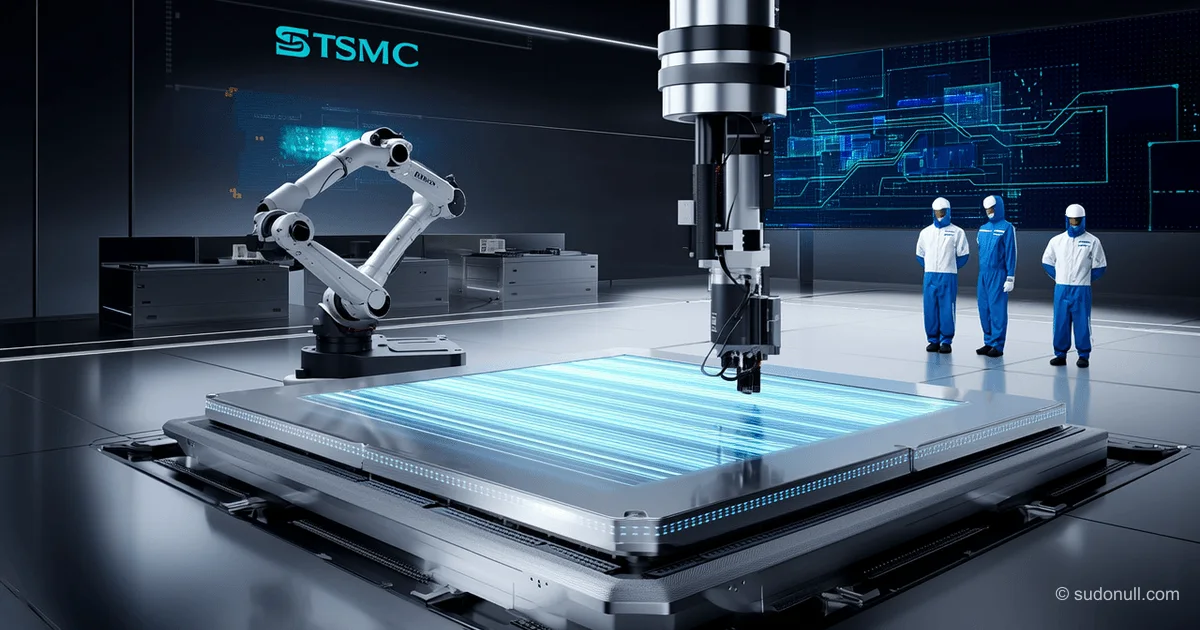
TSMC and Sony Form Joint Venture to Develop Next-Generation Image Sensors
The partnership will combine Sony's design expertise with TSMC's manufacturing capabilities in Japan. The new sensors will target AI systems for the automotive industry and robotics.
The Gist: What's Really Happening
The creation of a joint venture between TSMC and Sony is not just another industry partnership, but a fundamental shift by Sony to a "fab-light" model disguised as a technical collaboration. Sony CEO Hiroki Totoki explicitly called this deal "the first step toward becoming fab-light." Behind this phrasing lies a tectonic shift: a company that for decades prided itself on vertical integration in its sensor business now admits that the capital intensity of advanced semiconductor manufacturing has become unsustainable even for a market leader.
The memorandum of understanding was signed on May 8, 2026, and its key point is that Sony retains a majority and controlling stake in the JV, but will place development and production lines at its new plant in Kikuchi, Kumamoto Prefecture. TSMC brings its technological processes and manufacturing expertise in exchange for a long-term anchor client. This is a mirror deal to the 2021 JASM: then TSMC held a controlling stake and Sony was the junior partner. Now Sony leads but outsources production to the same TSMC—only on its own turf and under its own brand. Investments will be phased in based on market demand, with the mandatory condition of support from the Japanese government.
Timeline and Context
The roots of this deal go back to 2021, when JASM—the first TSMC-Sony joint venture—was created. At that time, TSMC held a controlling stake, and the Kumamoto plant began mass production in late 2024. Sony had already partially outsourced sensor production to JASM but retained its main facilities.
By January 2026, Sony had already formed a joint venture with China's TCL to produce TVs under the Sony brand, where it also retained a majority stake but fully handed production to the partner. This was a rehearsal for the new model: Sony controls the product intellectually, while leaving production to those who can do it cheaper and more efficiently.
Meanwhile, competitive pressure was mounting. Last year, reports emerged that Apple might start sourcing sensors from Samsung Electronics at its Austin, Texas plant. For Sony, which had been Apple's exclusive sensor supplier, this was an alarming signal. The response was to accelerate a formal partnership with TSMC—now not as a junior partner, but as an equal technological ally.
On May 8, 2026, the companies announced the signing of a non-binding memorandum. On May 9, Sony's shares rose 9.8% to 3,420 yen (about $21.83). The market immediately grasped the strategic logic: Sony reduces capital expenditure while maintaining technological leadership.
An important context is Japan's national strategy to revive its semiconductor industry. The deal is clearly planned with government subsidies in mind, continuing the trend of public-private partnerships in Japanese chipmaking.
Who Wins and Who Loses
Winners:
Sony gets exactly what it wanted: limiting capital expenditure while preparing for growing demand for the "eyes" of machines in the AI era. Totoki acknowledged in an analyst briefing that Sony's ability to supply sensors was constrained precisely by manufacturing capacity. Now that constraint is lifted without having to finance multi-billion-dollar fab projects alone.
TSMC wins on three levels. First, it gains a stable anchor client in the image sensor segment with minimal capital risk—its stake is minority, and control lies with Sony. Second, it loads its technological processes outside the main logic line, diversifying its business. Third, it deepens its presence in Japan, where it already receives government subsidies through JASM. As TSMC Senior Vice President Kevin Zhang put it, this is "a key step forward in developing future sensor technologies in the AI era."
The Japanese government gains a third strategic resident in Kumamoto—after JASM and potentially other projects. Strengthening the local sensor supply chain enhances Japan's technological sovereignty in a critical component for the automotive industry and robotics, two pillars of the Japanese economy.
Apple, though not directly mentioned in the memorandum, benefits indirectly. If Sony expands sensor production with TSMC's help, risks of supply disruptions for iPhones decrease.
Losers:
Samsung Electronics is the main casualty. The South Korean giant was trying to win market share from Sony in Apple's supply chain, but now faces an alliance between the sensor market leader and the contract manufacturing leader. If Sony and TSMC jointly optimize processes for AI sensors in automotive and robotics, Samsung risks being relegated to the mass-market but less profitable niche.
Chinese sensor manufacturers, including Sony's TV partner TCL, find themselves in a strange situation. Sony is playing a double game: with some partners it shares consumer electronics production, with others it creates advanced AI sensors with TSMC on Japanese soil, under export control protection. Access to the most advanced processes remains closed to Chinese players.
Small and medium-sized sensor manufacturers, especially in Europe and the US, face a competitor that combines the best design (Sony) and the best manufacturing (TSMC) with Japanese government support. Competing with such a combination is nearly impossible without subsidies of comparable scale.
What the Media Isn't Saying
Most publications focus on technological synergy and market shares, but miss the key non-obvious insight: this deal is Sony's hedge against the existential threat of losing Apple as a client. A source in the semiconductor industry confirms that when reports emerged about possible Apple sensor production at Samsung's Austin plant, Sony accelerated negotiations with TSMC. The JV with TSMC is not just about expanding capacity; it's insurance: even if Apple diversifies its sourcing, Sony remains the technological leader with the best price-performance ratio thanks to TSMC's processes.
A second underestimated aspect is the tension between two models within Sony itself. The company simultaneously talks about "fab-light" and new investments in its own plant in Nagasaki. This dual positioning suggests a likely resolution through specialization: Sony's own fabs will handle niche, ultra-rugged products like the Global Shutter sensor for the A9 III, which Sony will not share with anyone, while mass-market sensors for automotive and robotics will go to the JV.
A third point concerns the term "Physical AI," which both companies wrote into the memorandum. This is not a marketing term but a signal: the next generation of sensors is being designed specifically for machine perception tasks, not human vision. While today's sensors are optimized to look good on a smartphone screen, tomorrow's will be optimized for a robot to recognize an object in complete darkness at speeds beyond human capability. This is a new market still taking shape, and Sony and TSMC want to enter it with a ready-made technology platform.
Finally, the geopolitical context. Japan is methodically building a semiconductor hub in Kumamoto: first JASM for logic chips, now a JV for sensors. Add Rapidus in Hokkaido, and you get a three-pronged strategy: logic, sensors, and advanced processes. This is a direct response to the concentration of production in Taiwan and, simultaneously, to Chinese expansion in mature processes.
Forecast: Next 30 Days and 90 Days
30 days (by June 10, 2026):
I expect an announcement of a binding final agreement. The memorandum is an intention, but the speed at which Sony wants to move (the market won't wait) suggests a quick closure of legal formalities. The key condition is confirmation of subsidies by the Japanese government, but given the strategic nature of the project for Kumamoto, rejection is unlikely.
TSMC may reveal details of the technological processes to be used in the JV. Given the recent announcement of A13 at the North America Technology Symposium, part of the sensor production could be immediately designed for this process with a target implementation date of 2029.
Samsung will likely make a counter-statement—either about expanding its partnership with Apple or about its own technological breakthrough in sensors. The company cannot afford to stay silent when its main competitor forms an alliance with the world's largest foundry.
90 days (by August 9, 2026):
By the end of summer, the first engineering details should emerge: which specific sensors will go into the JV, on which process nodes, with what specifications for automotive and robotics. This is critical for assessing the realism of timelines: if the JV targets 2027-2028, design work must start immediately.
Meanwhile, Sony's shares will continue to rise if the company confirms its net profit forecast of ¥1.160 trillion for the fiscal year starting in April. Part of the optimism is already priced in with the 9.8% rise, but as JV details become clearer, analysts will start recalculating models, factoring in lower capital expenditure with expanded production.
The Japanese government will likely announce specific subsidies for the JV as part of the next tranche of semiconductor support—this will boost investor confidence and allow Sony to accelerate line deployment.
Strategic takeaway: Sony and TSMC are not just creating another manufacturing partnership. They are building a technology platform for an era where sensors become the nervous system of AI—from autonomous vehicles to industrial robots. Sony gives up production but retains control over architecture. TSMC gains access to the image sensor market without the risks of owning a fab. And Japan gains a second pillar of its semiconductor revival. The loser is anyone who cannot offer a similar alliance of design and manufacturing—and in this race, time is working against the solo players.
— Editorial Team









No comments yet.