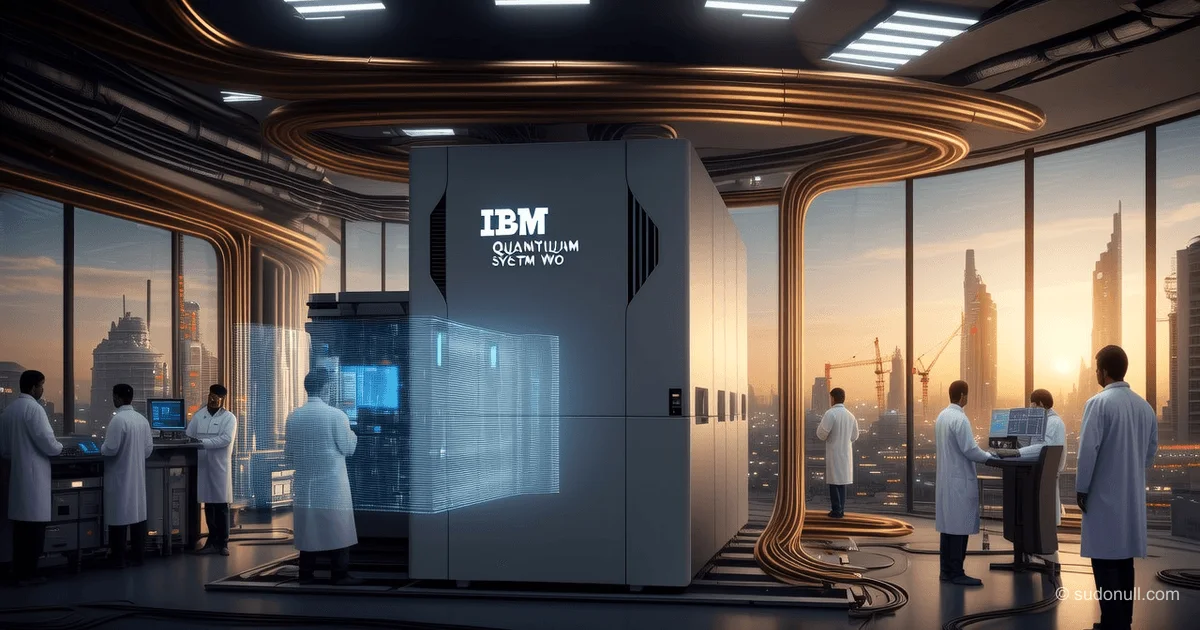
IBM Deploys 133-Qubit Quantum Computer in India
As part of one of Asia's largest quantum projects, IBM is building hybrid labs to accelerate biological research and develop new materials for energy.
The Gist: What's Really Happening
When IBM announces the deployment of a 133-qubit quantum computer in India, a superficial view sees technology transfer—the corporation selling or donating a complex machine to the government. In reality, a multidimensional chess game is underway, where the quantum computer serves not so much as a computing tool but as the architectural core of an entire economic cluster. Amaravati, the under-construction capital of Andhra Pradesh, is not just getting a lab; it's getting the nucleus of a "Quantum Valley"—a 50-acre tech park already drawing in Tata Consultancy Services, Larsen & Toubro, and hundreds of startups.
The main thing headlines miss: IBM isn't just supplying equipment; it's cultivating a market. The company is deliberately shaping an ecosystem in India tied to its architecture and software stack. Free cloud quantum computing via TCS, mass training on Qiskit reaching over 208,000 students in 2026 alone, and joint research programs—all of this creates a generation of specialists who will think in IBM's terms. When fault-tolerant quantum computers enter commercial use in 2029, these people won't switch to other platforms—they'll have already built their careers on IBM's infrastructure.
Timeline and Context
The project's development is remarkably fast. As early as May 2025, the Andhra Pradesh government signed memorandums of understanding with IBM, TCS, and L&T. By August, the state quantum technology commission approved the installation of a 133-qubit quantum computer under a four-year agreement, with IBM providing the hardware at no capital cost to the government—the state only pays for the facility, power, and cooling.
By February 2026, construction of the Quantum Valley tech park began, and by April, India's first open platforms for testing quantum hardware were operational at two locations—Medha Towers near Vijayawada Airport and SRM University. The target is to install IBM Quantum System Two by December 2026 and create one hundred practical quantum algorithms by October.
Behind this speed is a specific person—Nara Chandrababu Naidu, the state's chief minister, who previously architectured Hyderabad's IT boom. It was he who, in March 2025, personally asked L. Venkata Subramaniam, then head of IBM Quantum India, to help bring a quantum computer to Amaravati. And it was Naidu who secured unprecedentedly generous terms from IBM—365 hours of free computing time annually for academic and government institutions.
Key context: In IBM's roadmap, 2026 is marked as the year of "quantum advantage" on real-world tasks, and 2029 as the deadline for fault-tolerant quantum systems. The Indian installation is part of a global network of over 75 deployed systems, and its goal is not so much scientific records as preparing a vast market for the arrival of truly powerful machines.
Who Wins and Who Loses
Winners:
The Indian government gets the most powerful quantum hardware in the region without direct capital expenditure on the hardware, valued at an estimated $15 million. This gives political leadership a trump card: the country transforms from a "perpetual follower" into an early owner of quantum infrastructure. The ambition bar is set: 100 algorithms, 100 practical applications, testing quantum-resistant cryptography, predictive analytics in logistics and healthcare.
TCS gets exclusive access to the quantum computer and the role of cloud gateway operator even before the machine's physical launch—the company has been connected to IBM's cloud quantum resources since November 2025. In effect, India's largest IT outsourcer becomes the integrator and beneficiary of the entire ecosystem, gaining the ability to offer clients a unique service.
Local startups like QpiAI (25-qubit system) and component manufacturers—Qbit Force, Qubitech Smart Solutions, Sidwal Industries—gain a unique testing environment. They can plug their components into a working quantum stack and get test results without traveling to Bluefors Lab in Delft for $50,000 per test.
Losers:
Tension may arise around Google Quantum AI. While IBM builds physical centers and ties entire regions to itself through educational programs, Google seeks technological superiority in lab records. But without institutional presence in fast-growing economies like India, it risks losing the talent pipeline for a decade.
European quantum startups focused on exports will face a new competitor. India is not just importing quantum computers—it is deliberately building a full production cycle: cryogenic cables, amplifiers, dilution refrigerators. Two test centers were built for an estimated $3.6 million—half the cost of imported equivalents. Indian manufacturers will certainly use this price leverage in international markets.
Traditional IT companies ignoring the quantum transition. As Subramaniam notes, in the US, banks like HSBC are already running quantum experiments on real financial data—in September 2025, HSBC demonstrated a 34% improvement in bond trading optimization using quantum computing. Indian corporations that do not assign at least two employees and a couple of interns to quantum research risk falling hopelessly behind in 3-5 years.
What the Media Isn't Saying
Most publications focus on the 133 qubits but overlook IBM's true business model. The company has long promoted the "quantum cloud" concept, where clients don't need to buy and maintain hardware—they just rent access over the internet. Amaravati is not an exception to the model but its expansion. TCS becomes the cloud quantum access provider for the entire country, and it is TCS, not end users, that will pay IBM for this access.
A second underestimated fact is the talent funnel. Over 208,000 students have already signed up for IBM's free online quantum computing course through the National Technology Training Program. Another 9,500 teachers completed a year-long advanced training program. These people haven't just "learned about quantum"—they've mastered Qiskit, IBM's software stack. For comparison, Google's Cirq and other platforms have no comparable educational reach in India. In five years, the Indian quantum developer market will be 70-80% composed of specialists who think in terms of IBM products.
A third shift concerns geopolitics. The US consistently restricts China's access to advanced chips and AI technologies. In this context, India becomes an alternative platform for Western tech companies: they gain a huge market and a relatively predictable legal environment in exchange for technology transfer. IBM didn't choose Amaravati over Bangalore by chance—the local government has proven its ability to make quick decisions at the level of one person, Naidu, which corporations value more than years of bureaucratic procedures.
Forecast: Next 30 Days and 90 Days
30 Days (by June 10, 2026):
A wave of publications is expected on achieving intermediate goals. The workshop "Designing the Future: 100 Advanced Quantum Algorithms on Real Machines" at SRM University, with IBM experts Nick Bronn and Ritajit Majumdar, will provide the first practical demonstrations of algorithms on real quantum hardware. This marks a shift from theoretical simulations to concrete cases—modeling chemical reactions, optimizing supply chains for Indian companies.
Meanwhile, Indian component manufacturers (Qbit Force, Qubitech) will start receiving orders from foreign research groups. With a price advantage of at least half compared to European counterparts, Indian cryogenic cables and amplifiers will quickly find buyers in Germany and Japan.
90 Days (by August 9, 2026):
By the end of August, the first results of the "100 Quantum Applications" program will be ready—an important political milestone planned for India's Independence Day. Specific use cases from finance, logistics, and pharmaceuticals will be presented publicly, giving additional momentum to corporate adoption.
IBM will likely announce an expansion of the Indian program—either integrating Indian quantum resources into the global network on a permanent basis or adding more capacity. Given the speed at which the project moved from memorandums to construction, the quantum computer in Amaravati may go live before the scheduled December.
The main strategic takeaway: Quantum Valley in Amaravati is a model IBM will replicate. Similar "valleys" will appear in other countries with available capital, ambition, and no quantum legacy. This is not charity—it's building a global market that will generate revenue for IBM from licensing, cloud services, and consulting for decades to come. The Indian project is the pilot for this scenario, and its success will determine whether the plan becomes reality.
— Editorial Team










No comments yet.