World's First Unmanned Mining Truck Created in China
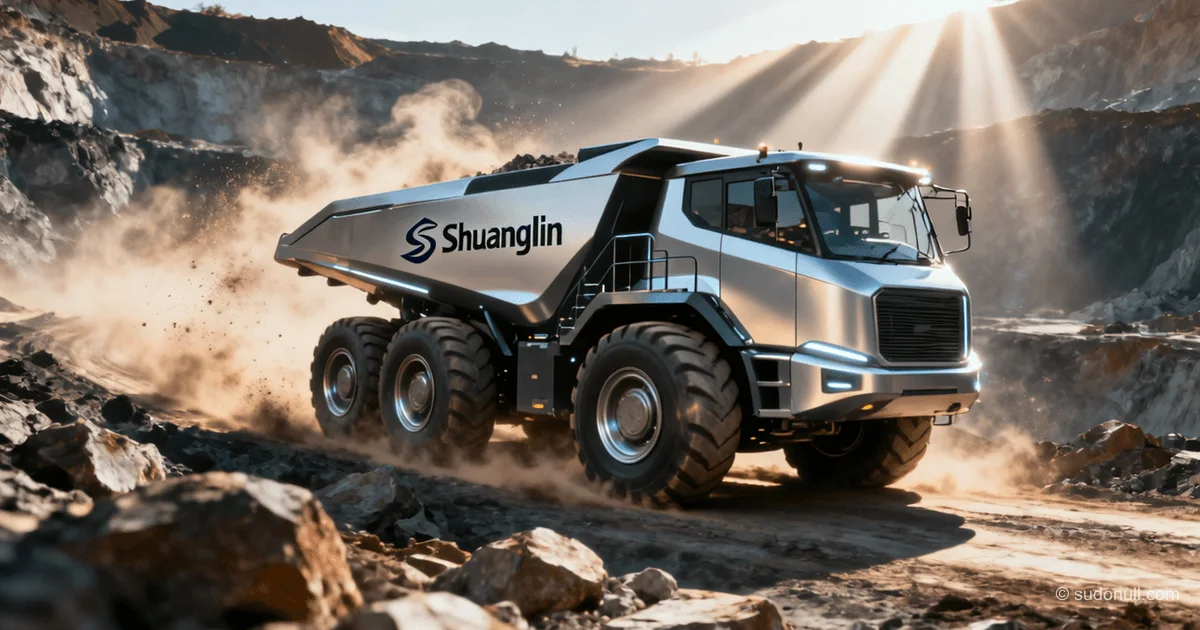
The unmanned Shuanglin K7 dump truck with Level 4 autopilot can operate around the clock and turn on the spot.
This isn't just about a new Chinese dump truck. It's about a fatal blow to the business model that Caterpillar and Komatsu have built over a quarter of a century. The Shuanglin K7 is the first case where the engineering logic of "why make it simple when you can make it complicated and expensive" has given way to the pragmatic "why have a human and diesel in a mine at all."
The Essence: What's Really Happening
Formally, China has unveiled an unmanned mining dump truck with the ability to move sideways and turn on the spot. But the essence isn't the "crab walk," but the distributed electric drive technology with independent wheel modules. Each wheel has its own motor, brake, and steering. This means the design completely eliminates: internal combustion engine, gearbox, driveshaft, differential, and steering column.
Why is this so important? Because Caterpillar and Komatsu have made money for decades not from selling dump trucks, but from servicing them. A traditional mining dump truck requires oil changes, filter replacements, brake pads, and tires every few thousand hours. A service contract for a fleet of 50 machines brings the manufacturer $15-25 million USD per year. The Shuanglin K7, with its electric drive and up to 85% energy recuperation, reduces maintenance costs by a quarter.
Moreover, the Shuanglin K7 is not a one-off, but part of a systemic offensive. In May 2025, China Huaneng Group launched a fleet of 100 unmanned dump trucks with Huawei systems. In April 2026, 300 electric autonomous vehicles were deployed in the Xinjiang Uyghur Autonomous Region, with 70% of mine equipment already electrified. China is building not just a machine, but a fully autonomous and electric mining ecosystem.
Timeline and Context
The Shuanglin K7 was unveiled on April 18, 2026, at a site in Shanghai by Shuanglin Co with participation from Tsinghua University. The presentation was held without Western journalists—only Chinese industry publications attended. This was a deliberate decision: the target audience is not Wall Street investors, but heads of state-owned mining corporations and officials responsible for the "Smart Mines 2026" plan.
The plan states: by 2026, the share of intelligent mining capacity must be at least 60%. This is not a recommendation but a directive. State-owned companies are required to implement unmanned technologies under threat of mine closures. The market created by this directive is enormous: just for China's large open-pit coal mines, about 21,000 unmanned dump trucks are needed. According to Dongwu Securities, by 2025, over 4,000 such machines were already operating in China, with penetration reaching 16%.
Pricing aspect. A traditional Caterpillar 798 AC costs about $5 million USD per unit. A 10-year service contract adds another $2-3 million USD. The Shuanglin K7, according to insider estimates, will cost $1.2-1.5 million USD per unit, and battery swapping reduces operating costs several times over. Even considering the cost of charging/battery swap infrastructure, the total cost of ownership is 35-40% lower.
Who Wins and Who Loses
Winners:
- Chinese state-owned mining companies. They get equipment that directly reduces the cost per ton of transported material. According to industry estimates, switching to electric and rail systems saves up to $3 per ton compared to diesel transport.
- Battery manufacturers. CATL and BYD get guaranteed demand for batteries for swap systems. One K7 requires a battery capacity of about 500-700 kWh—equivalent to 10 electric cars.
- Huawei and AI system suppliers. Their autopilots are becoming the standard for Chinese mines.
Losers:
- Caterpillar and Komatsu. They lose not just the Chinese market (the world's largest), but the very concept. Their model relies on diesel engines, mechanical transmissions, and patented autopilot systems that integrate only with their own equipment. Shuanglin offers an open electric platform.
- Mining unions in Australia and Chile. Chinese mines are becoming a testing ground for technologies that will arrive in Australia and South America in 3-5 years, reducing operator jobs.
What the Media Isn't Saying
Here's a non-obvious insight: The K7 is military technology in civilian service. The technology of independent wheel modules with individual electric drive was originally developed for a new generation of wheeled armored personnel carriers. The PLA required a vehicle capable of moving even after losing two out of eight wheels. The Shuanglin K7 claims to retain 70% load capacity under partial failures. When Tsinghua engineers talk about "multiple electronic redundancy," they mean exactly the same algorithms used in armored vehicles.
Second point: The crab walk and spot turn have a specific economic benefit. A traditional dump truck at a coal mine travels an average of 150,000 km per year, of which 20,000 km is maneuvering in loading and unloading zones. Reducing maneuver time by 30% saves 3,000 engine hours per year per truck. With operating costs of about $400 USD per hour for a diesel machine, the savings amount to $1.2 million USD per year per unit.
Third: China is changing the cost structure of the mining industry through supply chain control. Unlike Caterpillar, which depends on hundreds of American and European suppliers, Shuanglin uses components that are 90% produced within China: electric motors from CRRC, batteries from CATL, chips from Huawei, sensors from DJI. This means that sanctions pressure, effective against Huawei, cannot block this technology.
Forecast: Next 30 Days and 90 Days
30 days (by June 10, 2026):
Shuanglin will announce the first order from a state-owned coal company for a batch of 15-20 machines, with delivery by year-end. Simultaneously, Huawei will begin negotiations with iron ore mine operators to implement autopilot on existing electric dump trucks from other manufacturers.
90 days (by early September 2026):
A company from the top 3 global mining giants (BHP, Rio Tinto, or Vale) will send a delegation to assess deployment possibilities. They don't necessarily have to buy Chinese equipment—just to understand how quickly electric platforms with open architecture will eat into their investments in Caterpillar fleets, estimated at $3-4 billion USD collectively. I expect that Rio Tinto's annual report will include wording about "reassessment of useful lives of existing mining equipment fleets due to technological changes"—in financial terms, this means the company is preparing to write off billions of dollars in asset value.
— Editorial Team










No comments yet.