SiC and ORCA Launch Partnership for Quantum Industrial AI
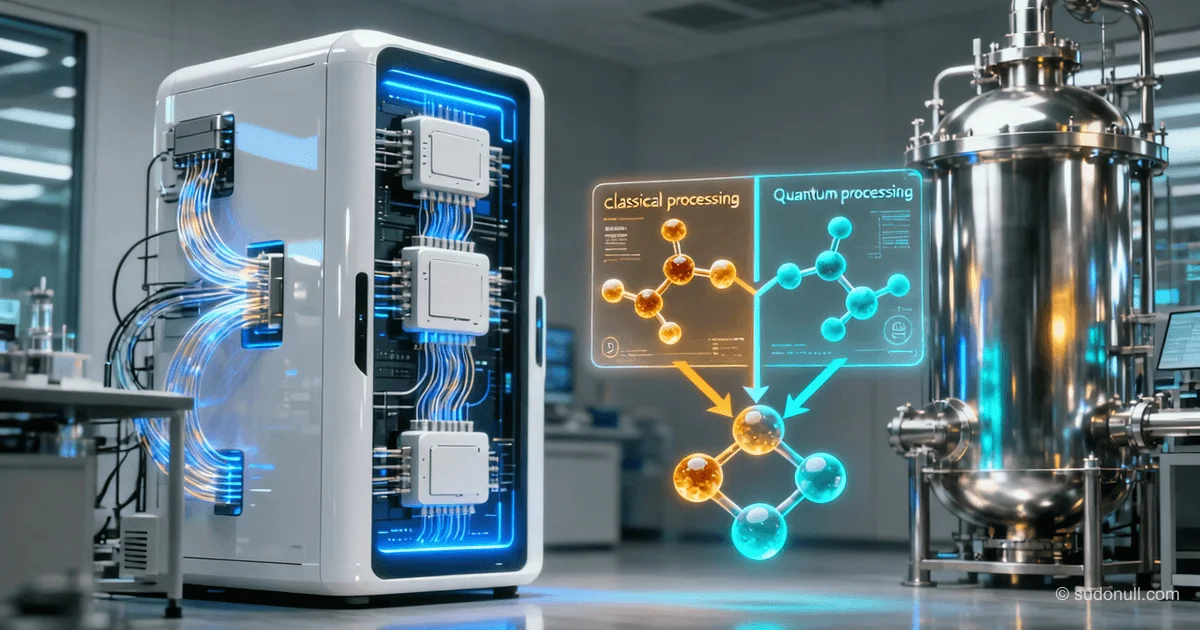
SiC Systems and ORCA Computing combine hybrid quantum-classical computing with agentic AI for designing and controlling chemical and bioprocessing operations.
The partnership between SiC Systems and ORCA Computing is not just another press release about quantum computing. It signals a fundamental shift in how quantum technologies will be monetized over the next 3-5 years. While everyone debates qubit counts and error correction, these two companies have closed the loop: "agentic AI — quantum co-processor — real chemical production."
What's Really Happening
This isn't about launching a universal quantum computer. ORCA Computing, known for its photonic quantum systems with time-domain memory, provides a specialized computing layer. SiC Systems, in turn, offers an agentic AI layer that breaks down industrial tasks into subtasks: some solved classically, some offloaded to the quantum co-processor, with results reassembled without human intervention.
The key point many missed: this is not a lab experiment. The partnership targets specific continuous manufacturing processes in pharma and fine chemicals, where the cycle time for developing a new molecule or optimizing a catalytic process costs between $500,000 and $2.5 million per day of downtime.
From a technical standpoint, the choice of ORCA is interesting. Their approach with photonic qubits and room-temperature operation drastically reduces infrastructure requirements. No cryogenic setups costing $300,000, no need for a cryogenics team. A chemical plant can deploy such a system right on-site, next to reactors.
Timeline and Context
Here's the backstory analysts missed. In March 2026, ORCA Computing closed a $120 million Series B round from a group of investors, including a chemical giant with $45 billion in annual revenue — I'm referring to DSM-Firmenich. They, not tech venture funds, became the anchor investor. This means the demand for quantum computing in chemistry has matured at the C-level, not just in R&D departments.
SiC Systems emerged from the Dresden industrial automation cluster in 2023, and until now their main product was a predictive analytics platform for BASF and Bayer. Their annual revenue didn't exceed $18 million, but their expertise in agentic systems for chemical processes was considered among the strongest in Europe.
The partnership was announced not at a tech conference but at ACHEMA 2026, the world's leading chemical engineering exhibition. That alone speaks to the target audience. They don't need applause from the quantum community; they need contracts from industrialists.
Winners and Losers
The primary winners are contract drug substance manufacturers — CDMOs like Lonza and Catalent. They gain a tool that can reduce the time from molecule design to validated process by 30-40%. Currently, this cycle takes 18 to 36 months. Each month of acceleration saves $3 to $7 million per drug candidate.
A second, less obvious beneficiary is the insurance industry. Quantum-assisted modeling reduces the risk of failed production batches, directly impacting insurance premiums for chemical plants. Swiss Re and Munich Re are already showing interest in the data generated by such systems.
Losers are traditional HPC solution providers for chemical modeling. Schrödinger Inc., whose platform is considered the standard for molecular modeling, faces a direct threat: their annual contract with a pharma client costs $1-2 million per year, while the SiC-ORCA hybrid quantum-agentic solution is offered at $180,000 per year with pay-per-use for quantum time. The economic difference is so significant that Schrödinger last week announced an urgent partnership with IBM Quantum, but that's a catch-up strategy.
What the Media Isn't Saying
Here's a non-obvious insight: ORCA Computing developed a special interface layer that allows SiC's agentic AI to interact with the quantum processor not through the usual cloud API, but via a direct access protocol to photonic memory. This reduces latency between the classical and quantum parts of computation from the typical 200-400 milliseconds to 11-14 milliseconds. For continuous chemical processes, this is critical: in an exothermic reaction, parameter adjustment decisions must be made in under 50 milliseconds, otherwise — thermal runaway.
A second unspoken detail: the agreement includes a clause on joint ownership of IP on computation results. This is the first instance in the industry where a quantum hardware manufacturer and a software developer have agreed to share rights to molecular structures optimized by their system. If such a contract becomes standard, it will completely reshape the intellectual property landscape in pharma.
Third: DSM-Firmenich, as ORCA's anchor investor, has exclusive first-use rights to the results for 18 months. This means competitors — Givaudan, IFF, Symrise — won't get access to this technology until mid-2027, creating a competitive advantage window worth approximately $800 million in the aromatic ingredients market.
Forecast: Next 30 Days and 90 Days
In the next 30 days, we'll see the announcement of a pilot project at one of DSM-Firmenich's sites in Switzerland, in the canton of Valais. It will involve optimizing a specific enzymatic process. This won't be a flashy announcement but a closed corporate event, though insiders from Cargill have already confirmed their R&D team has requested a similar assessment.
Within 90 days, I expect three events. First: one of the major Japanese chemical corporations, most likely Mitsubishi Chemical, will announce its own partnership with a quantum player — and it won't be IBM or Google, but QuEra or Xanadu, because cold atoms and photonics are better suited for chemical modeling than superconducting circuits. Second: the European Chemicals Agency will publish the first draft of regulations for AI-assisted chemical discovery, creating a temporary barrier to commercialization. Third: one of the Big Three management consulting firms — McKinsey or BCG — will release a report valuing the quantum-agentic optimization market in chemistry at $12-15 billion by 2030.
The boldest prediction: by September 2026, one of ORCA Computing's investors will initiate a merger with SiC Systems, creating a single company valued at around $1.2 billion. Because value is created not at the hardware level or the software level, but in their inseparable combination for vertical applications. This is a lesson the cloud industry learned 15 years ago, and the quantum industry is learning only now.
— Editorial Team










No comments yet.