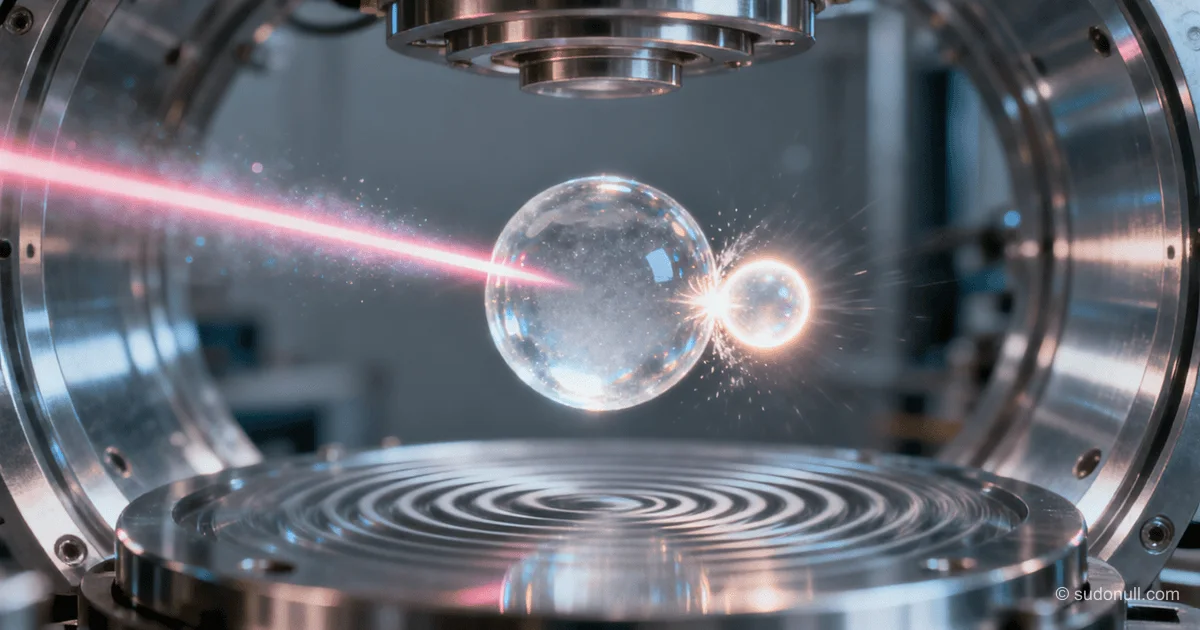
For the First Time, Pressure Exerted by Individual Particles of Matter Has Been Measured
Researchers have created a device with a microscopic bead levitating in a laser beam to measure ultra-small pressures, potentially enabling the detection of dark matter particles and mysterious types of neutrinos.
A levitating bead and the hunt for sterile neutrinos: why measuring the pressure of a single particle rewrites the rules of physics
The Gist: What's Really Happening
On May 7, 2026, a publication appeared in New Scientist that at first glance seems like a highly specialized technical note: physicists have, for the first time in history, measured the pressure exerted by a single particle. In reality, this is not just an elegant experiment but the opening of a new channel of interaction with the microcosm—a channel that could lead us to dark matter faster than any collider.
The essence of the experiment is elegantly simple. A silicon bead the size of half the smallest virus is held in space by a laser beam. When a gas particle strikes it, the bead shifts, changing the characteristics of the reflected light—and the instrument records this deviation. In ordinary physics, pressure is the statistical average of trillions of molecular impacts on a surface. Here, each impact is visible in real time, as if you were hearing not the noise of rain on a roof, but each individual drop.
What is the practical need for this? In ultra-high vacuum chambers, where particle density drops to vanishingly small values, traditional sensors show "zero" simply because they cannot detect rare single collisions. The new device allows counting these collisions directly—and obtaining an accurate pressure value where previously there was measurement blindness. This means physicists can now quantitatively work in a regime that was previously "invisible" to instruments.
Timeline and Context
The history of levitating particles as a tool for fundamental physics did not start yesterday. As early as 2018, Arthur Ashkin received the Nobel Prize for inventing optical tweezers—a technology that traps microscopic particles with a light beam. Since then, levitating nanoparticles have become a platform for dark matter searches in several laboratories worldwide.
In 2024, the KAKENHI project at the University of Tokyo received funding of 2,730,000 yen (about 18,000 USD) to search for vector dark matter using laser-cooled nanoparticles. A year later, the European Union invested 2,436,971 EUR in an Austrian project hunting for dark matter with magnetically levitated superconductors. In parallel, another European ERC grant of 1,999,777 EUR funded the search for dark sector signals in ATLAS collider data.
So by the time of the May 7, 2026 publication, the topic was already well heated. But all previous projects used levitating particles as probes of hypothetical forces that dark matter particles should exert on them. The new work does something fundamentally different: it turns a single collision into a measurable signal. This is a transition from "searching for an unknown interaction" to "registering a known interaction with unprecedented sensitivity."
Who Wins and Who Loses
Winners are primarily the experimental groups working on sterile neutrinos. The sterile neutrino is the leading candidate for a dark matter particle and simultaneously the most elusive of hypothetical particles. Unlike ordinary neutrinos, which, though rare, interact with matter, sterile neutrinos do not participate even in the weak interaction. They can only be detected one way: by recording the recoil that an ordinary nucleus receives during their extremely rare scattering.
Until now, such experiments required multi-ton detectors of liquid xenon or argon costing hundreds of millions of dollars. The levitating bead is a fundamentally different path. The sensitivity of a single microparticle is sufficient to feel the kick left by a sterile neutrino. If the method scales, the budget for dark matter searches could be reduced by orders of magnitude.
The second beneficiary is the entire ultra-high vacuum industry. Semiconductor factories, accelerator complexes, gravitational wave observatories—all need pressure measurements at the limit of sensitivity. A device that sees the "last" particles where ordinary sensors show zero becomes a calibration standard.
Losers are traditional detector collaborations. Experiments like XENONnT and LZ have invested decades in increasing detector mass, based on the assumption that detecting dark matter requires a large volume. The method of counting individual particles changes the logic: what matters is not mass, but sensitivity to a single event. A small lab with optical tweezers could outdo a giant at a fraction of the cost.
What the Media Isn't Saying
Most publications focus on "the hunt for dark matter" as the main goal of the experiment. It's a catchy headline, but it masks a more important point. Right now, the device is not searching for dark matter—it is calibrating the very concept of ultra-high vacuum.
Why is this critically important? Imagine: any measurement of background noise in a dark matter search experiment requires precise knowledge of how many "ordinary" particles hit the detector. If you don't know this accurately, it's impossible to distinguish a sterile neutrino signal from the impact of a random residual gas molecule. The new device provides unprecedentedly accurate calibration of this background—and thereby sharply increases the credibility of any future discovery.
Insight most readers don't know: The team doesn't just trap a bead in a beam—they use it to measure the pressure of three different gases and compare the results with mathematical predictions. The match was perfect. This means physicists not only "see" single collisions—they can identify the type of gas by the nature of its interaction with the bead. In the future, such technology allows not just counting impacts, but distinguishing what exactly hit: an argon molecule or a hypothetical new particle.
Another underreported aspect is cost. Optical tweezers are a laser, a camera, and software. No cryogenic systems, multi-ton tanks of liquid xenon, or underground laboratories to shield from cosmic rays. If a startup can package the technology into a commercial instrument, the market will get a new-generation vacuum gauge costing not billions, but hundreds of thousands of dollars.
Forecast: Next 30 Days and 90 Days
30 days (by June 9, 2026): A wave of citations in academia. Groups from Berkeley, MIT, CERN will request details of the experimental setup from the authors for independent replication. Simultaneously, discussions will unfold in scientific blogs and physicists' Twitter accounts about how realistic it is to scale the method from a single bead to an array of sensors. Key question: can a hundred such beads be made to work simultaneously without creating cross-interference?
In parallel, grant agencies in the US and Europe will begin reviewing their dark matter search project portfolios. If individual collisions can be counted with such precision, part of the funding for traditional detectors may be redirected to "levitation" methods as early as the next fiscal year.
90 days (by August 9, 2026): The first attempt to use the device specifically for searching for sterile neutrinos is expected. The team should place the setup in an environment shielded from all known background sources and start collecting statistics. If even a few candidate events accumulate in a month or two that cannot be explained by collisions with ordinary particles, this will trigger a chain reaction: preprint publication, collaboration formation, emergency funding application.
On the commercial front—first patents. Even if sterile neutrinos are not found immediately, the technology for measuring ultra-low pressures by counting individual particles is too valuable for the semiconductor industry to remain in an academic lab. Some vacuum equipment manufacturer (Pfeiffer Vacuum, Agilent, Leybold) will almost certainly start licensing negotiations.
The most intriguing question is one no one dares to ask aloud. If sterile neutrinos really exist and interact even slightly with ordinary matter, the levitating bead could detect their signal before any other experiment in the world. The chance is small—but it is not zero. And that is what turns an elegant laboratory experiment into one of the most exciting scientific stories of 2026. Physics is entering an era where a single particle, striking a tiny bead in a laser beam, can answer a question humanity has been asking for decades: what is the universe really made of?
— Editorial Team










No comments yet.