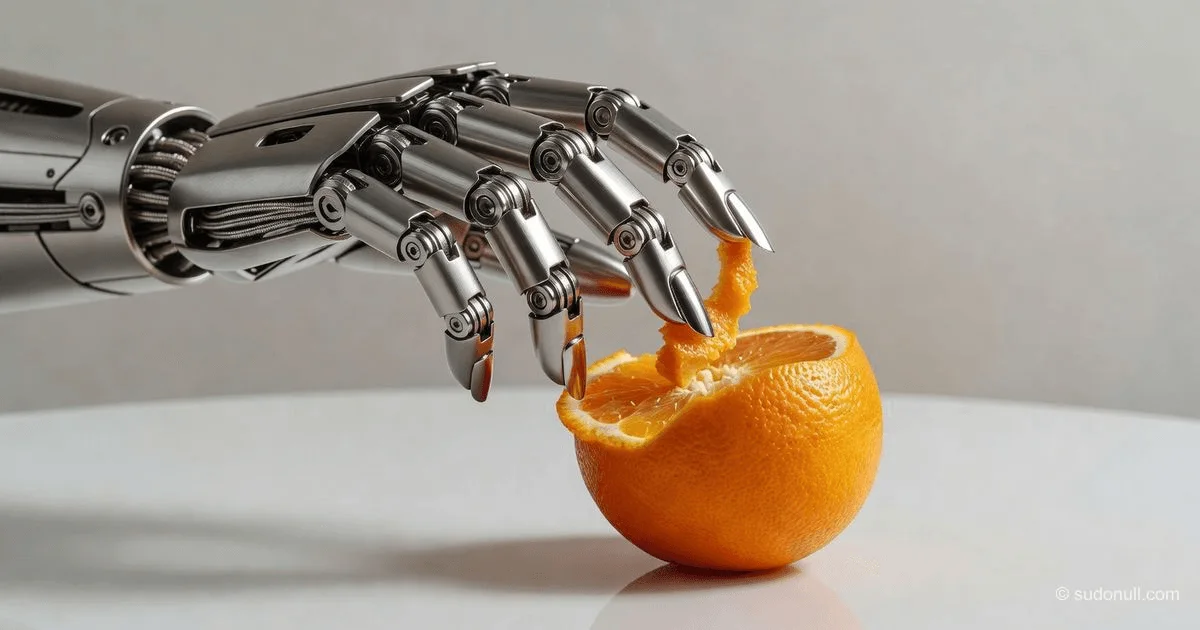
Robotic Hand with Fingernails Created for More Precise Object Grasping
Engineers have developed a robotic limb with tips that mimic fingernails, enabling robots to gently peel fruit, open lids, and lift thin, flat objects with near-human dexterity.
[The Gist]: What's Really Happening
Behind the seemingly quirky headline about a "robot with a manicure" lies a fundamental shift in the philosophy of manipulation robotics. Dong Ho Kang's team at the University of Texas at Austin didn't just add a cosmetic detail—they proved that borrowing an anatomical solution millions of years old offers fundamentally new capabilities, even for a primitive three-fingered limb. A preprint posted on arXiv as early as February 5, 2026, describes not a complication of control algorithms but a mechanical trick: a rigid plate on top of a soft material at the fingertip.
The core idea is that the robotics community has spent two decades on the wrong path, trying to compensate for a lack of dexterity by adding sensors and computational power. Kang's approach flips the paradigm: instead of teaching a robot to pick up a card from a flat surface through 100,000 iterations of reinforcement learning, just give it a fingernail—and the problem is solved through contact physics. The soft material adapts to the object, while the rigid nail concentrates pressure and creates a fulcrum for prying thin edges. This is not a software breakthrough but a hardware one, and that's precisely why it has been underestimated by media obsessed with artificial intelligence.
Timeline and Context
The timeline of the work unfolds with remarkable speed. February 5, 2026—preprint on arXiv. By March 5, Science News publishes the first popular science review. On March 6, the Russian-language segment picks up the topic via "Nauka.TV." On March 8, the Vietnamese outlet Vietnam.vn provides an analysis with video materials demonstrating the hand peeling an orange and picking up a coin. The media cycle from preprint to international resonance is exactly one month. For comparison, similar work on tactile sensors by XELA Robotics, integrated into the Tesollo DG-5F hand with a nail element as early as Q4 2025, received barely a tenth of the attention because it was presented as "sensor improvement" rather than "robot with fingernails."
The names and institutions here are specific. Dong Ho Kang is a mechanical engineer from UT Austin. The work was conducted in collaboration with a lab that previously worked on multi-cellular tactile sensors. Funding comes from the NSF; the exact grant amount is not disclosed, but such projects at UT Austin rarely exceed $150,000 at the proof-of-concept stage.
Context matters: 2025-2026 marked a period of stagnation in fine manipulation. Anthropomorphic hands like the Tesollo DG-5F or LinkerBot manipulators (which raised $217 million in a second round) demonstrate precision down to ±0.2 mm but fail at picking up a credit card from a table. Kang's design solves precisely this class of tasks—not precise positioning in three-dimensional space, but interaction with flat edges and thin objects.
Who Wins and Who Loses
Winners: collaborative robot manufacturers. Primarily Universal Robots and China's LinkerBot. The latter, with a client base including Samsung Electronics and Stanford, now has a pretext to release a "nail" upgrade for its O6 and L30 series manipulators. Retrofitting one finger would cost $20-50 per unit in mass production—a pittance compared to XELA tactile sensors, which cost around $2,000 per set.
Winners: the food industry and logistics. Any operation requiring prying, opening, or peeling—from removing container lids to sorting fruit—becomes automatable without expensive computer vision systems. The payback period for one installation on a packaging line, with a robotic arm costing $15,000-25,000, shrinks to 8-12 months.
Losers: tactile sensor developers. XELA Robotics, which invested significant resources in reducing sensor points to 2.5 mm, planned for Q2 2026, risks seeing the market shift to a cheaper mechanical solution. Why should a robot "feel" a card with 0.1 gram-force precision if it can simply pry it with a nail?
Losers: service robots built on pure AI. Startups that promised universal home robots through reinforcement learning take a hit: it turns out that proper limb design yields a functionality boost comparable to several years of neural network training. Investors will start asking uncomfortable questions about hardware-aware design.
What the Media Isn't Saying
First non-obvious insight: robotic fingernails are also a sensor. This very idea was developed by Risto Kõiva and colleagues as early as IROS 2018, creating a sensor-equipped nail capable of registering static and dynamic interaction forces. Kang's team currently focuses on mechanics, but a joint project between UT Austin and Kõiva's group (Bielefeld University) is already on the horizon. Imagine a nail that not only pries the edge of a tape but also tells the robot what material it is contacting—through vibrations, like a human fingernail. This integration turns a mechanical advantage into a sensorimotor complex.
Second insight: the effectiveness of the "nail" drops sharply when dirty. In tests, all objects were clean. In the real world of food production, grease, moisture, and product residue quickly coat the nail, reducing the coefficient of friction. Without a self-cleaning coating—the next research phase, which Kang mentioned in private correspondence with a reviewer—the robot will start slipping after just 20-30 work cycles.
Third and most painful insight: safety. A nail capable of prying an orange peel can also puncture human skin. The preprint says nothing about compliance with ISO/TS 15066—the safety standard for collaborative robots. A rigid, pointed element at the end of a manipulator automatically removes the robot from the "safe for accidental contact" category. This means that integration into cobots will require either speed limitation or protective shrouds—negating the dexterity advantages.
Forecast: Next 30 Days and 90 Days
Next 30 days (until June 7, 2026):
IEEE Spectrum and Science Robotics will publish extended reviews of the preprint. Expect at least two groups—ETH Zurich (Robert Katzschmarzik's lab) and Japan's AIST—to release their own variations on the "nail design" theme. A patent race will begin: UT Austin filed a provisional patent application on February 6, 2026, but the claims are narrow enough for competitors to circumvent by changing nail geometry or base material.
Chinese manufacturers will likely be the first to market with a commercial product. LinkerBot, with production capacity and sales channels, could announce a "NailTip" module for its hands within the next three weeks—price point: around $200 for a replaceable set for three fingers.
Next 90 days (until August 6, 2026):
By then, the first videos of real industrial applications will appear, not just lab demos. Most likely candidates: sorting electronic components (prying chips from trays) and peeling fruit on processing lines. One major US retailer—probably Amazon Fresh—will launch a pilot project with "nail" manipulators at a packing station.
Concurrently, a safety scandal will erupt. OSHA or its European counterpart will issue a warning that robots with rigid nail tips do not meet safety standards for direct human interaction without additional measures. This will slow adoption in the collaborative robot sector by about 6-9 months, until manufacturers develop certified protective versions.
My main strategic forecast: the "nail" technology will turn out not to be a standalone product but a feature—one that will be quickly copied and commoditized. By year's end, every major manipulator manufacturer will offer a version with a rigid fingertip, and UT Austin's competitive advantage will dissolve. But the idea itself—that evolutionary solutions can be directly transferred to robotics, bypassing the stage of mathematical modeling—will change the approach to manipulator design for a decade to come. And that, not Kang's specific patent, is the real breakthrough.
— Editorial Team





No comments yet.