Honda Doubles Down on Hydrogen: New Fuel Cell Generation to Halve Costs
Honda unveiled a prototype of its next-generation fuel cell module, co-developed with GM, with production costs half those of current models, triple the power density, and targeting power supply for data centers and factories.
Honda's announcement at ACT Expo in Las Vegas is not just a technical update to its fuel cell. It's a moment when the company acknowledges: hydrogen lost the battle for passenger cars, but is winning the war for power supply where batteries fall short. While Toyota continues to push the future of hydrogen transport, Honda has reshuffled its strategy and set its sights on a market where hydrogen has no alternative—data centers, factories, and backup power for critical infrastructure.
The Gist: What's Really Happening
At the Advanced Clean Transportation (ACT) Expo, held in Las Vegas from May 4 to 7, 2026, Honda showcased a prototype of its next-generation fuel cell module. The numbers are impressive: production costs half those of the current generation co-developed with GM, twice the durability, and triple the volumetric power density—allowing for a radical reduction in size. The module's nominal power output is 150 kW. But the real story isn't the numbers; it's the shift in direction. The module is designed not for under the hood of a car, but primarily for stationary power generation—factories, data centers, office complexes.
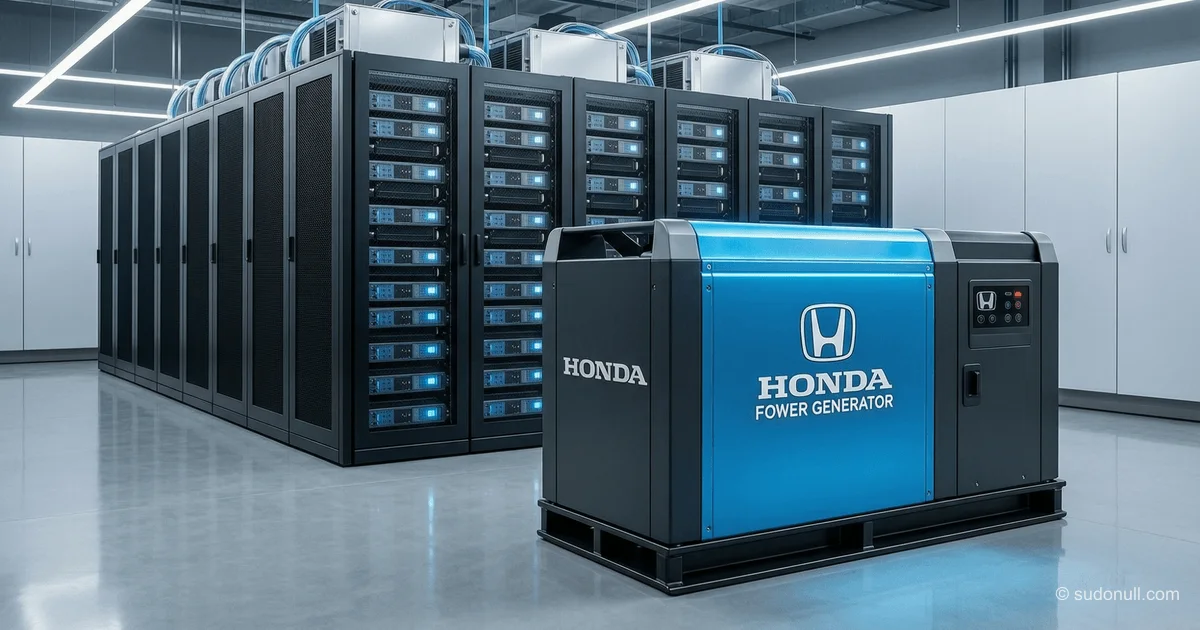
At its booth, Honda displayed the Fuel Cell Power Generator, a stationary system scalable from 250 kW to 3 MW per generator by combining multiple modules. Simultaneously, Honda introduced its new portable battery, the Mobile Power Pack e:, for light commercial electric vehicles. These are not two separate products but two halves of a unified strategy: batteries for last-mile mobility, hydrogen for heavy-duty energy.
A key change that few noticed: Honda developed this module entirely on its own. The joint venture Fuel Cell System Manufacturing LLC with GM, launched in January 2017 in Brownstown, Michigan, will be closed by the end of 2026. After "extensive discussions" with GM, both companies agreed to cease production of current systems. GM frankly called the path to a sustainable fuel cell business "long and uncertain" and pivoted to batteries and charging technologies. Honda, on the other hand, went in the opposite direction—investing deeper in hydrogen, but on its own terms.
Timeline and Context
This strategy has crystallized over several years. Back in March 2026, Honda presented the same module at H2 & FC EXPO in Tokyo, where it first disclosed its specifications. There, the company also demonstrated the EMS (Energy Management System)—a system that links hydrogen modules, grid storage, and renewable sources into a single intelligent network. EMS optimizes charging and discharging based on current supply-demand balance, smoothing out the main problem of renewable energy: volatility.
In August 2025, Honda, together with Tokuyama Corporation and Mitsubishi Corporation, launched a demonstration project in Shunan City (Yamaguchi Prefecture), where a stationary Honda fuel cell system, powered by byproduct hydrogen from Tokuyama's chemical plant, supplied electricity to a Mitsubishi data center. This was a proof-of-concept that confirmed hydrogen can provide stable power supply for high-energy-demand facilities.
Then in January 2026, a tectonic shift occurred: Honda announced it would stop production of joint fuel cell systems with GM. The FCSM plant, built nearly a decade ago as the world's first automotive joint venture for mass-producing fuel cells, will be closed. Honda hasn't abandoned hydrogen—it abandoned a partner that no longer believed in the technology.
Who Wins and Who Loses
Winners:
- Data center operators. They are the main beneficiaries. Data center energy demand is exploding due to AI and generative models. Honda's hydrogen generator can supply power within 10 seconds of startup. For a data center where a minute of downtime can cost $100,000, this is critical. Scalability from 250 kW to 3 MW allows flexible capacity expansion.
- Industrial manufacturers with access to cheap hydrogen. Chemical plants producing byproduct hydrogen (like Tokuyama) can turn waste into a valuable asset for their own power supply.
- Honda itself. The company is making a pivot that bypasses its main weakness—the lack of a competitive electric vehicle in the US market. Hydrogen generators have a B2B sales cycle, where you don't need to convince millions of consumers. You just need to convince a hundred data center operators.
Losers:
- GM. The company is exiting the joint venture, effectively admitting it sees no short-term commercial potential in hydrogen. But if Honda's bet pays off, GM will be left playing catch-up, without its own technology or a partner.
- Diesel backup generator manufacturers. Diesel generators are the standard for data center backup power today. A zero-emission hydrogen alternative that is cost-competitive threatens a market worth about $15 billion annually.
What the Media Isn't Saying
The first non-obvious insight concerns the real reason for the split with GM. The official story is "extensive discussions and mutual agreement." The real reason is deeper: GM wanted a module that could go into pickup trucks and SUVs. Honda wanted a module that could power factories. These are fundamentally different engineering requirements: an automotive module must be lightweight and compact; a stationary one must be cheap and durable. The tripling of power density in Honda's new module is an engineering compromise that allows it to be used in both applications, but it was achieved precisely because Honda shed GM's automotive constraints.
The second insight is the EMS as a "secret weapon." Everyone talks about the hardware, but Honda is building an energy operating system. The EMS, connecting hydrogen modules, grid batteries, and renewables, is a software layer that optimizes when to store energy as hydrogen, when to feed it to the grid, and when to use batteries. Whoever controls the energy distribution algorithm controls the data center's economics. Honda is following Apple's path: not just releasing a device, but an ecosystem locked into its own software.
Forecast: Next 30 Days and 90 Days
30 days (by early June 2026):
Sales of the Mobile Power Pack e: for B2B integrations in the US will begin. This will divert media attention to the battery product, but behind the scenes, Honda will be actively negotiating with early customers for stationary hydrogen systems. I expect one of the major data center operators—possibly Equinix or Digital Realty—to announce a pilot project with Honda to install the Fuel Cell Power Generator. Meanwhile, competitors will ramp up: Bloom Energy will likely issue a statement about its hydrogen developments to counter the buzz from Honda's announcement.
90 days (by early August 2026):
Honda will likely announce new partnerships in Southeast Asia, where grid instability is acute and hydrogen infrastructure is developing rapidly. Japan has a strategic interest in hydrogen as a way to reduce dependence on fossil fuel imports—and Honda, as a national champion, will benefit from government subsidies. I also expect Honda to launch a pilot project using its fuel cell modules for backup power at telecom towers—this market is even larger than data centers and is critical for 6G rollout.
The boldest prediction: Honda will move beyond traditional power supply and start offering "energy as a service"—contracts where customers pay not for equipment but for kilowatt-hours. A subscription model instead of capital expenditure would radically lower the entry barrier for customers and transform Honda from a hardware manufacturer into an energy company. That is the real goal of the new module: not to sell hardware, but to sell energy guaranteed by hydrogen.
— Editorial Team









No comments yet.