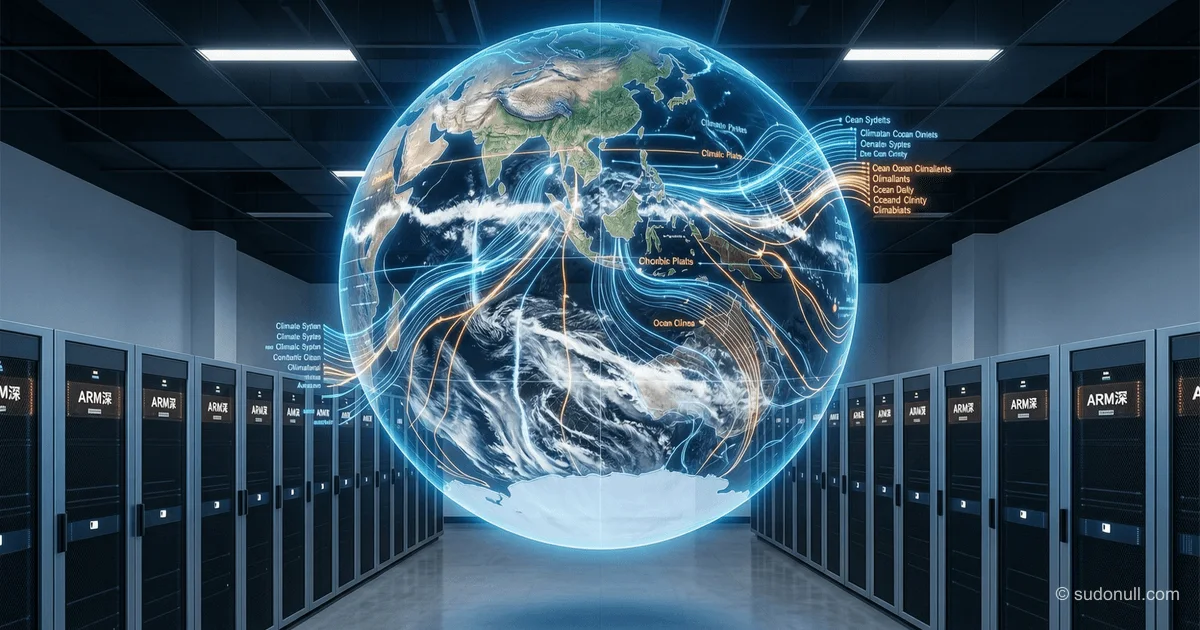
China Plans to Create a Supercomputer 'Digital Twin of the Earth'
Chinese scientists who created a 3D model of the Yellowstone supervolcano have announced an ambitious plan to develop a 'Digital Twin of the Earth' — a system for predicting climate change and geological processes on exascale supercomputers.
The announcement of the 'Digital Twin of the Earth' by Chinese scientists is not just a scientific fantasy about weather forecasting. It is about a fundamental shift in who controls the right to model the planet's future. While the Western world debates AI regulation and ethical norms, China is methodically building a computational foundation that will allow it to dictate terms in climate policy, agriculture, and even geopolitics, relying on a monopoly on ultra-precise forecasting.
The Core: What Is Really Happening
A research team led by Liu Lijun and Cao Zebin from the Institute of Geology and Geophysics of the Chinese Academy of Sciences used exascale supercomputers to build a three-dimensional model of the Yellowstone supervolcano, extending from the surface to the deep mantle. Their model showed that tectonic forces tore the lithosphere before magma began to rise — magma mush systems turned out to be located much closer to the surface than previously thought, completely overturning the classic 'magmatic overpressure' theory that had dominated for decades. The team did not stop there: they officially announced their intention to scale this approach to create a full-fledged 'Digital Twin of the Earth' — a unified system combining geological, atmospheric, and climatic processes.
The key word here is 'unified.' In the West, there are fragmented projects: NOAA hurricane simulations, ECMWF climate models, USGS volcanic models. But they all suffer from fragmentation: each model uses its own grids, its own initial conditions, and operates in an isolated sandbox. The Chinese are betting on seamless integration: one architecture, one data grid, one computational space capable of accommodating plate tectonics, ocean currents, the carbon cycle, and anthropogenic factors. This is a shift from analog predictions to digital determinism.
Timeline and Context
The Yellowstone breakthrough was published in early May 2026, a period when China is simultaneously completing the deployment of several exascale computing systems. In late April 2026, at a conference in Shenzhen, the LineShine (also spelled Lingsheng) supercomputer was unveiled with a target power of 2 exaflops, built on 47,000 ARM processors and housed in 92 computing cabinets. Almost simultaneously, in April, the national supercomputing network node in Zhengzhou reached full capacity, doubling the number of AI accelerators from 30,000 to 60,000 in just two months — all on Sugon chips, without a single US component.
In March 2026, the Laoshan Laboratory on the 'Shenwei' platform already demonstrated an Arctic ice fracture forecasting system with 2 km resolution, successfully predicting ice behavior 72 hours ahead with accuracy significantly exceeding random chance. In February 2026, the 'Pan-Energy Big Data' project was launched — an initiative to create a 'National Decision-Making Laboratory' with a digital twin of the energy system.
In other words, the 'Digital Twin of the Earth' is not a single ambition but the logical apex of a pyramid that China is laying brick by brick with alarming speed.
Who Wins and Who Loses
Winners:
- Chinese state-owned corporations. Sinopec, CNPC, and China Three Gorges Corporation will gain access to a tool that can predict groundwater changes, seismic risks for pipelines, and hydrological cycles decades in advance. This is a direct path to reducing multi-billion-dollar miscalculations in infrastructure projects.
- Asian agricultural giants. Accurate prediction of monsoons, droughts, and soil quality changes will allow Southeast Asian countries to optimize planting areas to the day, potentially saving hundreds of millions of dollars on food imports.
- Insurance companies that get early access. The reinsurance market, worth over $200 billion, operates on probabilities. Those who gain access to deterministic climate models will be able to more accurately assess hurricane and flood risks, destroying competitors for decades to come.
Losers:
- Western climate modeling institutions (ECMWF, NOAA). Their models are based on Nvidia's GPU ecosystem, which is under US export control. The paradox is that these restrictions, intended to contain China, forced Beijing to build its own ARM supercomputers, which are now beginning to outperform Western ones.
- Global grain traders (Cargill, Bunge). Their profits have always been built on information asymmetry: they knew about crop prospects before the market. The Chinese digital twin, covering hydrology and soil science, could collapse this asymmetry, making ultra-precise forecasts available to Beijing and its allies.
- Independent scientific groups without supercomputer access. As noted in the publication, conducting simulations of this level requires resources not available to all countries. This creates a dangerous gap in science: whoever has more computing power sets the 'scientific truth.'
What the Media Isn't Saying
The least obvious insight: the 'Digital Twin of the Earth' is primarily a defense project, not a climate one. In March 2026, Chinese researchers published the concept of a 'Digital Twin of the Border,' which details how digital mirrors of territories are used to predict border violations, automatically detect anomalies, and coordinate rapid response forces. In this concept, AI and supercomputers create a virtual copy of the border area, allowing real-time simulation of invasion or smuggling scenarios.
The 'Digital Twin of the Earth' is a natural extension of this same logic to a global level. Control over the virtual model of the planet means the ability to see in real time how sea level rise will affect enemy naval bases, how permafrost thaw will change the passability of land borders, how drought could trigger migration crises that can be exploited. This is not a weather simulation, but a simulation of the geopolitical consequences of climate change — and whoever owns this model gains a strategic advantage.
Forecast: Next 30 Days and 90 Days
30 days (until early June 2026):
A wave of independent verifications of the Yellowstone model will begin. Western geological surveys will be forced to respond to the publication, and I expect the USGS to issue an official comment confirming or disputing the Chinese findings on magma mush. Simultaneously, debates in scientific circles about 'digital colonialism' will heat up: the SCMP publication has already sparked discussion about how much scientific conclusions now depend on supercomputing power available only to a few states. I expect an editorial in Nature or Science on this topic.
90 days (until early August 2026):
China will announce the launch of an international consortium for the 'Digital Twin of the Earth,' inviting Asian and African countries to join the initiative. This will be a geopolitical move: Beijing will offer its computing infrastructure in exchange for geological and meteorological data, creating an alternative climate data center independent of Western institutions. Simultaneously, the deployment of the Lingsheng system will be completed, which will become the computational core for the first full-scale tests of the planet's digital twin. Finally, the insurance sector will begin closed-door negotiations for access to this data — the premium for early access could be tens of millions of dollars per year. The Yellowstone breakthrough in a few years will be remembered not as a geological discovery, but as the moment when China showed that the future belongs to those who can compute it first.
— Editorial Team










No comments yet.