Russian Scientists Create Film That Boosts Sensor Sensitivity by 1.5 Times
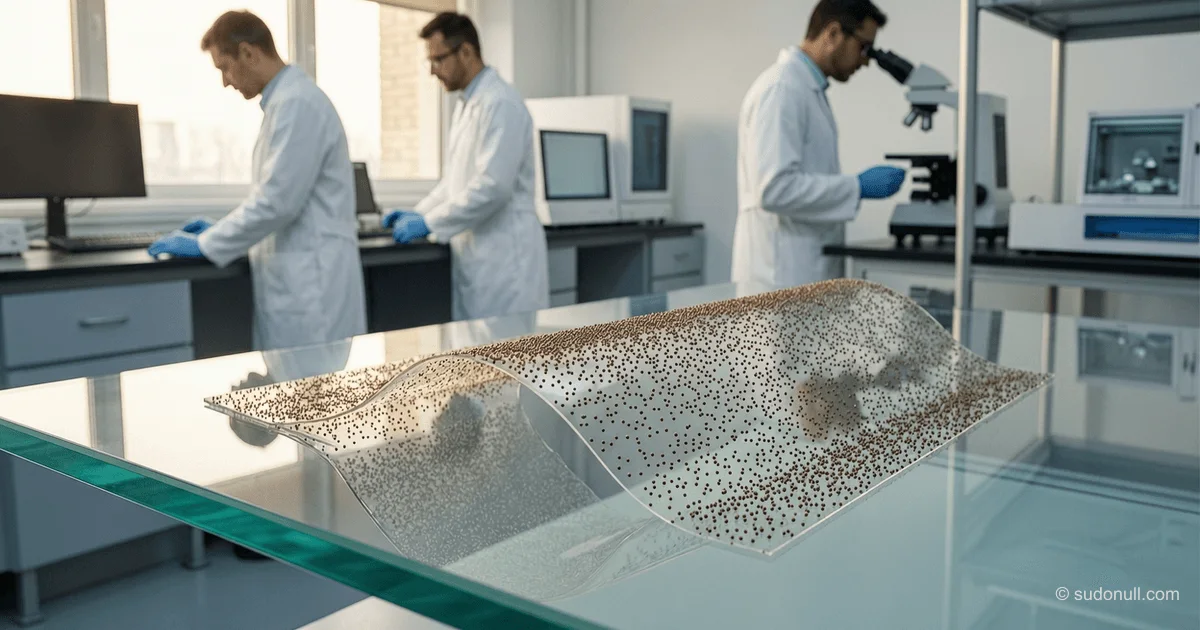
Researchers at Immanuel Kant Baltic Federal University (IKBFU) have developed a technology for creating flexible, biocompatible polymer films with magnetic nanoparticles, making sensors for smartwatches and cars significantly more sensitive and cheaper to produce.
The news from IKBFU about a "revolutionary film" for sensors that increases sensitivity by 1.5 times may at first glance seem like a routine lab note. However, when viewed through the eyes of an engineer working in the sensor industry, it becomes clear: the physicists in Kaliningrad have found a solution to one of the most expensive problems in modern electronics. Their breakthrough is not about a new chemical composition, but about a production technology that could collapse the cost of component bases for wearable devices and cars at a time when global supply chains remain in turmoil.
The Essence: What's Really Happening
At the Laboratory of Nano- and Micromagnetism of IKBFU, under the guidance of researchers from the Research and Education Center "Smart Materials and Biomedical Applications," a technology has been developed for producing flexible polymer films with embedded iron nanoparticles. The key breakthrough lies in the controlled drying mode. When the composite film is dried slowly at room temperature in air, its magnetoelectric coefficient α₃₃ reaches 35 mV/(cm·Oe) compared to 20 mV/(cm·Oe) with rapid high-temperature treatment. The 1.75-fold increase in sensitivity is not just a number. It means the sensor can detect magnetic fields that previously were lost in noise.
The physics of the process is simple and elegant: rapid heating causes magnetic nanoparticles to aggregate—scientists compare this to baking buns too close together on a baking sheet. With slow drying, the nanoparticles are evenly distributed in the polymer matrix, and the material acquires uniform sensitivity across its entire area. Importantly, the technology requires no additional equipment or energy consumption for heating. The economic effect comes not from replacing components, but from simplifying the process.
Timeline and Context
The results were published in the journal Physics of Metals and Metallography in late April 2026. The research was supported by the "Priority-2030" program, meaning that government funding is purposefully directed toward applied developments in sensor technology.
This is not an isolated result but part of the laboratory's systematic work. In March 2026, the same group published a comparative analysis of two signal readout methods for microwires in contactless inductive sensors in the journal Sensors. Earlier, in February, IKBFU scientists, together with colleagues from Moscow, demonstrated a composite based on silicone elastomer and cobalt ferrite that converts magnetic fields into electricity three times more efficiently than analogs. The Kaliningrad team is methodically building a portfolio of solutions in flexible magnetoelectric materials, and this new result is a logical continuation of that strategy.
Winners and Losers
Winners:
- Mid-range sensor manufacturers. Companies producing position sensors for pedals, steering, and tire pressure monitoring systems for mass-market automotive applications. Traditional sensors based on metal ceramics are expensive to produce and have a limited service life for the sensing element. The polymer film with iron nanoparticles promises to reduce sensor cost by 15–20% while maintaining performance. For a tier-2 automotive component supplier with an annual output of 5–10 million sensors, this means savings of $3 to $8 million per year.
- Wearable medical electronics manufacturers. Pulse oximeters, fitness trackers, heart rate monitoring patches—all use magnetic sensors. The flexibility and biocompatibility of the new material allow the sensor to be integrated directly into a strap or skin patch rather than a rigid housing. This paves the way for devices that users physically do not feel.
- Industrial sensor maintenance service companies. The increased service life of the sensing element means longer replacement intervals. For an industrial plant with a fleet of a thousand sensors, this reduces annual operating maintenance costs by several hundred thousand dollars.
Losers:
- Precision metal ceramics manufacturers. Their business model relies on expensive materials and complex sintering processes. The emergence of a competitive polymer alternative undermines their pricing foundation.
- Rare-earth magnet suppliers. Although IKBFU's technology does not completely eliminate magnetic materials, it reduces their content in the sensor. Less magnetic material per sensor means lower demand for costly rare-earth components, whose prices remain volatile due to geopolitical factors.
What the Media Isn't Saying
The main non-obvious insight concerns the nature of this development's competitive advantage. The result of Artyom Ignatov's group is not in a chemical formula protected by a patent. It lies in engineering know-how: parameters of the temperature profile, humidity, and drying time intervals. Reproducing the material knowing its composition is not difficult. Reproducing the technological regime that yields those 35 mV/(cm·Oe) is a trade secret.
That is why the publication in Physics of Metals and Metallography is more of a priority claim than a full disclosure of the technology. Commercialization will proceed through licensing the technology package, not through selling a patent on the material. This is the classic "Coca-Cola" model—the formula is known, but the proportions and process remain secret.
The second point relates to dual-use applications. Highly sensitive magnetic sensors are a key component in metal detection systems, navigation by Earth's magnetic field, and non-destructive testing. A technology that allows producing such sensors cheaper and more flexibly has obvious applications in the defense industry. No press release will say this, but interest from relevant agencies is guaranteed.
Forecast: Next 30 Days and 90 Days
30 days (until early June 2026):
IKBFU will begin negotiations with potential industrial partners through the "Priority-2030" program. The interaction format will likely involve R&D projects with one or two Russian sensor manufacturers. In parallel, Ignatov's group will present extended data on the film's stability under cyclic loading—a critical parameter for automotive applications, where a gas pedal sensor operates tens of thousands of times over its service life.
90 days (until August 2026):
The first independent reviews will appear at industry sensor conferences. The key question to be answered: can the technology be scaled from laboratory samples of a few square centimeters to meter-wide rolls of film? If the IKBFU group demonstrates a working prototype of roll-to-roll production, it will trigger the entry of a major industrial investor. The expected deal size could range from $2 to $5 million for an exclusive license to the slow-drying technology for a specific market segment.
The most likely commercialization scenario is the creation of a joint venture with a Russian or Asian manufacturer, where IKBFU provides the technology package and the partner provides production capacity and sales channels. The sensor market for wearable electronics is growing at 12–15% per year, and the window of opportunity to enter with a new material is open right now.
— Editorial Team










No comments yet.