Beijing High-Tech Expo Wows with Robots and Quantum Chips
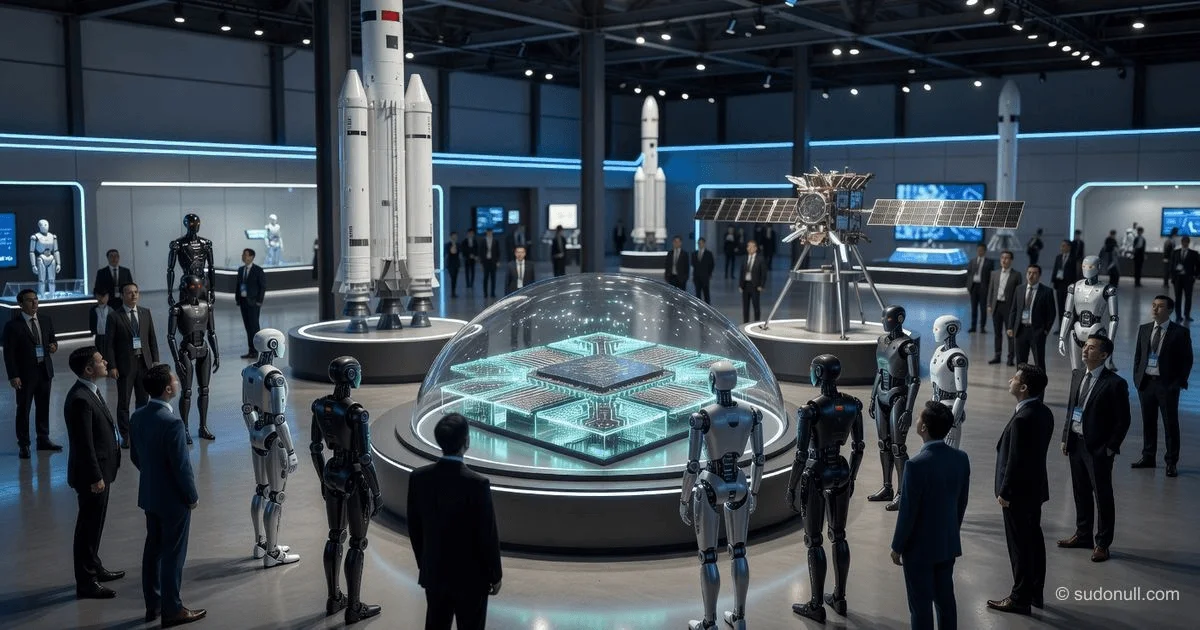
The 28th China Beijing International High-tech Expo featured humanoid robots, models of the reusable Zhuque-2 and Ceres-1 rockets, a next-generation quantum computer, and universal photonic quantum chips.
[The Gist]: What's Really Happening
The 28th Beijing International High-tech Expo is not an exhibition in the usual Western sense. It is a display of technological muscle as China accelerates its transition from "world factory" to "world laboratory." Behind the flashy facade of humanoid robots and rocket models lies a hard-nosed industrial policy: Beijing, through district clusters like Chaoyang and Beijing E-Town, is consolidating supply chains that were fragmented just three years ago.
The essence of the event is the presentation of three specific trump cards. First: commercial reusable launch vehicles (Zhuque-2, Zhuque-3, and Ceres-1) have moved beyond renderings and become flying hardware. LandSpace has already conducted three launches of Zhuque-2, two of which were successful. Second: quantum computing is transitioning from laboratory samples to universal photonic chips that can be publicly demonstrated, not just described in peer-reviewed papers. Third: "embodied intelligence"—i.e., robots—has finally taken the place of flagship consumer narrative, pushing aside smartphones and electric vehicles.
The district-based structure of the expo reveals the main mechanism. Chaoyang showcases 18 premieres, including the country's first satellite IoT module. E-Town pushes the line of social robotization. This is not a chaotic fair but a review of achievements by administrative units competing for budget funding and talent.
Timeline and Context
The expo opened on May 8, 2026, and runs until May 10. However, preparations began at least six months earlier: Chaoyang District announced its "Technology Hundred Parks" program on May 7. The timeline is critical: the expo starts less than a month after China's Ministry of Industry and Information Technology unveiled another round of subsidies for commercial space launches, and quantum startups like Boson Quantum received approval to demonstrate equipment that was considered sensitive for public display just a year ago.
LandSpace's Zhuque-2 has a history. Its first launch in December 2022 was a failure. By 2025, it achieved two consecutive successful missions. At the expo, they brought not just a mock-up but a flown stage—an insider detail not mentioned by China Daily but confirmed by on-site photos: the fuselage shows soot marks from methane engine firings. This is a statement: China has achieved operational readiness for medium-class methane launch vehicles, neck-and-neck with America's Rocket Lab.
The quantum section of the expo—in the Chaoyang zone—displays a universal photonic quantum chip. This is significant because until now, Chinese quantum computers have been based either on superconducting qubits (Jiuzhang, Zuchongzhi) or ion traps. The shift to photonic chips means scalability—potentially cheaper and more stable at room temperature.
Who Wins and Who Loses
Winners:
LandSpace and Galactic Energy. Their models on display attract not only onlookers but also insurance underwriters and representatives of commercial launch pools from Southeast Asia. The budget for a single Zhuque-2 launch is estimated at $6-8 million. For comparison, Rocket Lab's Electron costs about $7.5 million. Chinese private companies have for the first time achieved price parity without specific government subsidies for a given launch.
Chaoyang District and its residents, particularly Boson Quantum. The public display of a photonic quantum chip at a municipal expo is a bid for inclusion in the next tranche of the state quantum fund, worth about $1.5 billion, expected to be allocated in the second half of 2026. Eighteen premieres in one pavilion is a powerful argument in interagency bureaucratic battles.
Losers:
American and European commercial launch operators. While SpaceX dominates with Falcon 9, the niche of small and medium launch vehicles is slipping to Chinese private companies. Insurance rates for small satellite launches have already begun to drop: Lloyd's syndicates are recalculating risks based on the growing track record of successful Chinese launches.
Developers of superconducting quantum processors in the US (IBM, Google Quantum AI). The public demonstration of a working photonic chip means China is diversifying its quantum program. If photonics "takes off" before fault-tolerant superconductors, the first-mover advantage in commercializing quantum computing could slip away.
What the Media Isn't Telling You
The first non-obvious insight concerns the satellite IoT module presented in Chaoyang. Officially, it is "the country's first space IoT payload." Unofficially, it is a component of the "Celestial Web" system, an analog of Starlink but for low-orbit Internet of Things for military and dual-use purposes. The module operates in the L-band, allowing short data packets from sensors anywhere on the planet without ground infrastructure. This development, not the quantum computer, attracted the most attention from the Central Military Commission delegation that visited the expo on the first day.
The second insight: Boson Quantum and its photonic chip. The company is registered in Beijing, but its main academic partner is the Quantum Center of the University of Science and Technology of China in Hefei. The public display in Beijing is a demonstration of loyalty to the capital's authorities and a bid for Beijing residency for the next funding round. Internal competition among the scientific clusters of Hefei, Shanghai, and Beijing for quantum budgets is extremely fierce.
The third insight: Zhuque-3. The model on display is at 1:10 scale, but LandSpace representatives confirm in private conversations that the first flight of the full-scale prototype is scheduled for Q4 2026. It will be a partially reusable rocket with a recoverable first stage, competing with Falcon 9.
Forecast: Next 30 Days and 90 Days
Next 30 Days (until June 7, 2026):
The expo ends on May 10, and agreement signings will begin immediately. Within two to three weeks, expect announcements of at least three deals: licensing of Boson Quantum's photonic chip for a state data center, a LandSpace commercial launch contract for a Southeast Asian customer, and an export memorandum for robotic platforms from E-Town for logistics operators in the UAE. The total value of contracts announced on the sidelines of the Expo, in my estimation, will reach $150-200 million.
Next 90 Days (until August 6, 2026):
The key event will be the reaction of US regulators. The Commerce Department will likely add Boson Quantum and related organizations to the Entity List if the photonic chip demonstrates quantum advantage in a practically significant task. This will create short-term turbulence for optical component suppliers.
At the same time, I expect the first successful launch of Ceres-1A (an upgraded version from Galactic Energy)—the window opens in July. If the launch succeeds, Galactic Energy will gain access to the national "Qianfan" program (an analog of Starlink), adding about $200 million to the company's valuation.
The main process that will remain invisible to Western media is the redistribution of quantum funding within China. After the public success of Boson Quantum, the Beijing cluster will gain priority over Hefei in the 2027 budget allocation. This is a bureaucratic battle whose outcome will shape the landscape of Chinese quantum technology for the next three years.
— Editorial Team





No comments yet.