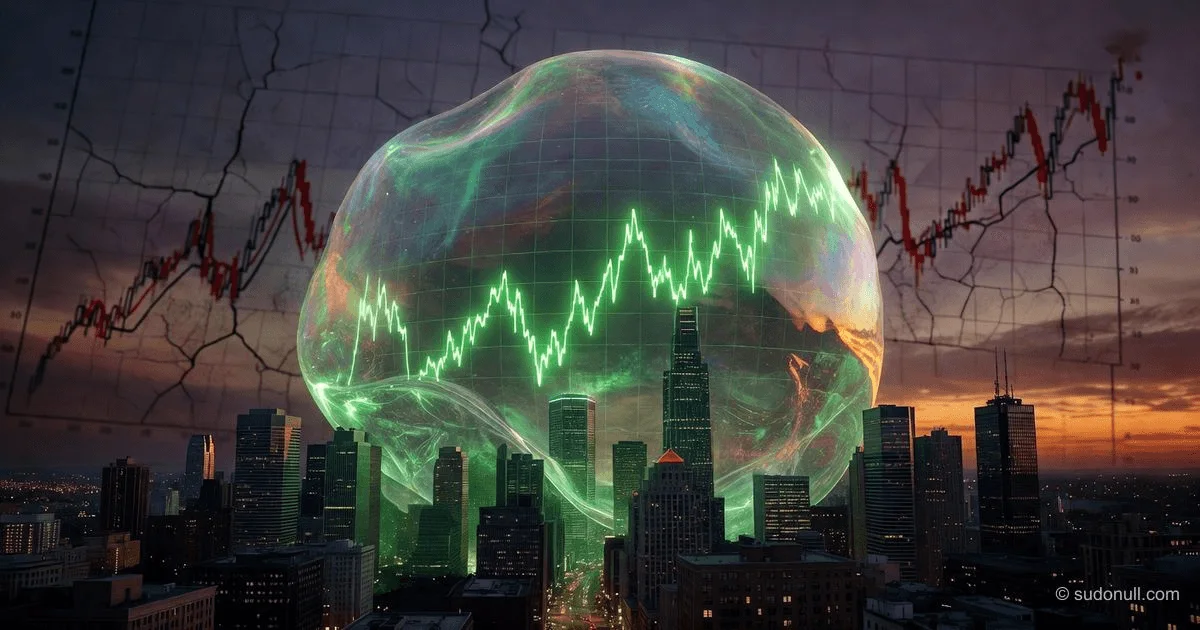
Analysts Warn of AI Bubble Surpassing Dot-Com Peak
The market capitalization of the semiconductor sector, driven by AI hype and new models like GPT-5.5, has reached record levels, exceeding the extremes of the dot-com boom, raising fears of an imminent correction among leading analysts.
The Gist: What's Really Happening
The semiconductor and AI market is overheated to a state that even Goldman Sachs veterans call unprecedented. The point isn't that a bubble exists—that's obvious to anyone who has seen NVIDIA's market cap chart, which has soared to $4.85 trillion. The point is that the mechanism inflating this bubble is fundamentally different from the dot-com era: back then, amateur investors bought shares of unprofitable websites at IPOs; now, the world's largest corporations—Microsoft, Amazon, Alphabet, Meta—are spending their own operating cash flows on infrastructure whose return on investment the market cannot yet adequately assess. Cloud giants will spend over $600 billion on capex in 2026, exceeding 100% of their free cash flow.
This isn't retail trader speculation—it's an institutional arms race where refusing to participate is seen as a mortal risk.
Meanwhile, OpenAI continues to spin the flywheel: launching GPT-5.5 Instant for all users, turning the model into a mass-market product. API output prices are $30 per million tokens—an increase over its predecessor. This isn't technological democratization; it's a business strategy to turn free users into future assets for an advertising model. OpenAI is burning $50 billion a year on compute; its president Brockman admitted in court that his personal capital invested in the company is $0, but his stake is valued at $30 billion. This gap between real contribution and paper value is a perfect illustration of the era.
Timeline and Context
Warnings have been sounding for months. Back in February 2026, Michael Burry, the legend of "The Big Short," drew a direct parallel between NVIDIA and Cisco during the dot-com crash: NVIDIA's purchase commitments soared from $16.1 billion to $95.2 billion in a year; the company is placing non-cancellable orders many quarters ahead without knowing real demand. NVIDIA CFO Colette Kress confirmed that inventories are growing and orders are placed beyond the usual horizon.
Then in May came a salvo from Goldman Sachs. On May 2, bank partner Mark Wilson warned that the momentum factor is overcrowded, hedge fund bets are near five-year highs, and over 60% of S&P 500 earnings growth is expected from just two companies—Micron and NVIDIA. On May 5, Goldman published an even harsher verdict: FOMO proved stronger than poor financial metrics. Two separate Goldman reports reached a rare institutional consensus: the machine is worth more than anyone is willing to admit and produces less than anyone is willing to state publicly.
Jim Covello, head of equity research at Goldman and a former semiconductor analyst, updated his famous thesis "Too Much Spending, Too Little Benefit" from June 2024. Two years of observation only strengthened his skepticism: out of $30-40 billion in corporate investment in generative AI, 95% of organizations saw zero return on pilot projects. EY recorded an average AI risk loss of $4.4 million per company. And Harvard Business Review calculated that AI errors cost an organization of 10,000 employees $9 million annually in lost productivity.
Against this backdrop—a fireworks display of tech announcements. The 28th Beijing High-Tech Expo showcases quantum photonic chips and reusable rockets [from user news context]. OnePlus releases the Nord CE6 with an 8000 mAh battery for $320—a price war in the smartphone market [from user context]. Adobe integrates AI agents into Acrobat [from user context]. Every new product is an attempt to convert hype into real revenue before the music stops.
Who Wins and Who Loses
NVIDIA wins. With a market cap of $4.85 trillion and net profit of $120 billion, the company controls 75% of all compute spending with a margin of about 75%. Covello puts it bluntly: chipmakers thrive at the expense of everyone higher up the chain. Since the launch of ChatGPT, NVIDIA's profit has grown roughly 20-fold; hyperscalers have shown much more modest growth, while corporate customers and model companies are losing money.
Early NVIDIA investors win. Three-year stock returns are 587%. But that's already realized profit, not future gains for those entering now.
Corporate AI customers lose. 85% of the workforce has no value-creating AI use case. 99% of companies in the EY sample suffered losses from AI risks. The gap between what the C-suite says about productivity and what actually happens on the ground is widening.
Hyperscalers lose in the long term. Microsoft plans $120 billion in capex over six months, Amazon over $200 billion for the year, Alphabet around $185 billion, Meta roughly $135 billion. These figures exceed the companies' operating cash flows, forcing them to increase debt: data center bond issuance doubled to $182 billion in 2025. Covello warns: either companies higher up the chain will start seeing returns on investment, or they will be forced to spend less on chips.
Retail investors who succumb to momentum lose. The momentum factor has surged 25% year-to-date; hedge fund net exposure and leverage are near five-year highs. Such concentration of risk historically precedes corrections.
What the Media Isn't Saying
First insight: Goldman Sachs is internally divided in its assessments, but this is kept quiet. While Covello sounds the alarm, another Goldman division—the Global Institute—publishes "Tracking Trillions," forecasting $7.6 trillion in cumulative AI capex by 2031. And a third Goldman pillar, analyzing tokenomics, claims that the inflection point for hyperscaler gross margins will occur within the next 3-12 months. Three teams from the same bank—three opposing conclusions. This is a rare case of institutional schizophrenia, and it means that even within Wall Street, there is no consensus.
Second insight: OpenAI is teetering on the brink of legal and financial collapse. Brockman admitted in court: zero dollars in personal investment, a $30 billion stake. The scale of "nothing invested, everything gained" is so shocking that even OpenAI's lawyers couldn't soften the impression. If the court sides with Musk, the consequences for the company's $852 billion valuation could be catastrophic.
Third insight: "Elongation" is the key word that will replace "bubble" in presentations. The Goldman Global Institute describes a scenario where bottlenecks—queues for grid connections, transformer shortages, lack of skilled labor—don't stop construction but stretch it over time and increase costs. The cost per megawatt of new AI data centers has already risen from $10 million to $15-20 million. If projects start failing simultaneously, elongation could turn into a feedback loop: doubts about demand lead to delayed or reduced investment.
Fourth insight: The semiconductor market grew 79% year-over-year—but this is an unreliable base. The SIA reports $298.5 billion in revenue for Q1 2026 and a trajectory toward $1 trillion for the full year. But these figures were compiled before the escalation of the trade war and new export restrictions. Chinese companies are not captured in Western statistics at all, and their market behavior is the biggest unknown for the second half of the year.
Forecast: Next 30 Days and 90 Days
Next 30 days (through June 7, 2026):
On June 11, Adobe publishes its quarterly report—this will be the first test of whether AI integration into Acrobat converts into real Document Cloud revenue. NVIDIA's report is also on the horizon: purchase commitments of $95.2 billion must be reconfirmed or adjusted, and any change in tone from CFO Colette Kress will move the stock 5-10% in either direction. OpenAI will likely use the GPT-5.5 Instant wave to announce an advertising model—an attempt to show the market a path to monetizing its free audience before the $50 billion compute bill raises too many questions.
Next 90 days (through August 6, 2026):
The key risk is not the market correction itself (it's inevitable), but the trigger that sets it off. The most likely candidate is a cascading failure of several large data center projects due to physical constraints (power grids, transformers, permits). If the "elongation scenario" from the Goldman report transitions into a "feedback loop" phase, capital budgets for 2027 will start being revised this fall.
Second scenario: a court ruling on Musk's lawsuit against OpenAI. If the court rules against the company, it will hit not only OpenAI but the entire ecosystem of startups built on its API. A domino effect could collapse the valuations of hundreds of AI companies.
Third factor: China. The launch of GPT-5.5 Instant coincides with the demonstration of Chinese quantum chips and commercial rockets at the Beijing Expo. China is accelerating its own technological sovereignty precisely when American companies are most dependent on global supply chains.
My main conclusion: the bubble will burst not when the money runs out—hyperscalers have proven they can borrow indefinitely. It will burst when one of the major players admits that ROI doesn't exist. That moment hasn't arrived yet—but Goldman Sachs, it seems, has already started the countdown.
— Editorial Team








No comments yet.