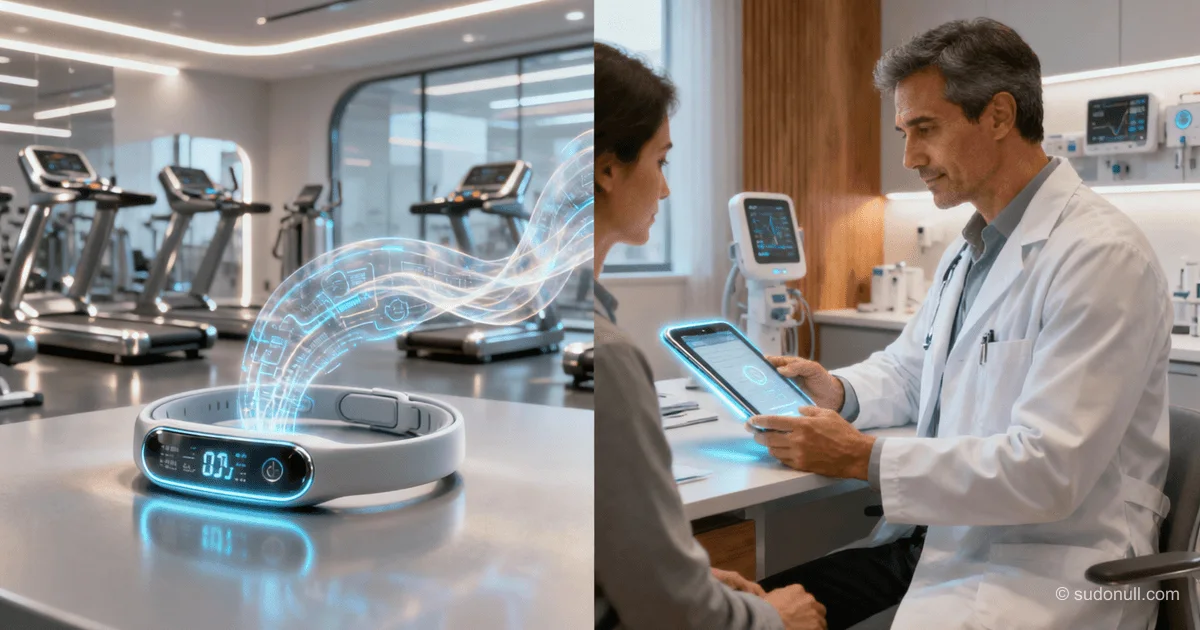
Google announces Fitbit Air fitness tracker with AI coach powered by Gemini
The new $100 device is a screenless tracker that, combined with the renamed Google Health app and an AI-powered coach, provides round-the-clock analysis of health, sleep, and physical activity.
Fitbit Air: How Google turns your body into a data farm, and Whoop challenges doctors to a duel
The gist: what's really happening
On May 7, 2026, Google released the Fitbit Air — a screenless fitness tracker for $99 with an AI coach powered by Gemini for $9.99 per month. Exactly 24 hours later, Whoop struck back, announcing video consultations with licensed doctors within its app.
This is no coincidence. It's a philosophical split in the wearable industry that crystallized in two days. Google answers the question "what to do with sensor data" with a chatbot. Whoop answers with a licensed medical professional. In January, the FDA loosened oversight on both AI health tools and consumer wearables — the regulator essentially said, "figure it out yourselves."
But behind this elegant showdown lies a far more cynical construct. The Fitbit Air is not a fitness tracker. It's a Trojan horse through which Google enters the market for continuous 24/7 biometric monitoring, using the $99 price as a dumping ram against competitors who earn an order of magnitude more per user.
Timeline and context
The story of this launch doesn't start in May 2026, but in January 2021, when Google closed its $2.1 billion acquisition of Fitbit. For five years, the company digested the asset, and the result was unexpected: instead of strengthening the Pixel Watch as an Apple Watch killer, Google went in the opposite direction — it removed the screen entirely.
Why becomes clear from the numbers. Sales of screenless trackers soared 88% in 2025. In March 2026, Whoop raised $575 million at a $10.1 billion valuation; Oura raised over $900 million at an $11 billion valuation. Two companies selling screenless devices are together worth over $21 billion — exactly what Google paid for the entire Fitbit with its multi-million user base.
Whoop built a 250,000-strong paid subscriber base with an annual run rate of about $1.1 billion. Oura sold 550,000 rings, 300,000 of them in 2025 alone. The screenless wearable market is no longer niche.
And Google responded not with one product, but with three simultaneous actions:
- Released the Fitbit Air as a $99 "entry point"
- Renamed the Fitbit app to Google Health, killing a brand that existed since 2007
- Made the Gemini AI coach paid — $9.99 per month or $99 per year
At the same time, the company announced the shutdown of Google Fit — another fitness app — with data migration to Google Health. This is a full consolidation of the health vertical under one brand and one monetization funnel.
Who wins and who loses
At first glance, the main beneficiary is Google. The company gets a platform where data flows from Fitbit, Pixel Watch, and in the future — from Apple Watch, Oura, and Garmin (Google Health is touted as wearable-agnostic). Anyone who puts on any tracker potentially becomes a Google Health user and a subscription candidate.
But there's a catch. When acquiring Fitbit, Google gave regulators a commitment: for 10 years, it would not use Fitbit health data for ad targeting. The clock is ticking. The deal closed in 2021, the moratorium expires in 2031. Fitbit Air and Google Health are the infrastructure that must be ready when the restrictions lift. Six years to build the base, then — monetization of sleep, heart rate, and blood oxygen data.
The losers — Apple. The company dominates the wearable market, but its "data on screen" approach is vulnerable to AI interpretation. In the morning, Apple Watch shows: "Heart rate 72, HRV 48, sleep 6:34." Whoop and Fitbit Air say: "Your readiness score is 65%, reduce intensity because deep sleep was 23% shorter than normal." The first is raw data, the second is a ready recommendation. It's the AI interpretation that creates the value users pay for.
Whoop is in a dual position. On one hand, the company responded with doctors, and that's a strong move: AI can say your heart rate variability is dropping, a doctor can say why. On the other hand, a Whoop annual subscription costs $199 to $359 versus Google's $99. That's a 2-3.5x difference. If the Gemini Health Coach proves good enough, the price argument will tip the scales.
Startups like Amazfit and Polar, which chose a "one-time purchase without subscription" model, risk being squeezed out: they compete on hardware price, while Google and Whoop compete on the value of AI interpretation. With a device price of $99 and a sensor module cost under $15, manufacturing the tracker is not even a business — it's a cost to acquire a user into the subscription funnel.
What the media isn't telling you
Almost all reviews focus on the "AI coach vs. live doctor" showdown. But the real story is different.
Insight: Google deliberately equipped the Fitbit Air with last-generation sensors. The device uses a standard optical heart rate sensor — not the multi-spectral sensor of the Pixel Watch 4 with a far-field temperature sensor. This isn't cost-cutting. It's an architectural decision.
Whoop 5.0/MG, released in May 2025, includes medical ECG and the "Healthspan" concept — an assessment of aging rate. Oura is developing an LLM for women's health. Google, with old sensors, consciously occupies the lower price segment but seals it with an AI overlay. The bet: good AI analysis on mediocre sensors > excellent sensors without AI interpretation. If the hypothesis holds, it will redefine the "hardware specs" race in wearables.
Second insight: subscribers to AI Pro and Ultra (Google bundles with Gemini, NotebookLM, and Flow) get Google Health Premium for free. This turns the Fitbit Air into a free companion for tens of millions of existing Google AI subscribers. Competitors cannot mirror this — they don't have an AI ecosystem of this scale.
Third insight: The Fitbit Air works on iOS with full Health Coach functionality — this is the first time Google launches an AI service on iPhone without feature cuts. CNET directly calls the device a "Trojan horse to deliver an AI coach to the iPhone." Google abandons the platform war to capture biometric data from Apple users.
Forecast: next 30 days and 90 days
30 days (by June 9, 2026):
On May 19, a key event occurs — the renaming of the Fitbit app to Google Health. This is not just a icon change. It's the moment when tens of millions of Fitbit users discover their data is now in the Google ecosystem with new terms of use and AI analytics. Expect a wave of outrage on social media from users who didn't read the migration notices.
Whoop will launch doctor consultations in the US in June-July. The critical question is price. If a consultation costs $25-40, it's an additional revenue stream. If $100+, it's a niche service for the wealthy.
90 days (by August 9, 2026):
By then, the first data on conversion from the three-month trial to paid subscription will be known. If Google achieves a conversion rate of 25%+ (standard SaaS benchmark), it will signal a mass migration of users from Fitbit devices to Fitbit Air and subscription.
Whoop will face the need to reconsider pricing. $199 per year vs. $99 — the gap is too wide. Either the company adds some doctor consultations to the basic tier, or it will see churn of the most price-sensitive users to Fitbit Air.
Regulatory factor: the FDA loosened oversight in January, but AI health recommendations are a minefield. The first high-profile case where Gemini Health Coach gives dangerous advice will trigger a scandal-investigation-regulation cycle. Google knows this: fine print states that Health Coach "is not intended to diagnose or treat diseases." But users paying $9.99 a month will expect otherwise.
The main intrigue of August 2026: will Apple announce a countermeasure? Apple's current health-tech strategy — passive data collection with minimal AI interpretation — is becoming vulnerable. Either Apple announces its own AI coach based on Apple Intelligence, or it cedes this market to Google and Whoop.
Fitbit Air will go down in history as the device that changed the game. Turning a fitness tracker from a gadget for counting steps into a gateway for a biometric monitoring subscription. This is not product evolution — it's the invention of a new business model.
— Editorial Team










No comments yet.