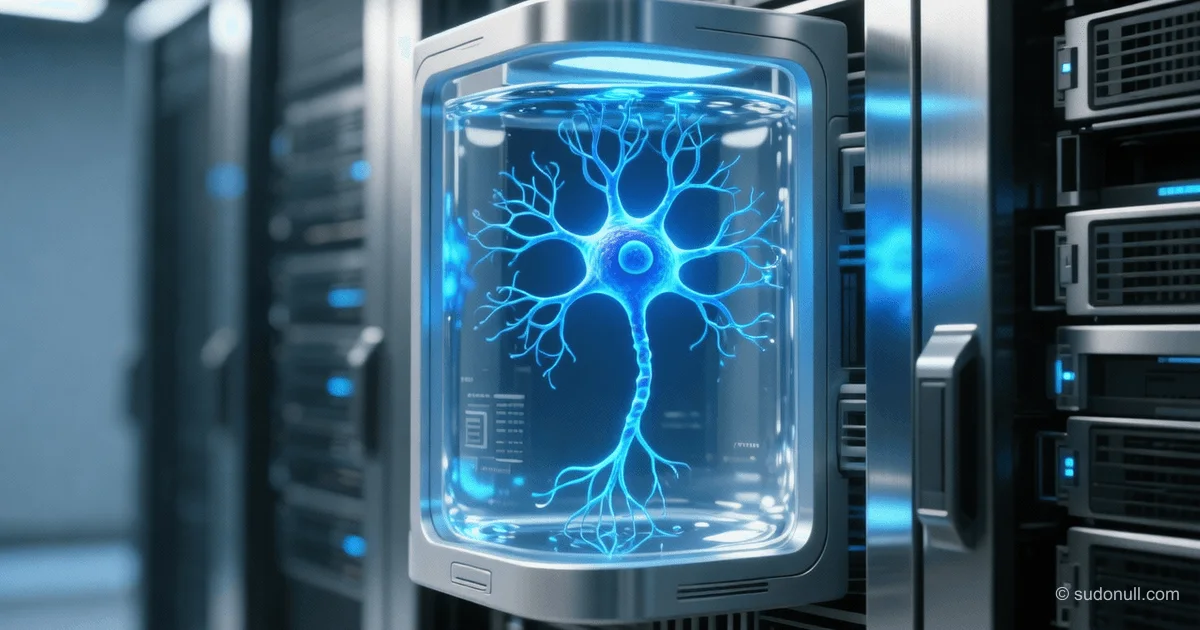
Researchers Explore Biological Computing as an Alternative to Traditional Processors
Amid a computing power shortage, scientists are conducting bold experiments in biological computers, exploring the potential of living cells to create fundamentally new computing systems.
Biocomputing 2026: When the cell replaces silicon and your blood becomes a data center
The Essence: What's Really Happening
Amid a global shortage of computing power and exponential growth in AI energy consumption, biological computers have ceased to be science fiction and have become a genuinely funded engineering project. Australian startup Cortical Labs has launched the world's first "biological data centers" using cultured human neurons, while Swiss company FinalSpark is already leasing biocomputer capacity via the cloud for $500 per month.
At first glance, this is just another scientific curiosity. In reality, it's a fundamental shift in computing architecture. Moore's law is dying, Dennard scaling has been dead for 15 years, and data center energy consumption is projected to double by the end of 2026 according to the IEA. In these conditions, a living neuron, consuming six orders of magnitude less energy than a silicon transistor, looks not like an alternative but the only way out. When Goldman Sachs estimates that a single ChatGPT query uses ten times more electricity than a Google search, it becomes clear: the industry has hit a physical limit, and biology is not a choice but an evacuation route.
Timeline and Context
The starting point can be considered 2022, when the Cortical Labs team published an article in the journal Neuron demonstrating DishBrain—a system in which living neurons learned to play Pong in 5 minutes without prior programming. This experiment proved a fundamental principle: biological neural networks are capable of real-time learning in response to electrical feedback.
In 2023, Cortical Labs raised $10 million in funding, and FinalSpark opened remote access to its Neuroplatform for researchers worldwide.
The turning point came in the first quarter of 2026. Cortical Labs launched two small data centers—one in Melbourne (120 CL1 modules) and one in Singapore (planned up to 1,000 modules). Each module, the size of a shoebox, contains a living neural array, requires nutrient fluid to keep cells alive, and according to the company, consumes less power than a pocket calculator.
Meanwhile, Japanese researchers from Tohoku University and Future University Hakodate achieved an independent breakthrough: they trained cultured rat neurons to perform machine learning tasks in real time using the FORCE learning method and microfluidic devices. The system updated every 333 milliseconds and demonstrated the ability to generate both periodic and chaotic patterns, including the Lorenz attractor.
By March 2026, Bloomberg and EuroNews began covering the launch of biological data centers as technological mainstream. Also in March, a publication in RSC Publishing described the creation of a "universal and scalable DNA nanochip" that performs logic operations inside living cells and can identify and destroy cancer cells through a cascade of seven inputs across three logic layers.
Three independent directions—neuromorphic biocomputers, DNA logic circuits, and microbial computing—have simultaneously moved from labs into the commercialization phase. This is not a coincidence but a tectonic shift.
Who Wins and Who Loses
Winners:
Cortical Labs and FinalSpark — pioneers with key know-how: how to keep neurons alive in a technological environment. Their position is analogous to Intel's in the early 1970s: the technology is imperfect, but whoever solves the scaling problem will own the market.
Cloud providers ready for hybrid architectures. Biocomputers will not replace silicon but complement it. Data centers that first integrate CL1 modules as coprocessors for energy-efficient tasks will gain a structural cost advantage.
Pharmaceutical companies. The technology allows testing a specific patient's neuronal response to drugs in vitro. This is a personalized medicine market with a potential of $100+ billion.
NVIDIA and accelerator manufacturers in the short term. Until biocomputers are scaled, demand for traditional GPUs will continue to grow—energy consumption and shortages only drive up accelerator prices.
Losers:
Silicon startups in neuromorphic computing (BrainChip and similar). Their argument of "energy-efficient neuromorphic architectures" is directly challenged by real neurons, which are a million times more efficient than any silicon neuromorphic chip.
ASIC manufacturers for inference. If Cortical Labs delivers on its scaling promise, inference workloads sensitive to energy costs will begin migrating to biological platforms.
Traditional data centers with high PUE. When the market sees that 120 CL1 modules perform work requiring megawatts on silicon, pressure for "green" transformation of data centers will become unbearable.
What the Media Isn't Saying
Insight one: The DNA nanochip is more powerful than Cortical Labs, but it's being ignored. While all headlines focus on CL1, Chinese scientists have created a scalable DNA nanochip that performs up to 11 addressable logic operations on a single DNA origami structure. This chip doesn't just compute—it works inside living cells and can trigger apoptosis in cancer cells by identifying them via three microRNA markers simultaneously. This is not just a biocomputer, but a biocomputer capable of therapeutic action. The media miss this aspect, focusing on "neurons in a box"—a more spectacular but not more advanced technology.
Insight two: "Biological data center" is currently a label, not a reality. Cortical Labs' announcement of data centers with 120 and 1,000 modules sounds impressive. But each module is a closed life-support system for cells. Neurons require nutrient medium, waste removal, temperature control, and infection protection. One module is a lab setup. A thousand modules is a biochemical plant, not a data center. No one discusses how contamination control is solved at a scale comparable to a data center. One bacterial infection in the nutrient system—and the entire "data center" shuts down within hours.
Insight three: The real race is not "silicon vs. biology" but "open biology vs. proprietary biology." Cortical Labs and FinalSpark keep their technologies closed. But an open direction is developing in parallel: researchers are using reservoir computing on microorganisms. A review article in Biotechnology Advances describes a shift from bottom-up design (monoculture digital circuits) to a top-down approach where the computer is the dynamics of the living system itself. If the open direction pulls ahead, the patent monopoly of early startups will become useless.
Forecast: Next 30 Days and 90 Days
30 days (by June 9, 2026):
Cortical Labs will announce its first cloud client at the Singapore site—likely a research consortium or AI lab testing hybrid architectures. FinalSpark, already leasing capacity at $500/month, will announce an expansion of its organoid park. Both companies will use the media attention window to attract the next funding round.
On the academic front—a wave of replications of the Japanese rat neuron experiment: labs will begin testing FORCE learning on other neuron types and more complex tasks. The first to demonstrate learning on human organoids will gain priority for publication in Nature or Science.
90 days (by August 9, 2026):
The key event will be the publication of the first independent benchmark of CL1 against traditional accelerators. If Cortical Labs' claimed energy efficiency is confirmed by at least an order of magnitude (rather than the promised six), the market will react with a wave of venture capital investment in the sector. If the numbers are not confirmed, biocomputing will enter the "trough of disillusionment" on the Gartner Hype Cycle for a year or two.
The main catalyst will be the position of regulators. The use of human neurons in commercial computing raises bioethical issues that are not yet regulated in any jurisdiction. By August, at least one country (likely Australia, where Cortical Labs is based) will issue preliminary regulatory guidance on biological computing systems. The content of this document will determine whether biocomputers remain a research curiosity or get the green light for commercial scaling.
Cortical Labs and FinalSpark are not just startups. They are proof that the boundary between "living" and "digital" is a 20th-century artifact. The 21st century will build computers not from silicon but from carbon. And when your great-grandchild asks if it's true that processors were once made from sand rather than grown in a Petri dish—that will mean the transition is complete.
— Editorial Team










No comments yet.