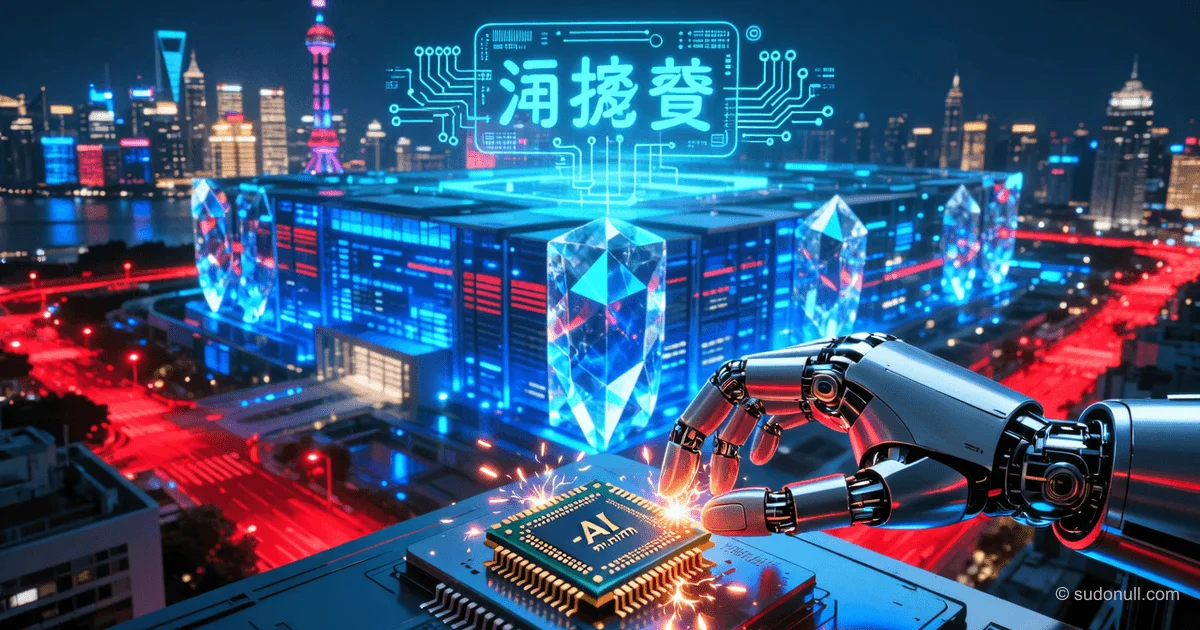
China Experiences Explosive Growth in Generative AI Amid Global Startup Investments
Analysts note the rapid growth of China's generative AI industry, accompanied by major investments in specialized startups and the development of next-generation AI hardware.
China's AI Explosion: Why $20 Billion for a Chatbot Is Not a Bubble, But a Second Front of the Cold War
The Core: What's Really Happening
While American media were digesting the news of Moonshot AI's record round, China's AI sector simultaneously achieved three strategic goals that are hardly being reported. Within 72 hours—from May 5 to May 7, 2026—Moonshot AI closed a $2 billion round at a $20 billion valuation, and DeepSeek entered negotiations to raise up to $50 billion.
But the main thing is not the money. The main thing is the mechanism of its distribution. The money came not from classic Silicon Valley venture funds, but from three types of players: the state-owned National AI Industry Investment Fund ($8.8 billion under management), telecom giant China Mobile, and the venture arm of Meituan, controlled by billionaire Wang Xing. This is not a venture deal. This is consolidation of the AI sector under the control of the state and the largest consumer-tech platforms.
In parallel, and this is a key point, Hua Hong Group announced the launch of a 7nm process for AI chips. Huawei is already collaborating with Hua Hong on 7nm chips. Dishan Technology is verifying a prototype 2nm AI chip with a hybrid FinFET/GAA architecture. And the level of localization of AI chips in China has risen from 35% to 46% in just six months.
Thus, China is not just financing AI startups—it is building a full sovereign stack: from chips (Hua Hong, SMIC, Dishan) to models (Kimi, DeepSeek, MiniMax) and their packaging into consumer ecosystems (Meituan, WeChat). This is the other half of the story that Western headlines about the "Chinese AI boom" are avoiding.
Timeline and Context
Events have been developing rapidly since the beginning of 2026. Moonshot AI was valued at $4.3 billion at the end of 2025, raised $500 million, then another $700 million at a $10 billion valuation—and finally in May 2026 jumped to $20 billion. Kimi's annualized recurring revenue exceeded $200 million in April 2026, doubling in a month. The company became second in the world in model usage on OpenRouter.
DeepSeek, meanwhile, released preview versions of V4 in April 2026, which immediately entered the top ten most popular models in the world. Negotiations for the first external round attracted valuations from $10 billion to $50 billion—a range unheard of for a company that had previously existed on internal funds.
On the hardware front: Baidu announced Kunlun M100 chips (inference, 2026) and M300 (training, 2027), as well as Tianchi 256 and 512 supernodes. Huawei is building an Ascend roadmap through 2028. Dishan Technology is developing a 2nm chip targeting commercialization in 2028-2029. Hua Hong is launching a 7nm line with an initial capacity of several thousand wafers per month, with Biren as one of the first customers for tapeout.
Who Wins and Who Loses
Winners:
Meituan. By investing in Moonshot AI, the food delivery platform gains exclusive access to Kimi's agent systems (Agent Swarm, up to 300 specialized agents). Integrating AI agents into China's largest consumer service means automating millions of transactions without human involvement—from ordering to logistics. This is not a partnership; it's a takeover of the operational stack.
Huawei and SMIC. US sanctions have paradoxically turned into the world's largest protectionist tool. Chinese AI companies cannot freely buy advanced NVIDIA chips—and are forced to buy Chinese ones. China's integrated circuit exports in the first quarter of 2026 grew by 73% in monetary terms, and the export-to-import ratio reached 56.6%. Huawei, simultaneously developing models (Pangu), chips (Ascend), and telecom equipment, is becoming a vertically integrated monster with no equivalent in the West.
The Chinese State. The National AI Industry Investment Fund ($8.8 billion) and directives from Premier Li Qiang on "the fastest development of AI technologies" are turning the AI sector into a state-managed project. The scale of China's AI industry is forecast to exceed 10 trillion yuan ($1.45 trillion) by 2030. This is not a market estimate but a political goal—and budget funds will be allocated for it, regardless of commercial viability.
Losers:
American AI Companies in the Chinese Market. OpenAI, Anthropic, and Google began "joint work to limit Chinese competitors" back in April 2026. But legislative barriers cannot stop the math: Kimi K2.6 with one trillion parameters, open source, and the ability to process context up to 262,000 tokens—this is a product that Chinese developers can freely use and modify. Closed American models do not offer this.
NVIDIA in the Long Term. The growth of AI chip localization from 35% to 46% in six months is a pace that means by 2028, the Chinese AI accelerator market could be 70-80% supplied by domestic manufacturers. NVIDIA is losing not just market share, but an entire region that is building AI infrastructure at an unprecedented rate.
The European AI Sector. While the EU regulates, China builds. The gap between European AI startups (Mistral raised about $640 million in its entire history) and Chinese ones (Moonshot raised $2 billion in one round) is becoming quantitatively insurmountable. Europe risks being caught between two AI superpowers without its own competitive AI stack.
What the Media Are Not Saying
Insight One: Kimi K2.6 is an "open model," and that changes everything. Moonshot AI initially adhered to a closed architecture, but under pressure from DeepSeek's success, it switched to an open-weight strategy. In practice, this means any company in any country can take a model with one trillion parameters, adapt it to their needs, and run it locally. This undermines the business model of OpenAI and Anthropic, which earn revenue from access to proprietary models via API.
Kimi K2.6 already ranks second in the world in token usage on OpenRouter. The company Cursor from San Francisco—pays Kimi for using the K2.5 model. An American AI startup uses a Chinese model. This is not just competition; it's technology diffusion in reverse.
Insight Two: Meituan is an ideal incubator for AI agents. Meituan has over 600 million active users and millions of transactions daily. Integrating Kimi's Agent Swarm (up to 300 agents simultaneously) into Meituan's ecosystem creates the world's largest testing ground for AI agents in real commercial scenarios. Neither Amazon, Meta, nor Google have a comparable environment with such transaction density and data volume. Once these agents are trained, they can be exported to other markets—and this competitive advantage cannot be replicated in laboratory conditions.
Insight Three: Dishan's 2nm chip—"CUDA compatibility" as a Trojan horse. Dishan Technology is designing its 2nm chip with toolchain support compatible with NVIDIA CUDA compilers. This means AI model developers will be able to run their CUDA-optimized applications on Chinese chips without code modification. If this compatibility is achieved in a commercial product, NVIDIA's lock on the developer ecosystem will be broken.
The chip itself uses a hybrid FinFET/GAA architecture and chiplet layout, promising a 40% performance increase over the previous generation. But the main thing is not the specs, but compatibility. This is an attempt to build a bridge between the CUDA ecosystem and Chinese hardware. And if Dishan or someone else (Biren, Iluvatar CoreX) solves this problem, the AI accelerator market will face a reshuffling comparable to the emergence of ARM in the x86 world.
Forecast: Next 30 Days and 90 Days
30 Days (by June 9, 2026):
DeepSeek will close its first external round. The valuation will likely settle in the range of $30-45 billion, not $50 billion—state funds rarely overpay. The investor structure will be the main news: if the state's share exceeds 50%, DeepSeek will de facto become a national project rather than a private startup.
Moonshot AI will begin integration with the Meituan ecosystem. The first AI agents will appear in the Meituan app in test mode, likely for automatic ordering and logistics.
Hua Hong will start shipping the first 7nm chips for Biren testing. This milestone is not so much commercial as political: proof that China can produce AI chips on an advanced process without access to ASML EUV lithography (SMIC had yield issues at 7nm).
90 Days (by August 9, 2026):
Kimi K2.7 or the next iteration from Moonshot AI will likely be announced. Given the pace—K2.5 in January, K2.6 in April—an August update is almost guaranteed. Main focus: even longer context and multimodality.
DeepSeek V4 will be publicly released. If the model confirms its claimed characteristics, it could become the most used AI model in the world among developers, surpassing GPT-5.5 in token usage on OpenRouter.
Baidu will begin deploying the Tianchi 256 supernode. This will be the first instance of large-scale use of Kunlun chips in external cloud infrastructure, not just within Baidu.
And the most important but non-obvious forecast: some American enterprise customer will publicly announce the use of a Chinese open-weight model (Kimi or DeepSeek) in production. This will trigger a wave of regulatory hearings in the US Congress about "AI dependence on China"—and simultaneously boost demand for Chinese models among developers, for whom "banned" means "interesting."
The Chinese AI boom is not a bubble. It is a systematic construction of a full sovereign AI stack: from silicon to consumer application. Moonshot AI and DeepSeek are just the visible part of the iceberg. Underwater are Hua Hong and SMIC with 7nm process, Dishan with a 2nm prototype, Baidu with Kunlun supernodes, and the state with an $8.8 billion war fund. Western analysts calling this a "bubble" are making the same mistake as with China in 5G, high-speed rail, and electric vehicles. China does not build bubbles. China builds infrastructure. And when the infrastructure is ready, the products that run on it capture markets faster than anyone expects.
— Editorial Team








No comments yet.