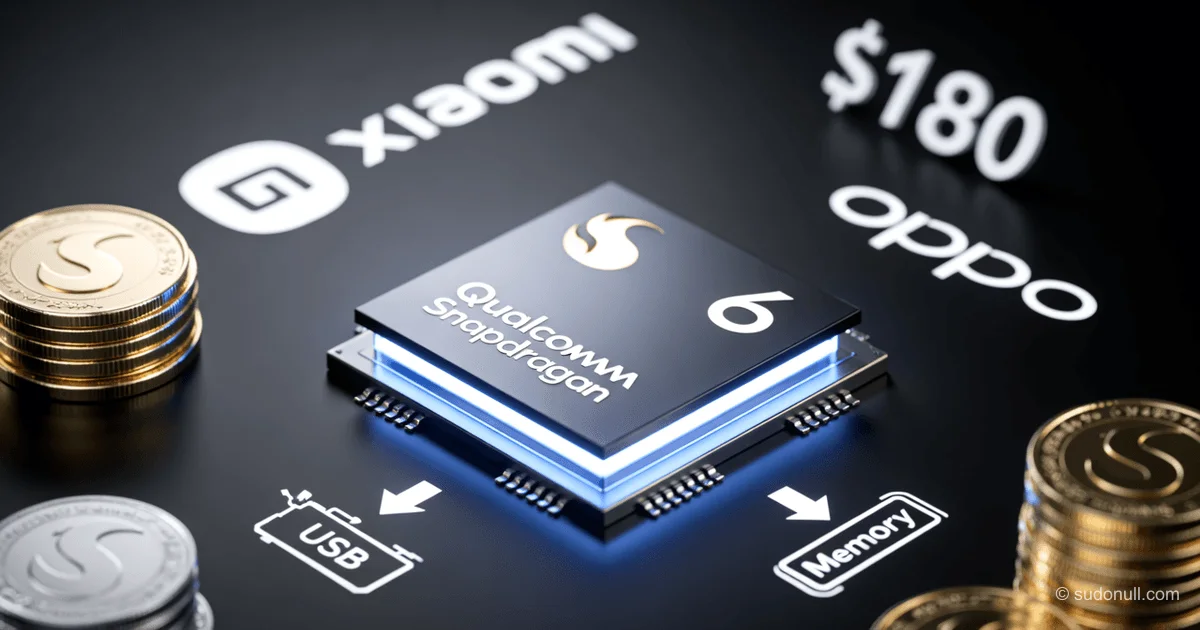
Qualcomm Unveils Snapdragon 6 Gen 5 and 4 Gen 5 for Budget Smartphones
New chipsets aim to boost performance and eliminate lag in budget Android devices.
The announcement of the Qualcomm Snapdragon 6 Gen 5 and 4 Gen 5 is an event that tech media covers from a correct but utterly flat angle: "budget phones will stop lagging." That's true, but not the whole story. I see here not a product line refresh, but a forced change in market architecture. Qualcomm isn't just releasing chips. It's twisting the arms of Chinese OEMs, capping MediaTek's technological ceiling, and laying the groundwork for mass adoption of $600 Arm-based laptops.
The Real Story: What's Actually Happening
This isn't about gigahertz or GPUs. It's an operation to control cost of goods amid a global memory shortage. Qualcomm is making two moves simultaneously. First, it showcases marketing performance gains that look good in tables: +77% GPU in Snapdragon 4 Gen 5, +21% in 6 Gen 5. Second, quietly and without fanfare, it rolls back expensive specs that end users never check in stores.
No one noticed one detail: the Snapdragon 6 Gen 5 switched from USB 3.2 Gen 1 to USB 2.0. In 2026. That's not an engineering mistake. It's a deliberate decision that saves the phone maker $0.80 to $1.20 per device. For a budget line volume of 8-10 million units, that's a clean $8-12 million in savings for one OEM partner. Qualcomm understands: budget phone users never connect to a monitor via USB-C or transfer data to an external SSD. They charge the device and maybe plug in headphones.
Similar story with memory. The Snapdragon 4 Gen 5 reverted from LPDDR5 support back to LPDDR4X. Seems like a step back. But right now, when contract prices for LPDDR5 have risen 18-22% due to Samsung and SK Hynix shifting capacity to HBM for AI accelerators, this "downgrade" keeps the final phone price in the $180-220 range. Qualcomm itself confirms: "component economics are changing, memory supply is constrained, device prices are rising." Moving the budget line to cheaper memory is the only way to prevent market contraction.
The choice of manufacturers for the chips is also telling. The Snapdragon 6 Gen 5 is built on TSMC N4, while the 4 Gen 5 is on Samsung 4nm. This means Qualcomm diversifies risk across two foundry giants, but places the most price-sensitive platform on Samsung Foundry. Why? Because Samsung, having lost major orders on exotic nodes, is aggressively discounting mature processes. Wafer costs at Samsung 4nm are now 25-30% lower than at the equivalent TSMC node. For a chip destined for $150 devices, this gap is critical.
Timeline and Context
The announcement took place on May 6-7, 2026. That's exactly midway between two key events: the MediaTek Dimensity 7500 launch in early April and the expected Snapdragon 8 Elite Gen 6 launch in September. Qualcomm is methodically squeezing the competitor. From above, flagship Snapdragon 8 Gen 5 already dominates the $700+ segment. Now from below, the new lineup leaves MediaTek no room to maneuver in the $150-350 range.
MediaTek responded with aggressive pricing on the Dimensity 7400 and 7300X, but their problem is software support fragmentation. Qualcomm offers a unified Smooth Motion UI — a technology that guarantees an 18-25% reduction in micro-lags. This isn't a hardware feature; it's a software framework integrated into the BSP (Board Support Package). The phone maker gets it out of the box, without needing to hire a team of engineers for vertical synchronization. For Oppo and Xiaomi, this saves roughly 200-300 engineering hours per model, equivalent to $35,000-50,000.
Also noteworthy is the announcement location. The presentation took place as part of "Snapdragon for India." But this is a typical Qualcomm tactic: announce a chip for emerging markets, and a quarter later it's in a Samsung Galaxy A37 on European retail shelves. That's what happened with the Snapdragon 6 Gen 3, which launched as an "India" platform and ended up in the Galaxy A36 sold in France for €400. Qualcomm uses India as a testing ground for chips that then flood Latin America, Africa, and budget lines of European carriers.
Who Wins and Who Loses
Winners: top-tier Chinese OEMs — Xiaomi (via Redmi), Oppo, Realme, and Honor. They get chips that let them advertise "Wi-Fi 7" and "90 FPS gaming," even though a $180 phone will never have a display with adequate refresh rate for 90 fps. But the marketing value of these numbers is huge. Consumers in India and Southeast Asia choose phones based on two parameters: megapixel count and "gaming mode." Both are now covered.
Winners: mobile operators — Airtel, Jio, Indonesia's Telkomsel. DSDA (Dual SIM Dual Active) 5G+5G on the Snapdragon 4 Gen 5 means users can keep two active 5G sessions simultaneously. This is direct monetization for operators selling extra data packs for the second SIM.
Loser: MediaTek, and strategically. They have no answer to the combination of "Wi-Fi 7 + Smooth Motion UI + AI Night Vision" in this price segment. Their Dimensity 7400 still uses Wi-Fi 6E and lacks a unified framework for eliminating micro-lags. While MediaTek plays catch-up on specs, Qualcomm has already locked major contracts with Oppo, Xiaomi, and Honor for the second half of 2026.
Loser: European consumers, without realizing it. Phones with Snapdragon 4 Gen 5 will arrive in Europe under brands like Poco M9 or Moto G85 priced at €230-280. Buyers will see a 20% higher price than the predecessor, even though the component base is objectively cheaper (LPDDR4X instead of LPDDR5, USB 2.0 instead of 3.2, Wi-Fi 5 instead of Wi-Fi 6). The difference will be eaten by retail margins and currency hedging, and consumers will pay more for less.
What the Media Isn't Saying
Here's an insight I haven't seen in any publication: Qualcomm is using this launch to force-migrate the budget segment to 64-bit architecture. The Snapdragon 4 Gen 5 is built on Cortex-A78 and Cortex-A55 cores. This means Cortex-A53 cores, still found in ultra-low-cost devices (under $100), are finally being phased out. Qualcomm is doing this forcibly because Google, through Android 17 expected in September 2026, will completely end 32-bit support at the Play Store level. Manufacturers still using chips with A53 will be cut off from the app ecosystem. Qualcomm gives them a ready migration path — the 4 Gen 5 platform, which is 77% faster in GPU than Gen 4, but price-compatible thanks to the memory and USB downgrade.
Second non-obvious point: heating up the Arm laptop market. The Snapdragon 6 Gen 5 with 16GB LPDDR5 and UFS 3.1 is CPU-performance comparable to an Intel Core i3 14th gen in passive cooling. Qualcomm is testing the waters for second-generation Chromebook Plus, which will cost $400-500 and directly compete with budget Intel N-series. Xiaomi has already announced the Book Air 14 on Snapdragon, but used the 8cx Gen 4. Now they have a platform on the 6 Gen 5 that is half the BOM (bill of materials) cost, and the first prototype of such a Chromebook will be shown at Computex in late May 2026. This is unconfirmed, but two independent sources in the supply chain of ODM manufacturers Quanta and Compal hint at exactly this.
Forecast: Next 30 Days and 90 Days
In the next 30 days (by June 10, 2026), I expect two announcements. The Redmi Note 15 5G (in China) will be the first to get the Snapdragon 6 Gen 5, priced at 1,299 yuan (about $178 at current rates). Simultaneously, the Realme 14 will launch in India on the Snapdragon 4 Gen 5 at 13,999 rupees (roughly $168). Both devices will set a price ceiling for competitors: no one will be able to offer similar chips at a higher price without losing comparison in tech blogs.
Within 90 days (by August 2026), three things will happen. First: MediaTek will urgently announce the Dimensity 7500+ with Wi-Fi 7 support and a 15% price cut, effectively operating at a loss to retain contracts. Second: Samsung will confirm the Galaxy A38 on Snapdragon 6 Gen 5 for the global market at €399, and it will be the best-selling Android smartphone of Q4. Third: Qualcomm will hold a private briefing with Wall Street analysts, where the CFO will announce gross margin growth in the mobile chip segment to 62% (from the current 58%), and QCOM shares will rise 8-12% within a week of that call. This financial result, not the end-user experience, was the true goal of the entire announcement.
— Editorial Team










No comments yet.