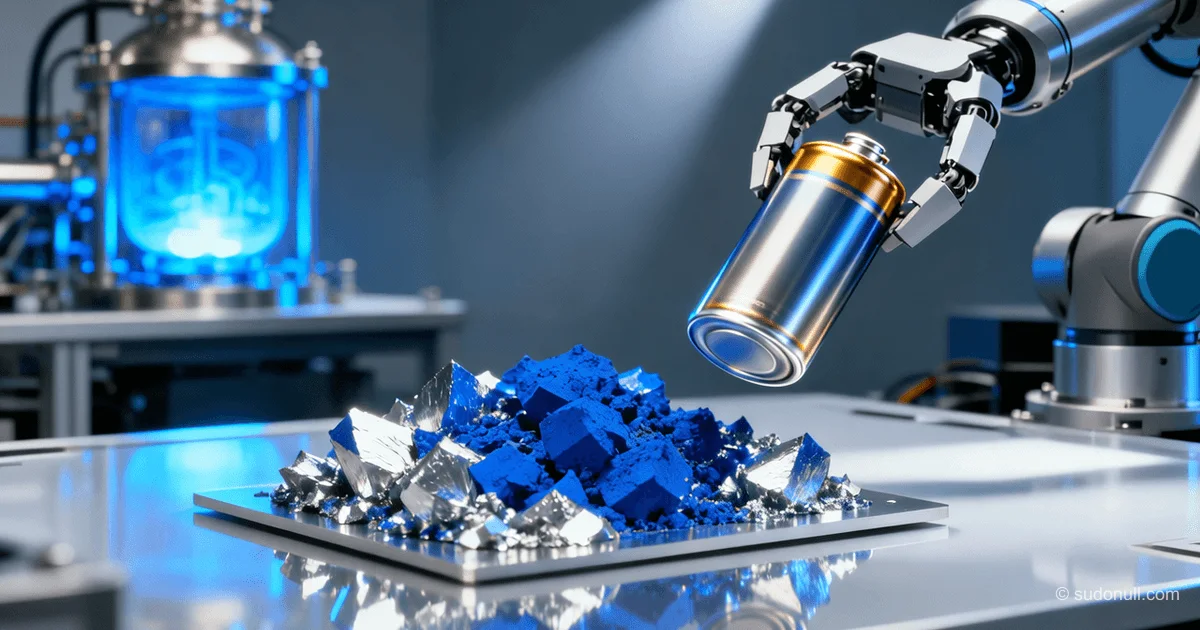
Rosatom Creates Material That Increases Battery Capacity by 15%
An improved lithium cobalt oxide for high-power batteries in portable electronics and aerospace has been developed.
The news about Rosatom's new cathode material at first glance looks like a routine laboratory development. However, in the current geopolitical and market context, this event has implications far beyond the chemical formula. It is not just about improving performance, but about an attempt to forcefully enter a market valued at tens of billions of USD and tightly controlled by Chinese manufacturers.
The Essence: What Is Really Happening
Formally, scientists at Rosatom Chemistry (a structure within TVEL JSC) synthesized high-voltage lithium cobalt oxide with an altered crystal shape and adjusted chemical composition, achieving an increase in battery energy density of more than 15%. But the essence of the event lies in its economic and political background.
Lithium cobalt oxide (LiCoO2) is a classic, the most widespread cathode material for consumer electronics. Its market is a mature, low-margin commodity market. Why would Rosatom, a company with a capitalization comparable to global nuclear giants, enter this segment? The answer lies in supply chain control. Russia has reserves of lithium (Kolmozerskoye deposit) and cobalt. Until now, the country exported raw materials and imported finished cathode materials with a 300-500% markup. Developing a closed loop "from ore to electrode" allows the margin to be redistributed within the state corporation's perimeter.
This is not a scientific breakthrough in solid-state physics. It is an engineering and technological market capture.
Timeline and Context
The announcement was made on May 7-8, 2026, through the TVEL press service. Prototypes of the modified lithium cobalt oxide have been handed over for qualification to potential customers as part of test battery cells. This means the technology has passed the "test tube" stage and is at the pilot industrial scaling stage.
Context is important. The global lithium-ion component market is overheated. Lithium hydroxide prices are volatile. China, which controls about 70% of global cathode material production, uses this as a leverage tool. For Russia, which is accelerating import substitution in critical industries, dependence on imported cathode materials was an Achilles' heel. Rosatom is methodically building a complete vertical: from lithium mining to battery recycling. This technology closes the last critical link—the synthesis of a high-performance cathode.
Who Wins and Who Loses
Winners:
- TVEL JSC and Rosatom as a whole. They gain not only the domestic market (state orders for aerospace and military equipment) but also an export product with high added value for friendly countries. The claimed +15% energy density is a strong marketing argument.
- Russian manufacturers of portable electronics and power tools. They gain access to world-class components without currency risks and logistics costs. A smartphone or drill with such a battery will work 2-3 hours longer with the same weight.
- Aerospace industry. For drones and satellites, reducing battery weight by 15% while maintaining power is critical. This provides either greater payload or longer flight time.
Losers:
- Chinese cathode manufacturers (Shanshan Technology and the like). They lose not only the Russian sales market (now closed by domestic production) but potentially the markets of Central Asia, where Rosatom can export products with political support.
- Traditional importers. Companies that made money reselling Chinese cathode materials lose their business.
What the Media Are Not Saying
Here is a non-obvious insight: Rosatom is not so much competing with China on quality as it is escaping "cobalt slavery" through voltage control. Most research worldwide today focuses on reducing cobalt content (NMC, NCA) due to its high cost and ethical mining issues. Rosatom, having access to cobalt from domestic sources, bet on increasing the charge voltage.
Changing the crystal shape and composition allowed raising the operating voltage without destroying the structure. This means the same volume of material now stores more energy (formula: Energy = Capacity × Voltage). This is a cheap way to gain an increase without adding mass of expensive lithium raw materials and complex doping additives.
The second insight is the connection with nuclear energy. The technology for producing lithium cobalt oxide involves high-temperature synthesis. Rosatom has an abundance of cheap electricity from nuclear power plants, which accounts for up to 40% of the synthesis cost. Competitors in Europe pay several times more for electricity, making the Russian material potentially cheaper at comparable quality.
Forecast: Next 30 Days and 90 Days
Next 30 days (June 2026):
I expect the completion of qualification tests. There will be no surprises—the material will confirm the stated characteristics. Rosatom Chemistry will issue a press release about successful tests, and one of the large enterprises (likely in the defense or aerospace sector) will be named as an anchor customer.
Next 90 days (August-September 2026):
An investment program for the construction of an industrial synthesis plant with a capacity of several thousand tons per year will be announced. Investments will amount to about 50-70 million USD. In parallel, Rosatom will start negotiations on supplies with India and Vietnam, offering a comprehensive solution: raw materials + synthesis technology + finished cathode. This is not just a sale of material, but an export of a technological platform, which is a long-term strategy to win loyalty in emerging markets.
Within a year, the development will become the standard for all Russian Li-Ion batteries, and Rosatom will transform from a raw material donor into a serious player in the battery materials market, with potential revenue in this segment of up to 200 million USD by 2028.
— Editorial Team










No comments yet.