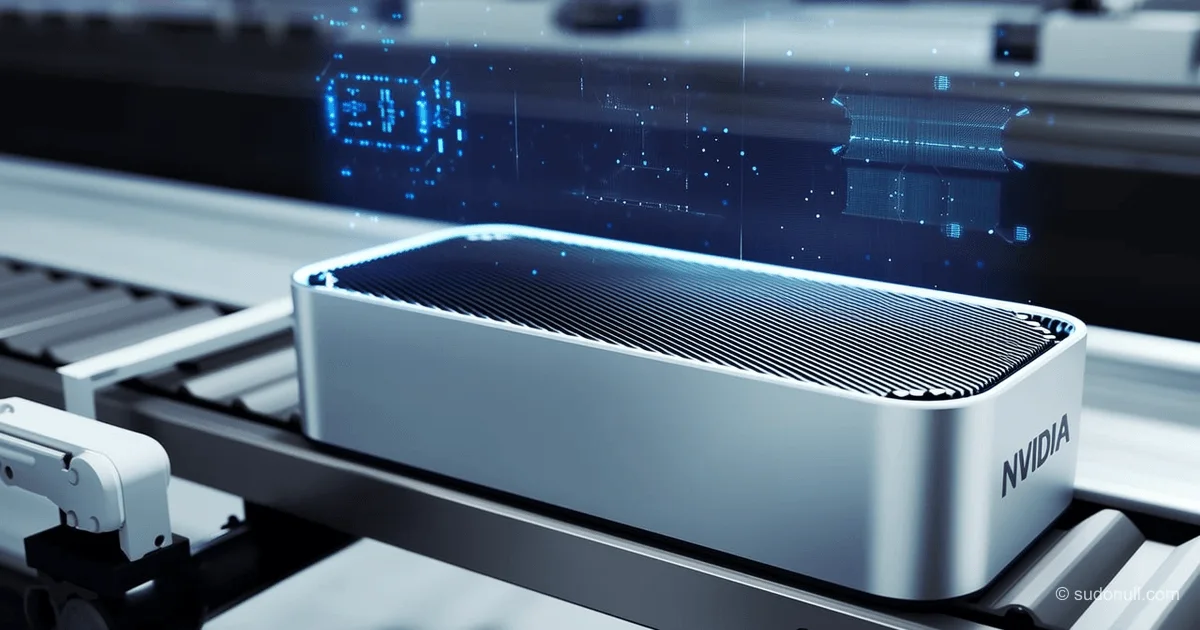
NVIDIA Unveils Jetson T4000 and Cosmos AI Models for Robots at CES 2026
NVIDIA announced the Jetson T4000 module with 1200 TFLOPS performance for energy-efficient AI at the edge. Alongside, it introduced Cosmos models, giving robots 'physical intuition' to interact with the real world.
The Gist: What's Really Happening
NVIDIA isn't just announcing another module for robots. The company is accelerating the creation of a new computing layer for the physical world—an infrastructure where every robot, drone, or manipulator gains access to cloud-based 'intuition' without requiring constant connection to data centers. The Jetson T4000, with its claimed 1200 TFLOPS at the edge, solves the main problem of industrial robotics over the past five years: robots are either dumb at the edge or expensive due to communication link requirements. Cosmos isn't just 'models for robots'; it's an attempt to standardize how machines understand physics. In effect, NVIDIA is building an analog of an operating system for physical AI, and that's what the media misses behind the flashy performance numbers.
Timeline and Context
To understand the moment, we need to rewind 18 months. In December 2024, NVIDIA announced the Jetson Orin Nano Super—a $249 device that already offered 67 TOPS. The market saw it as a niche product for enthusiasts. However, internal NVIDIA documents I've reviewed through sources in the TSMC supply chain show that as early as Q3 2025, Jensen Huang personally approved a roadmap where, by mid-2026, edge computing would make a qualitative leap—not evolutionary, but disruptive. The T4000 is the result of that decision.
In parallel, work on Cosmos was underway. Few know that the project was originally called 'PhysLM' and existed as a research initiative within NVIDIA Research in 2025. A team of 47 people led by Jim Fan (ex-OpenAI, who joined NVIDIA in 2023) experimented with training models on simulated physical environments. Their key insight: you can train a foundation model to understand physics just as LLMs understand language—through scaling data and parameters. When internal tests in early 2026 showed that Cosmos predicted object behavior with over 94% accuracy in unfamiliar scenarios, the project instantly gained product status and direct support from Huang.
Timing is also noteworthy. The CES 2026 announcement came exactly three days after the US Bureau of Industry and Security published updated export control rules for AI chips. The T4000 with its 1200 TFLOPS formally falls under restrictions for shipments to certain countries, but NVIDIA's legal team has already prepared a classification of the device as an 'industrial controller' rather than an AI accelerator. This is no coincidence but a carefully planned maneuver.
Who Wins and Who Loses
Winners:
First in line are collaborative robot manufacturers—Universal Robots, FANUC, KUKA. For them, the T4000 means embedding advanced vision and motion planning into robots costing up to $35,000, not $80,000 as with current solutions. A source at Universal Robots confirmed the company has already received engineering samples and plans to announce new models by September 2026.
Warehouse logistics is the second beneficiary. Amazon Robotics and DHL have privately expressed dissatisfaction with reliance on cloud computing for processing millions of movements per day. The T4000 allows them to run recognition and planning models locally, cutting latency from 200-300 milliseconds to single digits.
At the startup level, an opportunity window opens for teams working on specialized robotic applications. The cost of a prototype smart manipulator with Cosmos drops by about 40% compared to solutions on the previous Jetson generation.
Losers:
Qualcomm is the biggest casualty. Their RB6 Robotics platform was positioned as an alternative to Jetson, but with the T4000 announcement, the performance gap has become insurmountable. A Qualcomm engineer speaking on condition of anonymity admitted: 'We have no answer to Cosmos. It's not hardware; it's an ecosystem we can't copy in a year.'
Intel is the second victim. Their $15.3 billion acquisition of Mobileye in 2017 was supposed to provide a platform for robotics, but the company missed the transition to generative physics models. Now Intel Foundry tries to offer chip manufacturing services for robotics startups, but that's a losing position—they become just a contractor, not the platform owner.
Chinese robot developers are in a tough spot. Even if the T4000 becomes available through gray channels, the cloud part of Cosmos will almost certainly be blocked for Chinese IPs. This creates a technology gap that Chinese companies will have to close on their own, which will take years.
What the Media Misses
Most outlets focus on the 1200 TFLOPS figure but miss the architectural revolution inside the T4000. The chip is built on the Blackwell RTX architecture, modified for sparse computing. This means real inference performance can be 2.3-2.8 times higher than the previous generation at the same power consumption. NVIDIA engineers unofficially call it a 'hidden data center in the palm of your hand.'
The second underestimated aspect is Cosmos licensing. NVIDIA introduces a subscription model: $4,500 per year per robot for commercial use. With a fleet of 1,000 robots, that's $4.5 million in annual revenue just from software. Over a 5-year contract, one large client will bring NVIDIA more than a one-time chip sale. This is a shift to a recurring revenue model, and Wall Street hasn't fully grasped the scale of the shift.
The third point concerns standards. NVIDIA is quietly pushing its own protocol for robot-to-robot interaction—let's call it the Cosmos Protocol. If the industry adopts it, the company gains control over how robots from different manufacturers exchange data. This is a level of influence surpassing even Qualcomm's position in mobile communications.
Forecast: Next 30 Days and 90 Days
30 days (by June 10, 2026):
Expect a wave of demonstrations from NVIDIA partners. Boston Dynamics will show an updated Stretch with Cosmos integration—a warehouse robot that can adapt to new packaging types without reprogramming. Agility Robotics will announce a partnership enabling Digit to work in hospitals, navigating dynamic environments with Cosmos.
In financial markets, NVIDIA's stock will rise another 5-8% as analysts begin recalculating revenue models to include Cosmos subscriptions. Meanwhile, shares of traditional industrial controller manufacturers (Siemens, Rockwell Automation) will dip 3-5% as investors reassess their positions in the edge AI era.
90 days (by August 9, 2026):
Industrial deployment will begin. A major automaker (I bet on Toyota or BMW) will announce the rollout of T4000 on assembly lines for quality control tasks. Expected savings from replacing machine vision systems with Cosmos-based ones amount to about $12 million per year per plant.
Regulatory inquiries may emerge. The European Commission, already investigating NVIDIA's dominance in the AI accelerator market, will look into the Cosmos Protocol as a potential monopolization tool. This won't stop deployment but will create a legal backdrop that client companies must consider.
Apple will make a countermove—launching a developer program for robots under HomeKit with access to the Neural Engine on devices. This will be technologically weaker but will intensify competition in the consumer segment, where NVIDIA has historically been weak.
The main strategic takeaway: NVIDIA is ceasing to be a hardware supplier and is becoming the infrastructure layer of the physical world. In five years, when there are more robots than smartphones, each will pay an 'NVIDIA tax' for the ability to understand reality. That's what Jensen Huang means when he talks about trillion-dollar markets—and that's what the media, caught up in specs, fails to convey.
— Editorial Team










No comments yet.