Neural Network Learns to Take Control of a Human Hand
A technology has been developed that allows artificial intelligence to control limb movements, opening up prospects in prosthetics.
The news that a neural network has learned to control a human hand sounds like science fiction, but it's actually a project by students at the Massachusetts Institute of Technology that raises questions far beyond a hackathon. While headlines shout about futuristic prosthetics, the real story is how a team of enthusiasts built a platform over a weekend that can bypass human consciousness to execute commands from a commercial language model.
The Gist: What's Really Happening
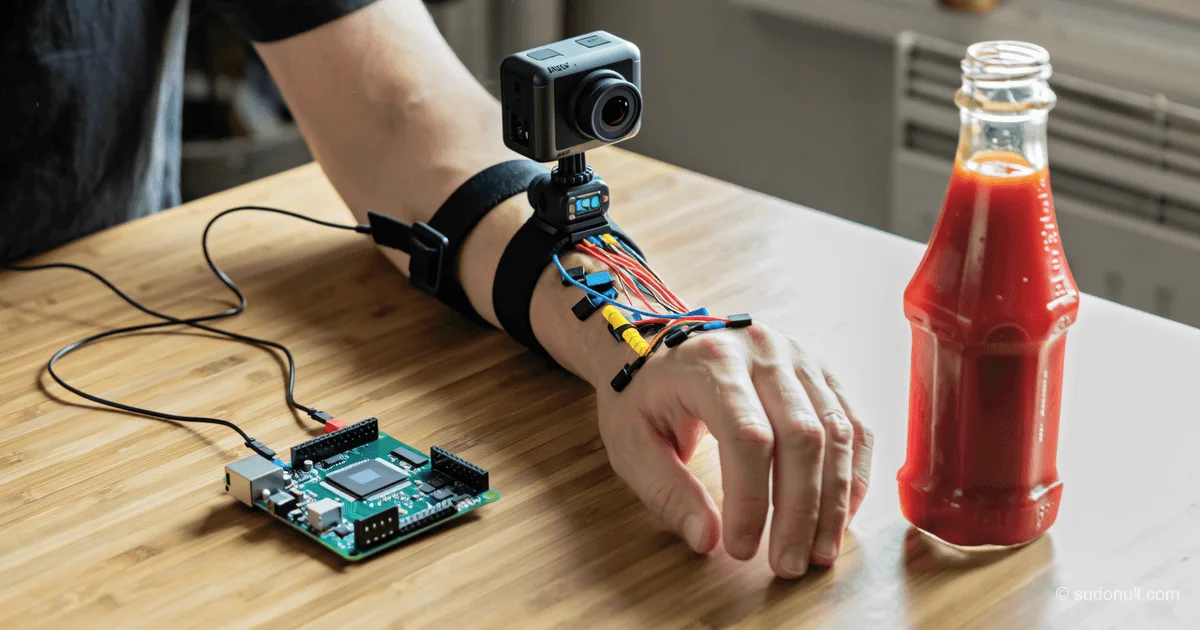
Technologically, the "Human Operator" project is a prototype wearable device that uses electrical muscle stimulation (EMS) to make a human hand move according to commands from Anthropic's multimodal neural network, Claude. The system consists of a head-mounted camera, a microphone for voice commands, an Arduino-based controller, and a set of electrodes. The user asks a question or gives a command, the camera takes a snapshot of the environment, the neural network analyzes the context and decides what movement to make, and then the microcontroller generates electrical impulses that cause the necessary muscles to contract.
What actually happened was a demonstration of a fundamentally new model of human-AI interaction—not through an interface, not through text, but through direct control of the body. In demonstrations, the students showed the system making a hand wave hello, play the piano, and even mix drinks. This is no longer an assistant that advises, nor a tool that executes commands—it's an agent that takes control of the human body. Albeit for now in the form of a student prototype.
Timeline and Context
The project was created by a team of six MIT students participating in the HARD MODE 2026 hackathon and took first place in the "Learn Track" category. Information was published on GitHub and on the Human Operator project website. The demonstration took place in early May 2026.
The choice of neural network is no coincidence. Claude from Anthropic is positioned as a model focused on safety and ethics, yet it was used for a project that inherently raises serious ethical questions about voluntariness and control over the body. This creates a certain paradox in the technology's positioning.
It's important to understand the context: alongside this project, two related directions are developing, painting completely different pictures of the future. On one hand, serious scientific work on real prosthetics—researchers at Chalmers University are implanting electrodes directly into nerves to control prosthetic legs. On the other, Elon Musk's Neuralink, which has raised $650 million USD in investments at a valuation of $9 billion USD, implants chips in paralyzed patients, allowing them to control drones, robotic arms, and play video games with their thoughts.
Who Wins and Who Loses
The Human Operator project is an open-source student prototype, so it's too early to talk about direct commercial beneficiaries. But strategically, the direction of wearable robotics as a whole wins. The cost of developing such systems is decreasing, the availability of components is increasing, and cloud neural networks provide computing power that researchers could only dream of a decade ago.
Rehabilitation technologies come out ahead—similar electrical stimulation systems are already used for patients with spinal cord injuries, showing improvements in hand function and strength. Lowering costs and simplifying integration with AI could accelerate the development of affordable rehabilitation devices.
Those who invested in complex, expensive, and invasive solutions, believing that cheap alternatives wouldn't appear for another decade, lose out. Neuralink, despite its $9 billion USD valuation, may face unexpected competition not from other implant manufacturers, but from wearable devices with a smart software layer. Why drill through the skull and risk glial scarring if basic functionality can be achieved with skin electrodes and a well-crafted prompt?
What the Media Isn't Saying
The first non-obvious insight: Human Operator is not so much a prosthetics project as a demonstration that modern language models are capable of somatic control without specialized training. Claude was not created to control muscles. It's essentially a text-and-vision model. Yet its multimodal capabilities were enough to, upon seeing the environment through the camera and hearing a command, make a decision about a motor response. This means the barrier between "AI for text" and "AI for body control" is blurring faster than expected.
The second insight, which no one is discussing: this is a mirror version of the usual human-computer interface. Previously, humans gave commands to machines. Now, machines give commands to humans. For now, it looks like a fun trick—playing a melody on the piano or making an "OK" gesture in response to a philosophical question about what it's like to have a body. But the system architecture allows for scaling. Camera, neural network, Arduino, electrodes—these are basic, accessible components.
The third point: Human Operator is built on the multimodal Claude model with a video camera. This means the AI doesn't just execute a program—it sees the environment, interprets context, and decides on a movement. In the example shown, the user asks, "What's it like to have a body?" and the neural network makes their fingers form an "OK" sign. This is not a programmed response to a keyword; it's the model interpreting the question and choosing a gesture. Architecturally, this is closer to an autonomous agent than a remote control.
Forecast: Next 30 Days and 90 Days
In the next 30 days, the Human Operator project will go viral in the GitHub community. Student teams in different countries will start forking it and experimenting with different language models. Versions on GPT-4.1, Grok, and Gemini will appear. This will spark a discussion in the AI safety community about whether multimodal models should be allowed to control the human body, and if so, under what conditions.
Within a 90-day horizon, one of the major medical device manufacturers (likely Medtronic or Abbott) will announce a partnership with language model developers to create a "smart" rehabilitation platform. It won't be a direct copy of Human Operator, but architecturally similar: wearable sensors and stimulators connected to a cloud AI that adapts therapy in real time based on visual context and patient history.
The boldest but well-founded prediction: by the end of 2026, the first commercial version of a device for fine motor skills (e.g., for musicians recovering from a stroke) will appear, based on the same "camera + neural network + EMS" architecture. The device price will be around $3,000–4,000 USD—several times cheaper than traditional robotic rehabilitation systems, which currently cost from $40,000 USD.
The main strategic takeaway: the boundary between AI that advises and AI that acts through our body has just become thinner. Human Operator is a student project that doesn't aim for commercialization. But it has shown that the door is open, and it can no longer be closed. The only question is who will enter first, and with what intentions.
— Editorial Team










No comments yet.