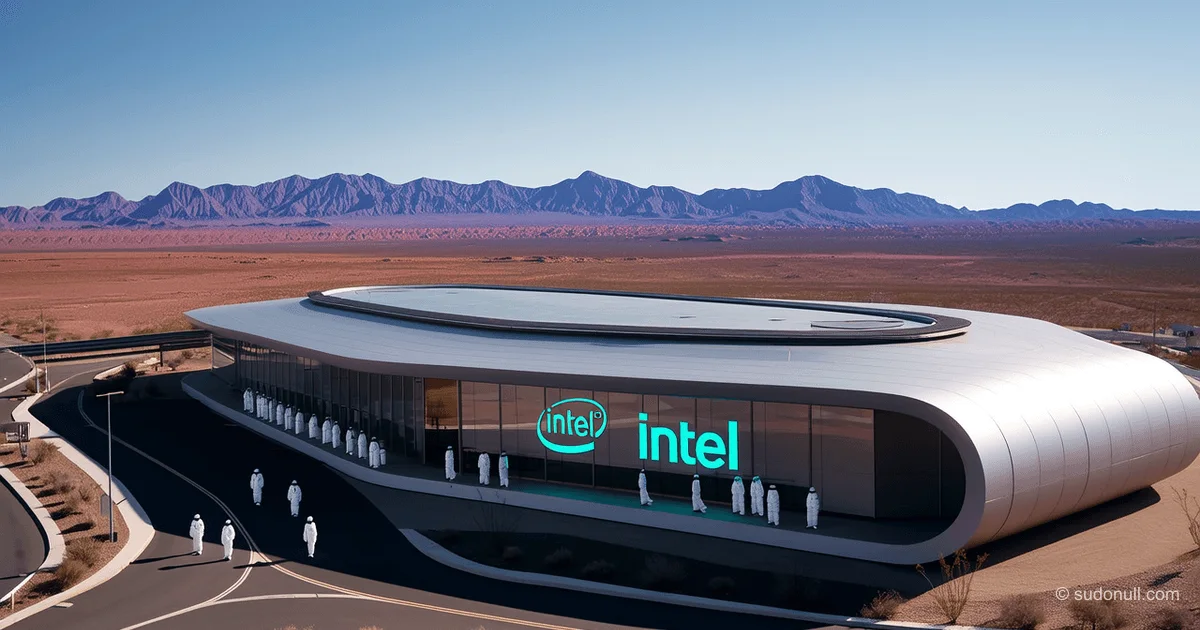
Intel Reaches Chip Manufacturing Agreement with Apple
Intel and Apple have signed a preliminary deal under which Intel will manufacture some chips for iPhones. Talks intensified with the involvement of the U.S. government, which seeks to diversify supply chains.
The Gist: What's Really Happening
The Apple-Intel deal isn't just about diversifying supply chains—it's the result of a tectonic shift in global semiconductor geopolitics. The U.S. government, which became Intel's largest shareholder with a roughly 10% stake after injecting about $9 billion in federal subsidies, now directly influences the global chip market configuration. Commerce Secretary Howard Lutnick has spent the past year methodically meeting with Tim Cook, Elon Musk, and Jensen Huang, urging them to place orders at American fabs.
The results are now evident: Nvidia has already invested $5 billion in Intel, Musk chose 14A for his Terafab, and now Apple has signed a preliminary agreement. Intel isn't the tech giants' market choice—it's a political one. But that doesn't make it any less real. For Tim Cook, it's a forced yet rational move: when you have to explain to investors at two consecutive quarterly conferences that iPhone sales are constrained not by demand but by TSMC's inability to produce enough chips, finding a second supplier becomes a matter of survival.
Timeline and Context
The story began long before the Wall Street Journal's May 9, 2026, publication. Talks had been ongoing for over a year, and in recent months, the parties agreed on formal terms. As early as September 2025, reports emerged that Intel was discussing not only contract manufacturing with Apple but also potential investments in its business. In November 2025, analyst Ming-Chi Kuo predicted that Intel would manufacture chips for iPad Pro and entry-level MacBook Air.
The market reacted instantly. On May 9, Intel shares surged 14% to $124.92—an all-time high, surpassing dot-com era records from 2000. In the 13 months since CEO Lip-Bu Tan's appointment, the company's market cap grew nearly 600%, from about $18 to $124.92 per share. Meanwhile, TSMC shares in Taipei fell 1.5%, while competitors' stocks—Samsung, SK Hynix, SMIC—rose.
Asian exchange dynamics are telling: Samsung jumped 5.7%, SK Hynix 11.2%, SMIC 5.4%, and MediaTek 8.8%. The market is betting on a scenario where TSMC's monopoly crumbles, opening opportunities for second-tier manufacturers.
The technical details of the agreement remain undisclosed. It's unknown which specific chips Intel will produce. But sources point to 18A-P—an enhanced version of the Intel 18A process, delivering roughly 9% higher performance at the same power consumption compared to the base version. Apple is expected to place orders for entry-level M-chips in 2027 and non-pro iPhone processors in 2028. Separately, it's reported that Apple received Intel's design kit for 18A-P evaluation, and the secret "Baltra" chip may use Intel's proprietary EMIB packaging.
Winners and Losers
Winners:
Intel gets the grand prize it never had in the contract business: an anchor customer with guaranteed demand for years to come. Apple sells over 200 million iPhones annually—even a fraction of that volume turns Intel Foundry from a loss-making experiment into a business with predictable utilization. Lip-Bu Tan gains a trump card to attract more clients: "Apple trusts us."
Intel shareholders are already winning. A 14% one-day gain and nearly sixfold market cap increase in 13 months transform the company from an underdog into the semiconductor market's biggest growth story.
Apple wins strategically. First, pricing leverage: according to Wccftech, Intel 18A wafers cost 25% less than TSMC 2nm wafers. Second, Apple can finally diversify production, reducing reliance on Taiwan risk. Third, access to additional capacity solves the chip shortage that, as Cook admitted, is already constraining iPhone sales.
The U.S. government wins politically. The scheme works: federal subsidies to Intel return as contracts from tech giants, production returns to Arizona, and America gains a cutting-edge foundry business on its soil.
Losers:
TSMC loses its status as Apple's sole supplier of advanced chips, a position held since 2015. The company's shares have already fallen, but the long-term consequences are more severe. As TechNews notes, the era of "one-horsepower" in contract manufacturing is ending, giving way to three-way competition among TSMC, Intel, and Samsung.
Taiwan's economy receives a worrying signal. Local lawmakers are already discussing measures to "protect the silicon shield," and political commentators acknowledge that TSMC's golden age of monopoly is over. For an island whose strategic security was built on the indispensability of advanced chips, this is a geopolitical shock.
Samsung finds itself in an ambivalent position. On one hand, its shares rose on the news, and talks with Apple on May 5, 2026, suggest a chance to secure some orders. On the other, Intel is clearly pulling ahead in the race to become the second supplier, while Samsung's $17 billion Taylor, Texas fab hasn't even started mass production.
What the Media Isn't Saying
Most coverage focuses on political motives and financial metrics but misses a critical technical risk. Intel 18A is a problematic process. In 2025, reports emerged that its yield fluctuates in the range of just 55-65%. For comparison, TSMC launches processes at yields of at least 80-85%. This means Intel's cost per working chip may be higher than the promised 25% wafer savings—defects eat away the price advantage.
A second underestimated aspect is the conflict of interest within Apple itself. The company spent nearly a decade building Apple Silicon as a unique advantage over the Intel world. The shift from x86 to ARM in 2020-2023 was positioned as liberation from Intel. Now Apple returns to Intel—not for architecture, but for manufacturing. This puts marketing in a tough spot: how to explain to consumers that an Intel-made chip is no worse than a TSMC-made one, when for ten years the opposite was claimed.
A third nuance concerns specific products. The most likely candidates for Intel production are not flagship iPhone Pros but entry-level models. This mirrors the 2015 strategy: Apple then placed some A9 orders with Samsung, and instantly a "chipgate" scandal erupted—users found differences in power consumption between versions. Apple learned its lesson: this time, risky products will go into the least consumer-visible niches—iPad Pro, entry-level MacBook Air, non-pro iPhones.
Finally, few discuss that Nvidia has already become an Intel client. The $5 billion investment isn't a portfolio allocation but payment for future custom data center processors. Combined with Apple and Musk, this creates a customer pool that could keep Intel's fabs busy for years. But these three clients are direct AI competitors: Apple is developing its own data center chips, Nvidia dominates the AI accelerator market, and Musk is building Terafab for X.AI. Intel will have to serve three rivals simultaneously, guaranteeing design confidentiality for each—a task TSMC handled for years, and not always flawlessly.
Forecast: Next 30 Days and 90 Days
30 Days (through June 10, 2026):
A wave of analyst reports from investment banks is expected, revising Intel's target prices. The stock is already at all-time highs, and analysts will justify further growth based on the Apple contract's potential. Insider information about specific products Intel will make for Apple may emerge.
TSMC will hold a series of closed investor meetings, trying to calm the market. The company will likely emphasize that its capacity remains fully utilized and that Apple will continue placing its main orders for advanced processes with TSMC.
Samsung will intensify talks with Apple. Given that the May 5 meeting already took place, leaks about a potential deal could surface in the coming weeks. Samsung is keen not to be left out of the race for Apple orders.
90 Days (through August 9, 2026):
Intel will publish its quarterly report, providing the first opportunity for CEO Lip-Bu Tan to comment publicly on the Apple deal. If data on 18A-P yields emerge by then, the market will get key numbers to assess the venture's realism.
Apple's technical team will complete evaluation of Intel's PDK and deliver a verdict: whether test production can start in 2027. This decision determines whether real order transfers begin or the agreement remains a political declaration.
The U.S. government may announce additional incentives for Apple—likely through the Advanced Manufacturing Fund, which already finances TSMC Arizona. If Apple invests comparable sums in Intel fabs, it will signal long-term partnership.
Key strategic takeaway: what began as a political project is turning into the largest reconfiguration of the semiconductor industry since the outsourcing revolution of the 2000s. Intel's success will determine whether TSMC remains an indispensable monopolist or the world returns to a multipolar chip manufacturing model. But one thing is already clear: the era of "one fab for all" is over.
— Editorial Team










No comments yet.