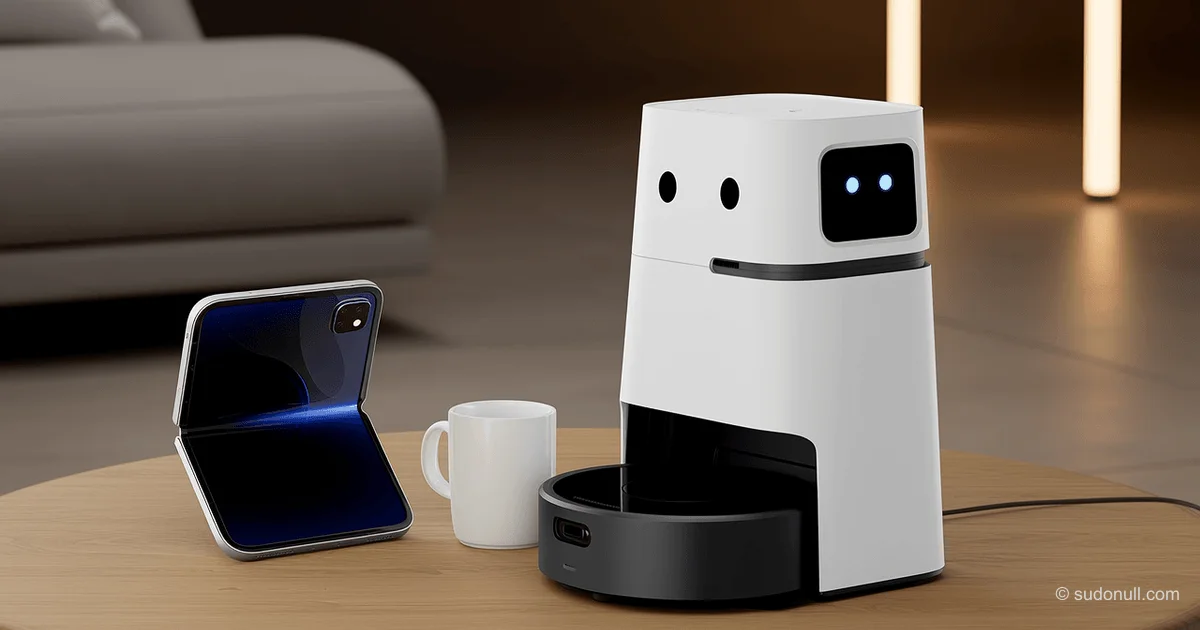
Apple Prepares Its Biggest Device Launch Ever: Foldable iPhone and Home Robot
According to Bloomberg, after the CEO change in fall 2026, Apple will unveil more than 10 new product categories. Key new products include a foldable iPhone priced from $2,000 and a home robot.
The Gist: What's Really Happening
When Mark Gurman reports that Apple has more than ten new product categories ready to launch after the CEO change, a superficial view sees diversification — the company is looking for new revenue sources beyond the iPhone. In reality, a far more fundamental shift is underway: Apple is redefining the very concept of the ecosystem, transforming it from a set of devices centered around the phone into a distributed intelligent environment that accompanies the user everywhere — in their pocket, on their face, in their room.
John Ternus, who officially becomes CEO on September 1, 2026, is not just another executive. He is a career engineer who rose from product designer to head of hardware, the person who personally oversaw the transition to Apple Silicon and the development of the foldable iPhone. He will be the one on stage presenting the iPhone Fold — a product he has led since the first prototypes. Tim Cook is handing over not a crisis, but a detailed roadmap of ten product categories, making this moment unique: never in Apple's history has a CEO change been accompanied by such a dense schedule of hardware launches.
But what the headlines about the $2,000 foldable iPhone and home robot miss is that these devices are not isolated gadgets. Apple is building an Ambient Computing Environment — a computing environment where products create synergy rather than competition. The foldable iPhone becomes a bridge to the era of flexible displays, smart glasses become a channel for Apple Intelligence without needing to pull out a phone, and the home robot becomes a physical avatar for Siri, capable not just of answering but of acting.
Timeline and Context
The story of this massive launch began long before the April Bloomberg article. Back in fall 2024, reports emerged that Apple had shifted some engineers from the Vision Pro project to develop a foldable device — the first signal that the company was seriously pursuing flexible displays. In November 2024, Korean sources confirmed that Apple had entered a formal development process with display manufacturers.
The turning point came in January 2026 at CES, when Samsung showed a prototype OLED display with no visible crease. Journalists from Stuff noted: "The crease is invisible when viewed from the front. It becomes visible when tilted, but it's a quantum leap compared to the Galaxy Z Fold 7." According to industry sources, this display will form the basis of the iPhone Fold.
By April 2026, the picture became clear. On April 21, Apple officially announced Ternus as CEO effective September 1. Two days later, Gurman revealed the scale of the upcoming launch — ten categories, including a foldable iPhone, smart glasses, several smart home devices, a robot, and wearables. On May 7, insider Instant Digital on Weibo reported that the iPhone Fold had already entered trial production at Foxconn factories.
Meanwhile, the smart home line was developing in parallel. Project J595 — a desktop robot with a manipulator, screen, and deeply revamped Siri — has appeared in Apple documents since 2025. It is positioned as a "virtual companion" capable of tracking the user's movement around the room, engaging in conversations, offering solutions, and even physically moving objects. Initially planned for a 2027 launch, technical difficulties may push it to 2028.
Important context: Apple is simultaneously accelerating its own AI strategy. Unlike competitors betting on cloud chatbots, the company integrates Apple Intelligence directly into devices, making AI not a separate service but a property of the hardware itself. This is fundamental: each of the ten categories is not just a gadget but a carrier of Apple's intelligent environment.
Who Wins and Who Loses
Winners:
Samsung Display — the main beneficiary at the supply chain level. The South Korean company is the supplier of foldable OLED panels for the iPhone Fold, and a contract of this scale could offset slowing sales of Samsung's own foldable devices. If Apple sells 3-5 million units in the first year (analyst Ming-Chi Kuo's forecast), it would bring Samsung Display around $400-600 million in display revenue alone.
Foxconn — the second beneficiary. The launch of trial production for the iPhone Fold at their facilities confirms their status as Apple's main manufacturing partner for the most complex devices. The contract to assemble the foldable iPhone, with its unique precision and reliability requirements, is a multi-billion dollar order for years to come.
Consumers in the Apple ecosystem will get something they never had: the ability to unfold a phone into a mini-tablet with a 7.8-inch screen without losing compatibility with iMessage, FaceTime, Apple Pay, and the entire service infrastructure. Smart glasses will provide an interface to Apple Intelligence without needing a bulky headset like the Vision Pro. And the home robot could finally make Siri truly useful — not just answering questions but interacting with the physical world.
Losers:
Samsung Mobile finds itself in a difficult position. The company has dominated the foldable segment for seven years, but now faces a competitor with the resources to perfect the technology. When Apple releases a foldable iPhone with a display where the crease is "almost invisible to the naked eye," arguments for the Galaxy Z Fold become much weaker.
Meta gets a direct competitor in the smart glasses market. Ray-Ban Stories were virtually the only product in this niche with a recognizable brand; now Apple is preparing a response with integration into its ecosystem, which for iPhone users could be a decisive factor.
Amazon and Google lose initiative in the smart home. Echo Show and Nest Hub have dominated the home display segment for years, but Apple's HomePad with Apple Intelligence and HomeKit integration could attract the most affluent audience. Especially if Apple implements facial recognition via HomeKit for security cameras — a feature competitors don't offer with the same level of privacy.
Amazon will also face competition in the home robot segment. Amazon's Astro project was met with lukewarm reception, but Apple's robot priced around $2,000 with a manipulator and emotional intelligence could redefine expectations for the entire category.
What the Media Isn't Saying
Most publications focus on device specs but miss a fundamental shift in Apple's business model. Cook built the most successful service ecosystem in history — iCloud, Apple Music, Apple Pay, Fitness+, TV+ generate tens of billions in annual revenue. But services depend on devices as entry points. Ten new categories are not just about finding a replacement for the iPhone; they create ten new types of relationships with users through which subscriptions can be sold.
The second aspect the media avoids is the price of risk. Launching ten categories in a compressed timeframe puts enormous strain on supply chains, engineering teams, and retail networks. Given that the foldable iPhone is already facing "complex issues" according to Nikkei Asia, and the robot may be delayed until 2028, Ternus risks starting his tenure with a series of delays. Investors accustomed to Cook's operational perfection may react nervously.
The third underestimated fact is the synergy between smart home and wearables. Apple isn't just releasing disparate gadgets: HomePad, security cameras, and the robot form a unified system of Apple's physical presence in the home, while glasses and AirPods with cameras extend that presence outdoors. Essentially, Apple is building an infrastructure where the user is always in contact with its AI — not through a single device but through an environment. This is more ambitious than anything competitors have attempted, including Amazon with its ambient computing concept.
Finally, the price. The foldable iPhone costing between $2,000 and $2,500 (depending on estimates) positions it not as a mass-market product but as an ultra-premium gadget, directly competing with the Huawei Mate XT Ultimate. This signals that Apple is not chasing Samsung in the $1,000 foldable segment but creating a new price category where it will have no competitors.
Forecast: Next 30 Days and 90 Days
30 Days (until June 10, 2026):
WWDC 2026 will be the platform for the first serious hint at new devices. I expect Apple to show elements of iOS 27 optimized for a foldable display — apps that change interface when unfolded, new gestures for a large screen. There will be no direct hardware announcements, but developers will be made to understand that the ecosystem is preparing for devices with fundamentally different aspect ratios.
Meanwhile, suppliers will ramp up activity. Foxconn will increase trial production volumes, and analysts like Barclays will update price forecasts. Apple's stock may see moderate growth on expectations, but the main movement will be in supplier stocks, especially Samsung Display and TSMC.
Tim Cook will hold his last major public event as CEO at WWDC, and his speech will be closely analyzed for signals about the future.
90 Days (until August 9, 2026):
The main event of this period is preparation for the September presentation. In the weeks leading up to the announcement, leaks will become torrential: we'll see real photos of the devices, learn exact specs for cameras, batteries, and displays. If the iPhone Fold is indeed unveiled on September 8 as expected, August will be the month of final PR campaign assembly.
At the same time, component shipments for the HomePad — a screen-equipped device expected to be the first among home novelties in fall 2026 — will begin. This will test Apple's ability to simultaneously launch products from completely different categories.
On the corporate front, August is Cook's last month as CEO. Expect a series of farewell interviews and publications summing up his 15-year tenure, further fueling attention to the brand ahead of the biggest launch in company history.
Strategic conclusion: Apple enters the Ternus era not with a defensive strategy but with the most ambitious product line expansion since Jobs' return in 1997. The success or failure of this strategy will determine whether the company remains the world's most valuable by 2030 or cedes ground to those better at navigating the transition from the smartphone era to the ambient computing era. The bet is on engineering excellence and ecosystem synergy — classic Apple approach, but on a scale the company has never achieved before.
— Editorial Team










No comments yet.