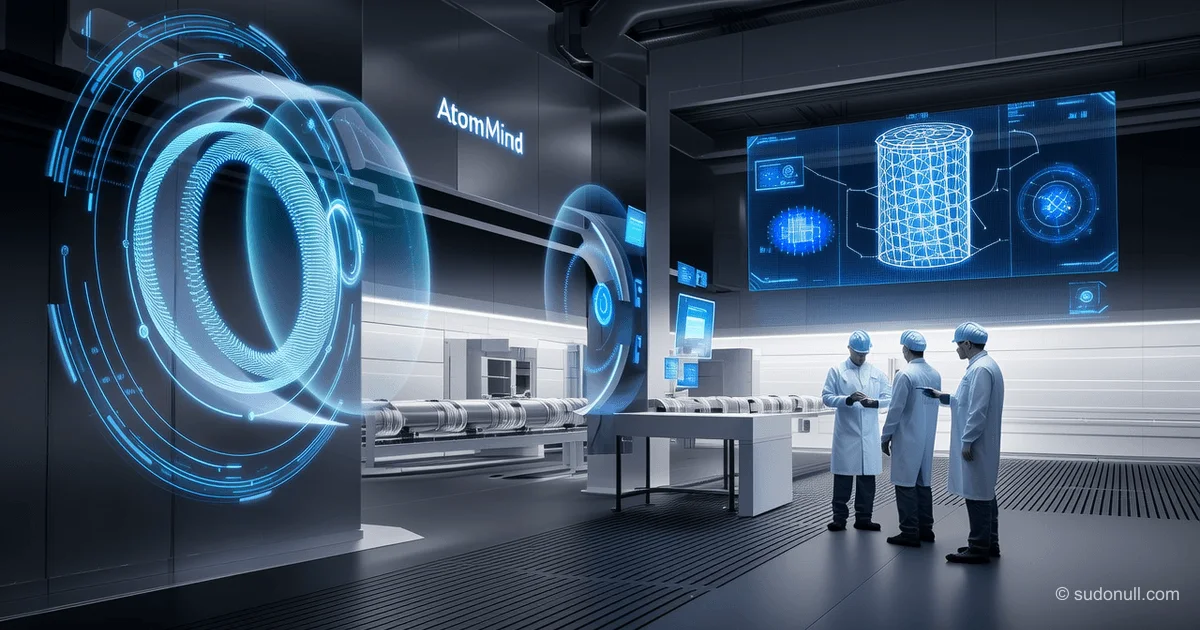
Rosatom and IT Developer Create Unified Industrial AI Platform AtomMind
The fuel division of Rosatom has signed a strategic partnership agreement to develop a predictive analytics platform. The new environment will allow enterprises to manage AI solutions within a secure perimeter.
The Essence: What Is Really Happening
Behind the partnership between Rosatom and Industry Soft Solutions is not just technological cooperation, but a strategic shift from import substitution of basic software to expansion in the industrial AI market. The state corporation has completed the "digital sovereignty" phase — achieving 100% import substitution for critical information infrastructure objects and creating the certification system "KII-Sert". Now Rosatom is packaging its accumulated experience into the AtomMind product and bringing it to the external market.
The key non-obvious detail is not the technical architecture of the platform, but the mechanism of its creation. AtomMind was originally an in-house development for quality control at Fuel Division plants — the system predicted defects in zirconium rolling. Now an external private developer has joined its development. The parties are forming a "unified technological perimeter for industrial AI". The product, born as an internal automation tool, is turning into a commercial platform. This is a classic model for capitalizing on in-house IT solutions: first fine-tune it on yourself, then sell it to others. The status of a "particularly significant project" and state co-financing from RFRIT open access to budget funds.
Timeline and Context
The current announcement builds on multi-layered preparatory work. In March 2026, Rosatom updated its Unified Digital Strategy until 2027. The central point is "a multiple increase in the number of projects using artificial intelligence technologies across all business areas" and an almost quarter increase in investment in Russian software. A month later, in April, at the IIPROM-2026 conference, Rosatom representatives announced plans to "accelerate the delivery of AI services and AI agents to the production landscape" and to form a unified digital infrastructure platform.
The partnership agreement was signed on May 7-8, 2026. AtomMind is evolving from a predictive analytics tool into a "unified platform operating environment". While version 1.0 solved local tasks on specific equipment, the new platform enables enterprises to independently develop, deploy, and manage multiple AI solutions from a single center. The release is scheduled for the end of 2026.
A parallel process is the mass import substitution of ERP systems. By March 2026, 150 organizations in the nuclear industry had been migrated to 1C:ERP, and by 2027, more than 80 additional enterprises will be connected. This forms a potential customer base for AtomMind within the state corporation's perimeter.
Who Wins and Who Loses
Winners:
TVEL JSC and Rosatom gain a double benefit: the external developer takes on the creation of a commercial product, while the state corporation becomes both a co-author, anchor customer, and beneficiary of sales to third-party clients. The system is already included in the register of domestic software of the Ministry of Digital Development, providing preferences in government procurement.
Industry Soft Solutions gains a strategic customer and a testing ground for refining technologies on real production data from the nuclear industry. As noted by the company's CEO Alexey Akulov, Rosatom's requirements "set a high bar for the entire market." After successful implementation in the nuclear industry, sales to mechanical engineering, metallurgy, and chemical industries become significantly easier.
Industrial enterprises from regulated industries receive a platform with built-in protection for restricted information. For plants with CII requirements, this eliminates the need to independently build a secure AI perimeter.
Losers:
Foreign suppliers of industrial AI platforms are finally losing the Russian market in segments with high security requirements. The platform with architectural CII protection and domestic software status creates an insurmountable barrier for solutions not localized to Russian legal requirements.
Alternative Russian developers of industrial AI face a competitor with a combination of factors unavailable to independent startups: administrative support from a state corporation, access to real plant production data for model training, government funding, and guaranteed internal demand.
What the Media Are Not Saying
Most publications focus on the platform's functionality but miss a fundamental point: Rosatom is becoming an IT vendor in the external market. This is a qualitative shift — from a consumer and customer of software to a supplier of commercial digital products. The state corporation already offers external clients "data center services and other digital products." The industrial AI platform is the next step in this logic.
The second underestimated aspect is the synergy with the import-substituted ERP. AtomMind does not exist in a vacuum: a potential customer base of hundreds of enterprises on a domestic ERP system creates a unique environment for rapid scaling. The model effectively copies the strategy of global vendors like Siemens, which for decades built ecosystems of engineering software around industrial controllers. The difference is that Rosatom uses regulatory requirements as a lever for market penetration.
The third nuance is the pace. From the announcement of the platform's transition to an enterprise-level solution to the promised release is less than 8 months. Given that the new version involves creating a "unified enterprise AI asset management center," such timelines seem ambitious. Likely, a significant portion of the components already existed within Rosatom's perimeter and are now being integrated into a unified shell.
Forecast: Next 30 Days and 90 Days
30 days (until June 10, 2026):
I expect clarification of plans for external sales. Given the mention of RFRIT, the parameters of state support — amounts, timelines, and conditions for obtaining — may be announced soon. The companies will also reveal the roadmap for the new release's functionality, with an emphasis on capabilities for mechanical engineering and the fuel and energy sector.
Within Rosatom's internal perimeter, adaptation of enterprises to the new platform environment will begin. Given the scale of the state corporation, approval of internal regulations and staff training will be required.
90 days (until August 9, 2026):
A series of pilot projects at external enterprises is likely — candidates may include fuel and energy companies with data security requirements. In parallel, Industry Soft Solutions will intensify hiring of developers and data scientists to accelerate release preparation.
By autumn, the first feedback from test customers will appear. If the platform confirms its claimed ability to work with "small data" and ensure solution replicability, this will become a qualitative differentiator from competitors. Most industrial AI systems require large datasets for training, whereas real production environments often lack sufficient data.
The main strategic conclusion: the partnership around AtomMind is an indicator of the maturity of the Russian industrial software market. The transition from import substitution of basic infrastructure (ERP, OS, DBMS) to creating proprietary intelligent platforms for production means that the industry is covering a path that took global competitors decades. The success or failure of this model will show whether Russian state corporations can become full-fledged IT vendors, not just technology consumers.
— Editorial Team









No comments yet.