Thinking Machines Lab Unveils AI Models for Real-Time Interaction
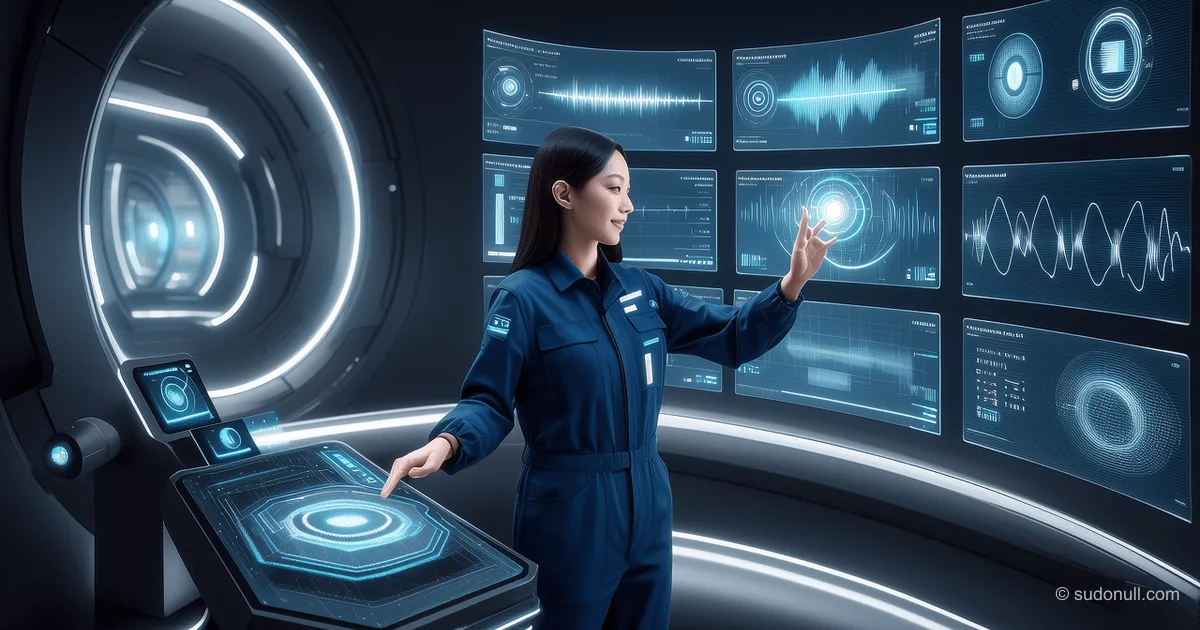
Mira Murati's startup Thinking Machines Lab has released interaction models capable of native full-screen audio and video in real time. A demonstration showed synchronous translation, web search, and multi-person collaboration without lag.
Thinking Machines: How Mira Murati Rewrites the Rules, Making Latency AI's Biggest Enemy
What's Really Happening
Mira Murati's Thinking Machines Lab has just unveiled a working prototype of "interaction models" — and this is not just another multimodal system. It's a fundamental rethinking of how AI perceives time and human presence. All current models, from GPT-4o to Gemini, operate in a step-by-step mode: the user sends a request, the system thinks, then responds. In between, the model is blind and deaf. Murati calls this the "straitjacket of the interface" that humans have to adapt to.
TML-Interaction-Small is a 276-billion-parameter mixture of experts (12 billion active parameters) that processes audio and video in 200-millisecond chunks while simultaneously generating a response. The turn-switching latency is 0.40 seconds, compared to 0.57 for Gemini-3.1-flash-live and 1.18 for GPT-realtime-2.0. The system can interject into a conversation uninvited, notice a visual cue (a coding error, a person entering the frame), and react — all without external speech recognition modules like Whisper.
But speed isn't the main thing. The main thing is the architectural shift: interactivity has become a property of the model, not of the software wrapper. It's the difference between a car with a bicycle bell bolted on and a car designed around the driver.
Timeline and Context
The story of Thinking Machines is a chronicle of the biggest talent war in Silicon Valley history.
February 2025: Mira Murati, former CTO of OpenAI and architect of ChatGPT, announces the founding of Thinking Machines Lab. OpenAI co-founder John Schulman and several key researchers leave with her.
July 2025: The company raises the largest seed round in history — $2 billion at a $10-12 billion valuation. Andreessen Horowitz, NVIDIA, Accel, ServiceNow, Cisco, and AMD participate.
August 2025: The Wall Street Journal reports that Mark Zuckerberg personally tried to buy Thinking Machines. After being refused, Meta poached over a dozen of its roughly 50 employees.
October 2025: Launch of Tinker, a platform for fine-tuning open-source models. Early users include research groups from Princeton, Stanford, and Berkeley.
January 2026: A low blow. Three co-founders — Barrett Zoph, Luke Metz, and Sam Schoenholz — return to OpenAI. Murati publicly states she fired Zoph for "unethical behavior." A subsequent Wired investigation reveals undisclosed personal relationships between Zoph and a female executive. OpenAI disputes Murati's characterization in an internal memo.
March-April 2026: Thinking Machines strikes back. The company poaches Soumith Chintala, creator of PyTorch from Meta, and appoints him CTO. Simultaneously, a strategic agreement is signed with NVIDIA to deploy at least 1 gigawatt of Vera Rubin systems. Industry experts estimate the cost of such infrastructure at $500 billion. The partnership with Google Cloud based on GB300 is also expanded.
May 2026: The climax. Thinking Machines demonstrates interaction models, proving that six months of talent losses did not halt development.
Winners and Losers
Winner: Meta — the least obvious beneficiary. Zuckerberg gained access to key Thinking Machines developers without buying the company. Soumith Chintala, creator of PyTorch, is now Murati's CTO, meaning the PyTorch ecosystem remains dominant at Thinking Machines, indirectly benefiting Meta.
Loser: OpenAI. Losing Schulman and the talent drain to Murati forced the company to spend resources on counter-poaching. The return of Zoph and Metz is a victory, but a Pyrrhic one. OpenAI had to publicly justify hiring an employee with a reputational shadow. Worse: Thinking Machines created a product that directly attacks OpenAI's flagship interface — ChatGPT's voice mode.
Loser: Google. Gemini-3.1-flash-live, announced as a breakthrough in real-time interaction, is already outdated on paper. 0.57 seconds vs. 0.40 is the difference between "almost like a human" and "human."
Winner: NVIDIA. Jensen Huang continues to masterfully hedge his bets. NVIDIA is an investor in OpenAI, Thinking Machines, and Anthropic. Whoever wins the AI model race, chips are bought from Santa Clara. The 1-gigawatt Vera Rubin agreement means that even if Thinking Machines doesn't take off as a business, NVIDIA already has orders for years to come.
What the Media Isn't Saying
Insight One: The Peripheral Play No One Talks About. The entire Thinking Machines presentation revolves around low-latency voice and video. But the real economic significance of interaction models lies not in call centers but in industry. A model with an embedded sense of time can monitor a production line, a surgical operation, or a chemical experiment and intervene without being asked — simply by noticing an anomaly. Currently, this requires separate computer vision systems that can't talk. Thinking Machines unifies this in a single architecture. If the product reaches enterprises, it will replace not chatbots but a whole class of industrial safety SCADA systems. That's a market worth about $80 billion, which all startup reviews ignore.
Insight Two: The Reproducibility Problem. External speech encoders like Whisper can be swapped, changing recognition quality. But in Thinking Machines' architecture, there are no encoders — audio goes directly as a dMel spectrogram through a lightweight embedding. This means the model cannot be "fixed" by replacing a component. If it hallucinates on certain accents or dialects, the entire system must be retrained. For corporate customers, this poses a vendor lock-in risk on a scale that OpenAI never dreamed of.
Insight Three: Financial Pyramid or New Intel? The pattern where NVIDIA invests in AI startups, and those startups spend the raised money on NVIDIA chips, reminds some analysts of the late-90s internet bubble. But there's a crucial difference: telecom companies in 1999 laid fiber that no one was using. Thinking Machines is building data centers for existing demand — orders are already in, capacity is needed now. It will become a bubble only if the AI services market collapses, but for now valuations are rising. $12 billion for a company without a public product is aggressive, but eight months before the interaction model demo, the valuation was already at that level.
Forecast: Next 30 Days and 90 Days
30 days (by mid-June 2026). Thinking Machines will open limited access to a research preview for select partners. Most likely candidates: Redwood Research (already worked with Tinker), Stanford, and Princeton. I expect independent tests to confirm the 0.4-second latency but reveal issues with multilingualism — the architecture was trained mostly on English, and performance on Asian languages with different pause structures will be worse.
Meanwhile, competitors will ramp up. OpenAI will almost certainly announce an update to GPT-realtime with reduced latency — likely down to 0.5-0.6 seconds. Google will try to counter by integrating Gemini with the Android ecosystem at Google I/O, traditionally held in May.
90 days (by mid-August 2026). This is a critical period for Thinking Machines as a business. The company has spent at least $200-300 million on infrastructure and salaries since its founding (130 employees, many of whom are ex-OpenAI with compensation packages of $2-5 million per year plus signing bonuses). If no paying corporate clients emerge outside the research community within 90 days, talk of a new funding round will begin.
Industrial safety will be the first market. Thinking Machines must sign at least one major contract with a Fortune 500 manufacturer — a partnership with Siemens or Rockwell Automation, whose production management systems need real-time monitoring, seems logical.
The most important event on the 90-day horizon is Meta's decision. After Zuckerberg failed to buy the company and then poached part of the team, he has two options: either fully copy Thinking Machines' architecture for Llama 5, or propose a new deal, this time hostile. Given that Soumith Chintala is now Murati's CTO and knows Meta's internal workings, I'd bet on copying.
In the end: Thinking Machines went from idea to product in 16 months, beating OpenAI and Google's flagship systems on the key parameter of the future — reaction time. Whether Murati can turn a technological advantage into a sustainable business is a question for the next three months. But one thing is already clear: the era of making AI wait is ending.
— Editorial Team









No comments yet.