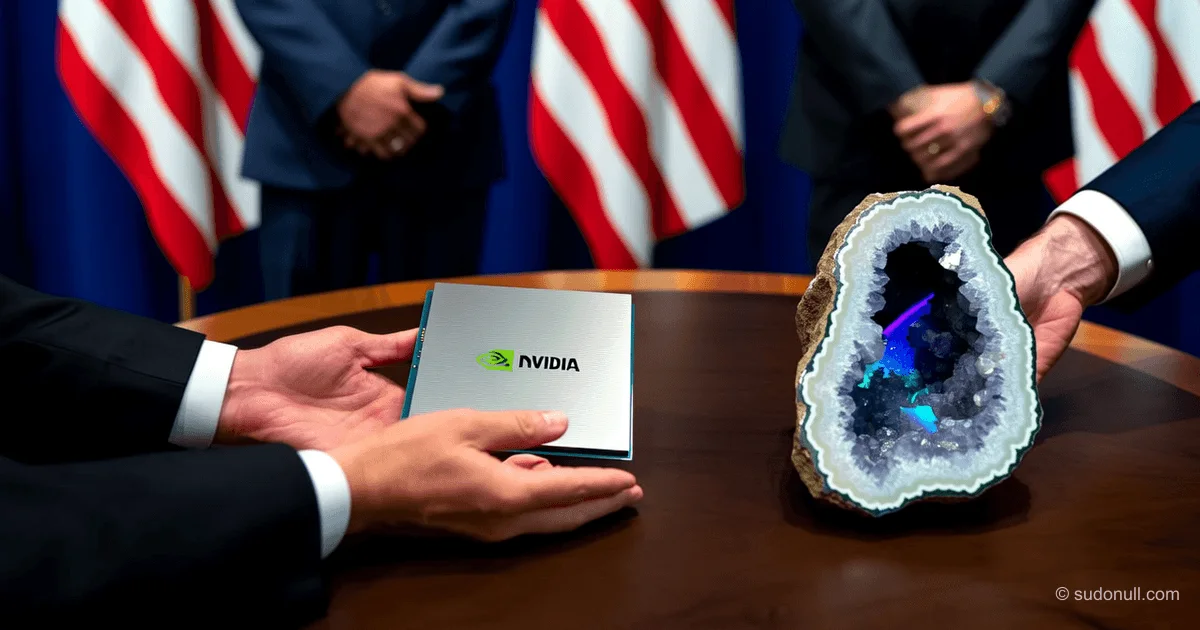
US and China Begin Key Talks Amid Threat of New Chip Sanctions
A two-day US-China summit kicked off in Beijing, with semiconductor export controls and rare earth metal supplies as central themes. NVIDIA CEO Jensen Huang expressed a desire to join the talks due to the high stakes for the AI industry.
US and China in Beijing: Why the Leaders' Summit Is Not Negotiations but a Grand Semiconductor Bargain
The Essence: What's Really Happening
On May 12, 2026, US President Donald Trump arrived in Beijing for a two-day summit with Chinese President Xi Jinping. Formally, the agenda looks like standard diplomatic ritual—trade, technology, Taiwan, the Iran conflict. But in reality, something else is unfolding. We are witnessing the first time in history that two superpowers have sat down at the negotiating table armed not just with arguments but with mutual economic weapons: the US with advanced AI chips, China with rare earth metals. This is not diplomacy; it is hostage swapping at the highest level.
The key signal came a week before the summit. NVIDIA CEO Jensen Huang stated at the Milken Institute conference that China will not get access to Blackwell and Rubin chips. A categorical "no" from the CEO of a company that was still fighting for the Chinese market not long ago is worth billions of dollars in market capitalization. But Huang added something more important: he would be happy to represent the US at the summit in Beijing, but he was not invited. This is not a technical detail—it is a demonstration of who really controls technology policy. Not the company, but the state. Huang, in effect, publicly acknowledged that private business in AI chips is no longer an independent player; it is an instrument of national strategy.
Timeline and Context
To understand what is happening in Beijing, we need to rewind two years.
April 2025: China imposes export restrictions on rare earth metals for the first time, immediately disrupting supply chains for the US aerospace and automotive industries. Washington realizes for the first time: control over chips is worthless if the opponent controls the materials from which those chips are made.
October 2025: The first trade truce, signed in Seoul. China slightly eases restrictions on rare earths, the US partially relaxes export controls. But both sides understand this is only a delay.
January 2026: The US Department of Commerce changes licensing policy, opening a limited opportunity to export NVIDIA H200 to China. A gesture Beijing considered an insult: the H200 is a previous generation, while Blackwell and Rubin remain banned.
February-March 2026: Chinese AI companies, cut off from access to advanced NVIDIA chips, begin a mass transition to Huawei Ascend. DeepSeek V4, unveiled on April 24, already runs on Ascend 950, not H200. This is a trigger: Washington realizes sanctions have not slowed Chinese AI—they have created a market for a Chinese chip maker.
May 2026: On the eve of the summit, Anthropic reports intercepting over 16 million attempts to "distill" its AI models by Chinese labs. This becomes a formal pretext for a tough US stance. Meanwhile, China's trade surplus with the US reaches $87.7 billion since the start of the year—a figure that makes Trump's position at the talks extremely awkward.
Who Wins and Who Loses
NVIDIA wins—paradoxically. The ban on exporting Blackwell and Rubin to China deprives the company of its largest market, but in return, NVIDIA becomes an indispensable strategic asset for the US. The state will protect its interests by all available means, including diplomatic pressure and subsidies. Huang understands this and is therefore so demonstratively loyal.
Huawei wins. The ousting of NVIDIA from the Chinese market has paved the way for Ascend. The DeepSeek deal with Huawei for Ascend 950 is just the beginning. Other Chinese tech giants are already in talks to purchase Huawei chips. The irony is that US sanctions created a market for Huawei that the company could not have won in fair competition.
Boeing wins—if the deal in question goes through. China is considering an order for 500 737 MAX aircraft plus additional wide-body jets. The potential contract value exceeds $60 billion. This is not just a commercial deal; it is a bargaining chip in the trade for chips and rare earths.
US aerospace and automotive companies lose—if the rare earth agreement is not renewed. The current pact, as a US official confirmed, "remains in force," but its future is uncertain. Any disruption in rare earth supplies will immediately impact production of the F-35, electric vehicles, and wind turbines.
Anthropic loses. The company detected 16 million distillation attempts of its models, but this is just the tip of the iceberg. Each successful distillation reduces the technological gap that is Anthropic's only competitive advantage. The Beijing summit may end with agreements on "rules of the game" in AI safety, but no rules will stop industrial espionage.
Retail investors in the semiconductor sector lose. The PHLX Semiconductor Index recently posted its biggest 25-day rally since the dot-com bubble. Any careless word at the summit—about sanctions, Taiwan, or rare earths—could crash stocks faster than an entire earnings season.
What the Media Isn't Saying
Insight one: The real goal of the summit is not an agreement but managed escalation. Analysts widely predict "no breakthroughs," but this is not a miscalculation—it is a strategy. Both sides benefit from a state of controlled conflict. The US maintains technological dominance; China gets justification for mobilizing resources toward import substitution. The real disaster for both sides is not escalation but premature resolution, which would remove the need for urgent investment in their own technologies.
Insight two: 16 million distillation attempts are not an attack but a test of defenses. The figure provided by Anthropic is presented as evidence of aggressive espionage. But 16 million attempts, spread over months, with zero publicly confirmed successful distillations, is more like mapping the boundaries of defenses. Chinese labs are methodically figuring out which queries are blocked, which get through, and where the weak points are. This is not theft—it is reconnaissance by fire, and reconnaissance that the US side cannot stop without cutting off public access to the models altogether.
Insight three: The Boeing deal is not business but insurance against war. The Chinese order for 500 aircraft is being discussed not because China Eastern urgently needs to expand its fleet, but because multi-billion dollar commercial contracts are the only working de-escalation mechanism. The more US money is tied to the Chinese market, the harder it will be for Congress to push through new sanctions. Buying planes is buying political lobbying in Washington at China's expense.
Insight four: NVIDIA has officially become a geopolitical weapon, and Huang knows it. When a CEO states that a certain country "should not get" his product, he ceases to be a businessman and becomes a politician. This is a new quality: the head of a tech corporation publicly formulates US foreign policy on semiconductors. NVIDIA is no longer just a supplier—it is part of the military-industrial complex, and there is no way back to the status of a neutral global seller.
Forecast: The Next 30 Days and 90 Days
30 days (through mid-June 2026). The summit will end without breakthroughs but also without disasters—this is the outcome markets are pricing in as the baseline. An extension of the trade truce until November 2026 will be announced, possibly with some adjustments. China will agree to large purchases of agricultural products and energy, but the Boeing contract will remain unsigned—the sides will continue to "work out technical details." The US will confirm that current restrictions on AI chips remain in place, but no new sanctions will follow.
The rare earth agreement, which the US has already confirmed as active, will be informally extended without formal announcements—to avoid creating the impression that Washington is making concessions.
In the markets, the PHLX semiconductor index will correct 3-5% after the summit—not because of bad news, but because of the removal of uncertainty, which paradoxically had supported valuations with expectations of a "grand deal."
90 days (through mid-August 2026). The moment of truth arrives. If China truly transitions to Huawei Ascend for domestic AI projects, US sanctions become meaningless. The market will closely watch DeepSeek V5 and other Chinese models—if they achieve parity with US counterparts on domestic chips, that will be a turning point.
I expect NVIDIA will privately begin lobbying for sanctions relief—not for Blackwell and Rubin, but to create an "intermediate" chip that can be sold to China. Purely commercial logic: if you sell nothing, the market will permanently shift to Huawei, and it will be impossible to win back even after sanctions are lifted.
Taiwan remains the most dangerous factor. Any change in US wording on Taiwan's independence—even cosmetic—will trigger an immediate market reaction. For now, the White House confirms its position is unchanged, but Beijing will clearly ramp up pressure. By the end of summer, we will see either a new escalation around Taiwan or, conversely, a tacit understanding that the issue is postponed until better times.
Key point: The Beijing summit is not peace negotiations. It is an inventory of weapons before the next round of confrontation. And the fact that both sides came to the table with chips and rare earths instead of tanks is perhaps the best news we could have gotten in May 2026.
— Editorial Team









No comments yet.