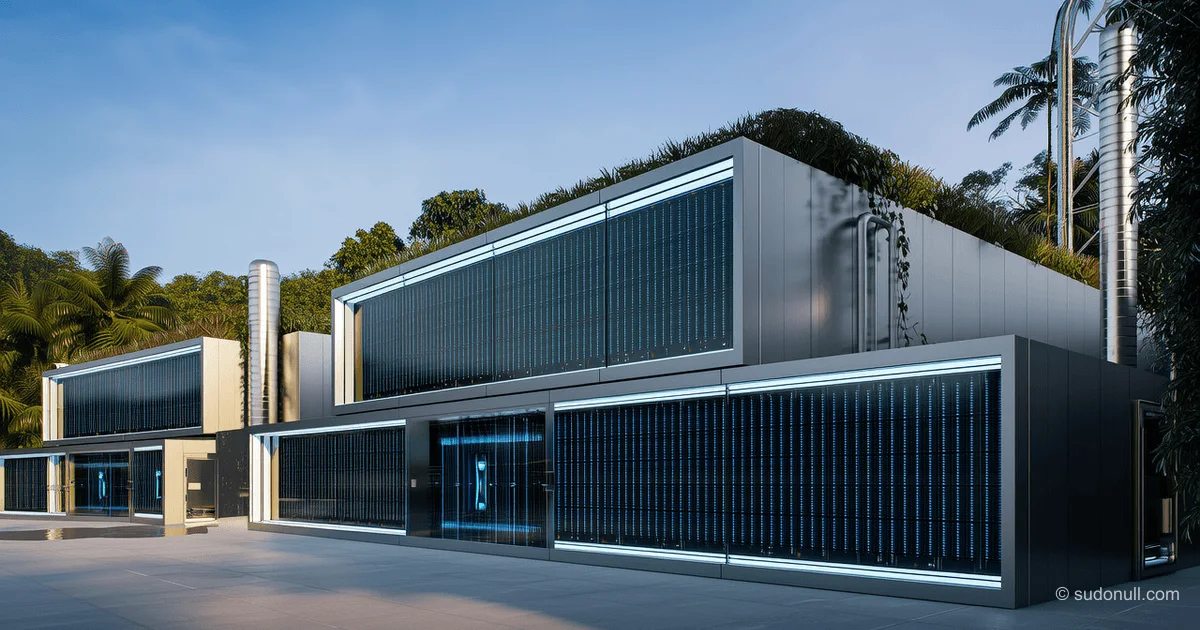
Malaysia Becomes New Data Center Hub for Chinese Tech Giants
Chinese cloud providers, including ByteDance and Alibaba, are massively relocating computing power to Malaysia. The country is exploiting supply chain loopholes to deploy advanced Nvidia AI chips, including B200 systems.
Malaysia — New AI Hub: How a Sanctions Loophole is Rewriting Southeast Asia's Tech Map
The Gist: What's Really Happening
Malaysia is rapidly transforming from a quiet periphery into a strategic node in the global AI race, unfolding in a way that even the most cynical sanctions policy analysts could not have foreseen. Chinese tech giants — ByteDance, Alibaba, and others — are not trying to import banned chips into China. They are building computing power outside China, leasing entire data centers in Johor Bahru and Kulai, equipped with the latest Nvidia B200 accelerators.
On paper, it's all legal. The chips are physically located in Malaysia, managed by cloud operators like Aolani Cloud, which are privileged partners of Nvidia. Chinese companies do not own the equipment, have no physical access to it, and merely lease computing power. Nvidia consistently maintains that US export control rules do not prohibit creating cloud services outside sanctioned countries, and the company thoroughly vets all cloud partners.
But the devil, as always, is in the details. Behind structures like Aivres — a server supplier for Aolani — the silhouette of Chinese Inspur, repeatedly accused of violating sanctions, can be seen. The supply chain is structured so that US chips pass through several jurisdictions, with all regulatory requirements formally met at each step. It is this multi-layered nature that makes the scheme so effective — and so vulnerable at the same time.
Timeline and Context
The story of Malaysia's AI hub is a classic tale of economic necessity finding a way around political barriers.
From 2019 to 2022, Singapore, the traditional leader in Southeast Asian data centers, suspended permits for new data centers due to acute energy shortages. The moratorium was lifted, but conditions tightened: quotas are limited, and the power usage effectiveness (PUE) must be no higher than 1.3. Malaysia, with significantly cheaper electricity and a government actively courting investors through the MIDA one-stop shop, became the natural beneficiary.
The direct contribution of data centers to Malaysia's GDP grew from 900 million ringgit (about $227.5 million) in 2021 to 14.1 billion ringgit by 2025. The forecast for 2030 is a sevenfold increase in industry employment, to nearly 31,000 jobs. The scale of investment is colossal: Singapore's DayOne Data Centers announced plans to invest $7 billion in Malaysia by the end of 2026.
ByteDance became the flagship of this process. In March 2026, The Wall Street Journal revealed details of the deal: the company is leasing capacity from Aolani Cloud, which is deploying systems based on 36,000 Nvidia B200 accelerators in Malaysia. The total equipment cost is estimated at over $2.5 billion. ByteDance has already made advance payments for Blackwell chips. Concurrently, the company plans to spend $23 billion on AI infrastructure in 2026.
March 2026 was a turning point. US authorities began to show signs of concern. In early 2026, the US passed the Remote Access Security Act, which directly prohibits China from accessing advanced AI chips even outside the country. And in April 2026, Malaysia unexpectedly tightened its own export controls, requiring strategic trade permits for all transits and transshipments of high-performance AI chips of US origin.
Who Wins and Who Loses
ByteDance wins. The company gains access to the latest chips without physically importing them into China. This allows it to develop AI applications for both the Chinese and global markets. Five ByteDance apps are already in the top 50 most popular AI apps worldwide according to Andreessen Horowitz. A quarter of the company's revenue comes from outside China, and access to advanced computing is critical to maintaining competitiveness.
Malaysian data center operators win. Aolani, Bridge Data Centres, and other players gain exclusive access to the largest clients. Aolani, founded in 2023 with a parent holding company in the Cayman Islands, is already among Nvidia's priority cloud partners with first access to the latest chips. This is a goldmine that will generate revenue for years.
Nvidia wins. The company finds itself in an ideal position: it complies with US laws while maintaining access to the Chinese market through cloud leasing. In private statements, Nvidia emphasizes that export controls "have led to the world's second-largest commercial market falling into the hands of foreign competitors" and insists on the need to maintain its position in Asia.
Chinese chip makers lose. Huawei, which counted on a mass migration of Chinese clients to Ascend due to sanctions, faces unexpected competition: its own compatriots find ways to continue working with Nvidia. The market for Ascend does not disappear but shrinks.
US sanctions policy loses. The leased data center scheme demonstrates a fundamental vulnerability of export controls: you cannot ban the lease of computing power in a neutral country. The Remote Access Security Act is an attempt to close the loophole, but its application has limits. American lawyers advising Aolani believe that changes to legal norms will be "prospective, not retrospective," meaning they will not affect already signed contracts.
Malaysia's regional competitors lose. Indonesia and Vietnam are trying to compete, but Malaysia pulls ahead due to a combination of factors: cheap electricity, English-speaking workforce, developed logistics, favorable regulation, and an existing concentration of clients.
What the Media Isn't Saying
Insight one: the real scale is not in chips, but in data. It is claimed that in March 2026, Chinese engineers brought hard drives with data to Malaysia, built AI models on local capacity using advanced US chips, and then took the trained models back to China. This means value is created not only computationally but also intellectually: finished models physically leave Malaysia, and no export control tracks the movement of trained neural networks. This is not even a loophole — it's a new class of assets for which no customs procedures exist.
Insight two: Malaysia tightened controls itself — but formally, not substantially. On April 7, 2026, the government announced that all export, transshipment, and transit of AI chips of US origin require a strategic trade permit. This looks like a response to US pressure, but it's just that — looks. Permits are issued. The mechanism continues to work. Washington gets a demonstration of loyalty, Kuala Lumpur keeps the investment flowing. Classic small-country diplomacy between two fires.
Insight three: the Megaspeed incident — a wake-up call not everyone heard. Bain Capital, through its Bridge Data Centres unit, evicted Singapore's Megaspeed International from a Malaysian data center after US authorities suspected the company of illegal chip shipments to China. BDC acted preemptively to protect its own position and credit lines ($2.8 billion). But tellingly, Megaspeed was replaced by Zenlayer — another cloud provider — meaning demand for such services is enormous, and removing one player merely makes room for another. Sanctions policy works like squeezing a balloon: it bulges elsewhere.
Insight four: China is not just leasing servers — it is building a parallel AI infrastructure beyond US control. The fact that Chinese companies control server assembly (via Aivres/Inspur) and are the end customers for computing creates a situation where US chips serve Chinese interests without US oversight. This is a strategic shift not only technologically but also geopolitically. Malaysia becomes a beachhead from which China continues to compete in the global AI race.
Forecast: Next 30 Days and 90 Days
30 days (to mid-June 2026). Investors will continue pouring money into Malaysian data centers. Contracts worth $3.26–3.51 billion across eight major projects are expected by mid-2026. ByteDance will accelerate B200 capacity deployment, and by June, the share of equipment commissioned will exceed $200 million (currently about $100 million).
Concurrently, competitors will step up: Tencent and other Chinese cloud providers will begin negotiations for placement in neighboring countries to keep up with ByteDance. However, Malaysia will remain the priority location due to existing infrastructure.
Washington will take at least one demonstrative step. The most likely scenario is an investigation into one of the intermediary companies, similar to the Megaspeed case. This will be a warning shot, not a real attempt to dismantle the scheme.
90 days (to mid-August 2026). The key question is how far the application of the Remote Access Security Act will go. If US regulators decide on retrospective application, it would jeopardize Aolani's contracts with ByteDance and trigger a chain reaction in the industry. However, lawyers advising Aolani are confident in the prospective nature of the restrictions, and I lean toward the view that a large-scale dismantling of the scheme will not occur.
Malaysia will continue to balance: on one hand, tightening formal requirements for chip transit; on the other, maintaining its status as Southeast Asia's leading AI hub. The country gains too much from the current situation to voluntarily destroy it.
By August, ByteDance will likely launch the first AI products trained on Malaysian B200 capacity. The global market will see that sanctions have not stopped Chinese AI development but merely changed its geography. This will become a powerful argument for easing rhetoric in Washington — or, conversely, for a new round of escalation.
The main lesson of Malaysia's 2026 story: control over chips does not equal control over computing. As long as demand from Chinese companies exists and neutral countries are willing to provide territory, technological barriers will be circumvented faster than they are erected. Malaysia has inadvertently proven this to the world.
— Editorial Team










No comments yet.