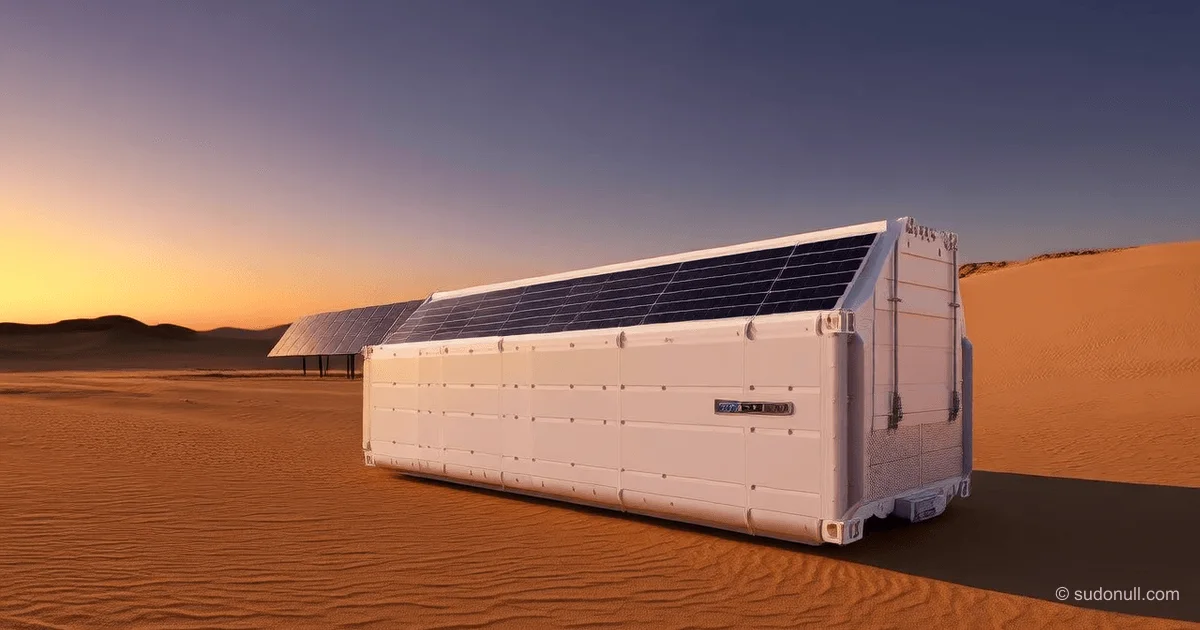
Ford Unveils Giant Industrial Ford Energy Batteries in Standard Containers
Following Tesla, Ford has entered the stationary energy storage market, offering massive battery blocks in shipping containers.
The news about the launch of Ford Energy with its DC blocks is not just another press release from an old automaker entering a trendy market. This event exposes a tectonic shift in global industrial policy. While headlines scream about a "Tesla Megapack challenger," the real game is unfolding on the field of technological sovereignty and chemical dependency. And Ford here is less an innovator and more a forced player, betting on Chinese tech licensing in a game of roulette.
[The Gist]: What's Really Happening
The essence of the May 11, 2026 announcement is not the launch of another "box of batteries," but the completion of Ford's strategic retreat from consumer EV manufacturing and a regrouping of forces in the energy infrastructure field. We are witnessing the birth of not just a subsidiary, but a "politically acceptable Frankenstein's monster": American assembly, American brand, and Chinese brains (LFP technology from CATL).
The key insider insight: Ford's DC block is the physical embodiment of the collapse of the "all-our-own" strategy. Ford Energy produces an "American" energy storage system, but its key component—the lithium iron phosphate cell technology (512 Ah prismatic LFP)—is licensed from Chinese giant CATL. Vice President Lisa Drake directly admitted: to reach CATL's level independently, the company would need "a decade." Ford didn't have ten years; they had a hole in their business model after the F-150 Lightning's failure. So when you look at a photo of a Ford Energy container, you are looking at "Chinese chemistry in an American package."
Timeline and Context
December 2025: Ford quietly kills two major contracts: a $11.4 billion joint venture with SK On and a $6.5 billion supply contract with LG Energy Solution. This was a moment of panic. The company exits costly nickel-manganese-cobalt (NMC) technologies for EVs.
Early 2026: Ford reorients its 2023 agreement with CATL. The LFP technology, originally intended for EVs, is officially redirected to stationary storage. Meanwhile, the Michigan plant that was supposed to produce these batteries faces political resistance and delays, but the assembly line is being retooled.
May 11, 2026: Official launch of Ford Energy. Location: not Michigan, but Glendale, Kentucky. Ford uses an existing plant originally built for SK On, repurposing it from packaging batteries for pickups to cutting electrode coils and assembling containers. Launch investments are estimated at $2 billion, with a target capacity of 20 GWh per year and deliveries starting by the end of 2027.
Who Wins and Who Loses
Data centers win. This is the main beneficiary, whispered about. The press release wording—"demand from data centers"—is key. Hyperscalers (Microsoft, Amazon, Google) desperately need an alternative to Tesla because Musk is becoming an unpredictable regulator of their energy supply. Ford's arrival with a 20-year warranty and the reputation of a 122-year-old industrialist is a lifeline for their AI infrastructure.
CATL wins (covertly). They are not just selling a license. They gain access to the US market, bypassing tariff barriers through the American auto industry itself. While the Michigan plant stalls, if the "American assembly of Chinese design" scheme takes off in Kentucky, CATL will capture the market without physically producing goods on US soil.
SK On and LG Energy Solution lose. They lose a key customer. Ford abandons their high-nickel cells. Their NMC technology path (more energy-dense but more expensive and fire-prone) is deemed unsuitable for industrial storage.
Inertial Tesla Energy loses. Although Tesla is still ahead with 80 GWh capacity and 47 GWh already deployed, and plans to launch Megapack 3 with 50 GWh annual production by end of 2026, Ford's entry means the end of 80% margins for Megapacks. Utilities and fleet operators gain a second "bankable" supplier with a trusted credit rating. Storage system prices will drop.
What the Media Isn't Saying
They are hiding the main horror for the UAW auto union: the Kentucky plant, retooled for Ford Energy, requires far fewer workers than EV production. Assembling large containers for data centers is not a conveyor-belt assembly of millions of cars. It's bespoke, robotic production. The labor markets of Michigan and Kentucky already face the fact that "new energy" provides far fewer jobs than the "old ICE" took away.
The second point missed by the media relates to safety standards. It is stated that the DC block operates at 4,000 meters altitude without power loss (no derating). To the average reader, this means nothing. But to a power engineer, it says Ford is targeting not only Texas deserts but also high-altitude computing clusters (e.g., in Chile or Nevada), where air density is critical for cooling. The Tesla Megapack has stricter altitude limitations. This is a technical "wedge" that Ford drove into a competitor's weak spot.
Forecast: Next 30 Days and 90 Days
30-day forecast (by mid-June 2026):
We will see a wave of "paper" agreements. Ford Energy will announce signed MOUs with major East Coast utility operators (Duke Energy, Dominion Energy) and at least one cloud provider (most likely AWS or Microsoft Azure). Investors will start revaluing Ford not as an auto company with a P/E of 7, but as an energy infrastructure player. The stock will revive on "protected growth" rhetoric. Simultaneously, in congressional backrooms, Republicans will ramp up demands to review the CATL licensing agreement as a national security threat.
90-day forecast (by end of August 2026):
A serious technological hiccup will occur. The Kentucky plant will face a shortage of those infamous 512 Ah prismatic cells. Their production still heavily depends on imported components or the debugging speed of CATL's US line. It will turn out that the assembly line is ready to build containers, but the pipes with cathode material are empty. This will spark the first major scandal about how "American" the "American Ford battery" really is. But financially, nothing will change: pre-orders for 2027 will be sold out because AI sector energy storage demand is insatiable, and customers are willing to wait for anything rather than buy Tesla.
— Editorial Team









No comments yet.