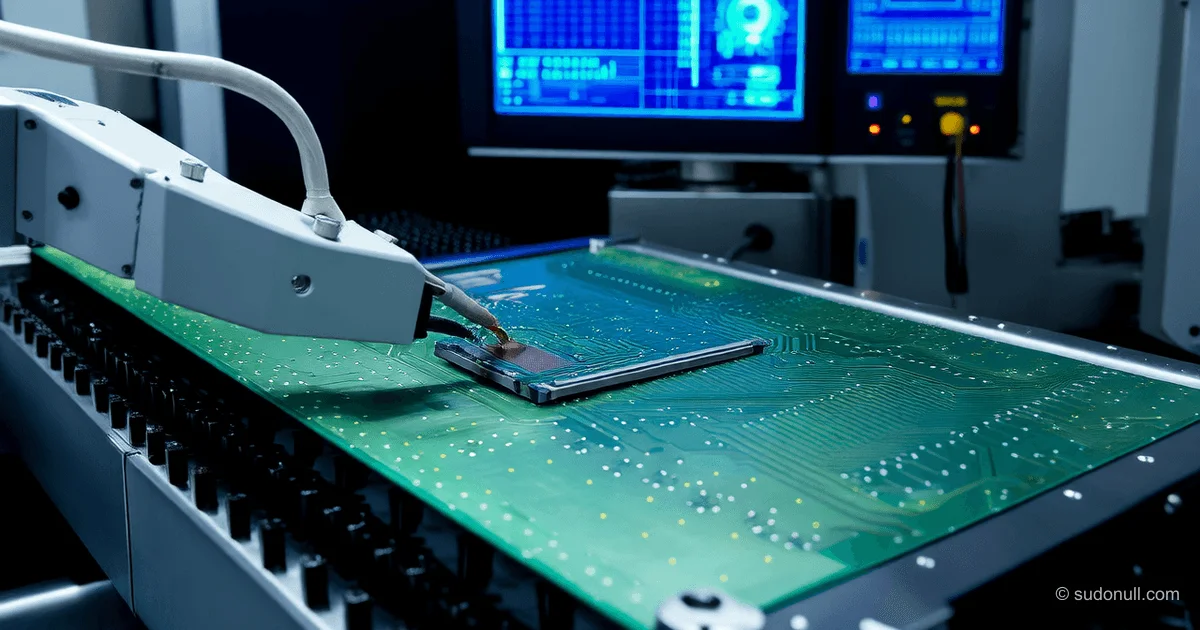
Moscow Announces Launch of Russia's Largest PCB Production Facility for the Automotive Industry
A new plant in the Rudnevo industrial park will produce 24-layer boards of 7th accuracy class for LADA, KAMAZ, and other automakers.
The news about the launch of the plant in Rudnevo is a case where triumphant reports about the "largest production facility" and "import substitution" require a cold shower of industry analysis. I view this project not as an industrial launch, but as an extremely complex logistical and technological operation where geopolitical risk currently outweighs production optimism.
[The Essence]: What Is Really Happening
At first glance, we have a long-awaited event: at the end of 2026, the country's first large-scale contract manufacturing of printed circuit boards, with up to 24 layers and 7th accuracy class, will start operating in Moscow. The project involves investments of over 5 billion rubles, equivalent to approximately $55 million at the current exchange rate. Key customers include AVTOVAZ, KAMAZ, and Moskvich.
However, the essence is not in the board itself. The essence is that the government is forcefully shifting the automotive industry onto the tracks of technological mobilization. This is not a commercial project in the classical sense, but an infrastructural one. The real goal of the plant is not to generate profit here and now, but to ensure the physical capability of producing cars under conditions where imported boards from China or Southeast Asia are either unavailable or have delivery times of 6–9 months. The entry price is $55 million; the cost of downtime for the same AVTOVAZ assembly line due to the lack of a single engine control board is about $10–15 million per day. The math is simple.
The second layer of reality is the architecture of the production itself. This will be a full-cycle surface-mount (SMD) assembly plant, not just a manufacturer of fiberglass laminate bases. Official statements often deliberately mix these stages, but the difference is fundamental: a bare board without chips is just a souvenir.
Timeline and Context
- 2024: GS Group and other players announce plans to build PCB plants. The cost of such projects was then estimated at €60 million.
- 2025: The share of Russian PCBs in the domestic market was less than 40%. Imports reached $255 million. Amendments to Resolution No. 719-PP came into force, requiring the use of at least one Russian board in a product.
- May 2026: The Mayor of Moscow officially announces the plant in Rudnevo, with launch scheduled for the end of the year. Simultaneously, the government allocates over 2.5 trillion rubles for the development of electronics in 2026–2028.
Who Wins and Who Loses
Winner: AVTOVAZ (in the short term). The Rudnevo plant is its logistical lifeline. Localization of boards allows it to earn points with the Ministry of Industry and Trade to be included in the register of domestic products and qualify for government procurement. For the LADA Vesta or Moskvich, this is not a matter of prestige but of access to the budget taxi fleet and government garages.
Losers: Independent Russian PCB manufacturers of the "old guard" — primarily Rezonit and Elektroconnect. Their capacities are 550 and 200 square decimeters per month, respectively. The new plant, with state support and resident status in a special economic zone with tax benefits, will begin to siphon off already scarce personnel and orders. This is a story of squeezing out "private players" by a state monster with administrative resources.
Unexpected loser: Mid-tier Chinese contract manufacturers. Previously, AVTOVAZ and KAMAZ could quietly order boards in Shenzhen. Now, with stricter requirements from the Ministry of Industry and Trade and the risk of secondary sanctions, this channel will shrink. But the paradox is that the Chinese will still benefit at the component level (more on that below).
What the Media Is Not Saying
Now for the most important part that you won't read in the mayor's press releases. The Rudnevo plant solves the assembly problem, but it absolutely does not solve the component base problem. The microcontroller for the engine, the ABS chip, the airbag driver — none of these are produced at the PCB plant. They are produced in China, Taiwan, and South Korea. A 7th accuracy class board with empty chip sockets is not a working control unit; it's a dummy.
And here is the main non-obvious insider point: the real goal of the plant is not so much production as a certification testing ground. The presence in the country of a facility capable of physically producing a board and mounting components on it allows automakers to obtain coveted localization points and access to government orders even while maintaining dependence on imported chips. The board is formally Russian, the components are "parallel imports," and the product makes it into the Ministry of Industry and Trade register. This is a legal gray zone that the state tolerates for now because otherwise the assembly lines would stop.
Second point: the problem of quality and reproducibility. For the 7th accuracy class, you need not just a good production line, but a production culture that takes years to develop. Defense enterprises produce boards of the highest quality, but that is piecemeal production under state defense orders. Mass production with guaranteed identical parameters from batch to batch is a completely different competency. Until it exists, automakers will receive boards with varying characteristics, which is critical for modern driver assistance systems.
Forecast: The Next 30 Days and 90 Days
30-day forecast (by mid-June 2026):
AVTOVAZ shares will show local growth amid the information noise. Simultaneously, Rezonit and other manufacturers will launch an aggressive PR campaign, pointing out that monopolization of the market by one player kills competition. Behind the scenes at the Ministry of Industry and Trade, debates will begin on procurement quotas — there are more plants, but the market is not rubber.
90-day forecast (by the end of August 2026):
We will see at least one of the anchor customers (most likely Moskvich) face a shortage of specific chips for mounting on these very boards. The Rudnevo plant will be ready to launch, but it will turn out that stable supplies of microcontrollers from Bosch, Infineon, or their Chinese equivalents in the required volume are not available. The assembly line will stop not because of boards, but because of chips. And this will trigger the next round of the state program — now for forced localization of chip production, but that is a completely different story with a budget not of $55 million, but of $2–3 billion.
— Editorial Team







No comments yet.