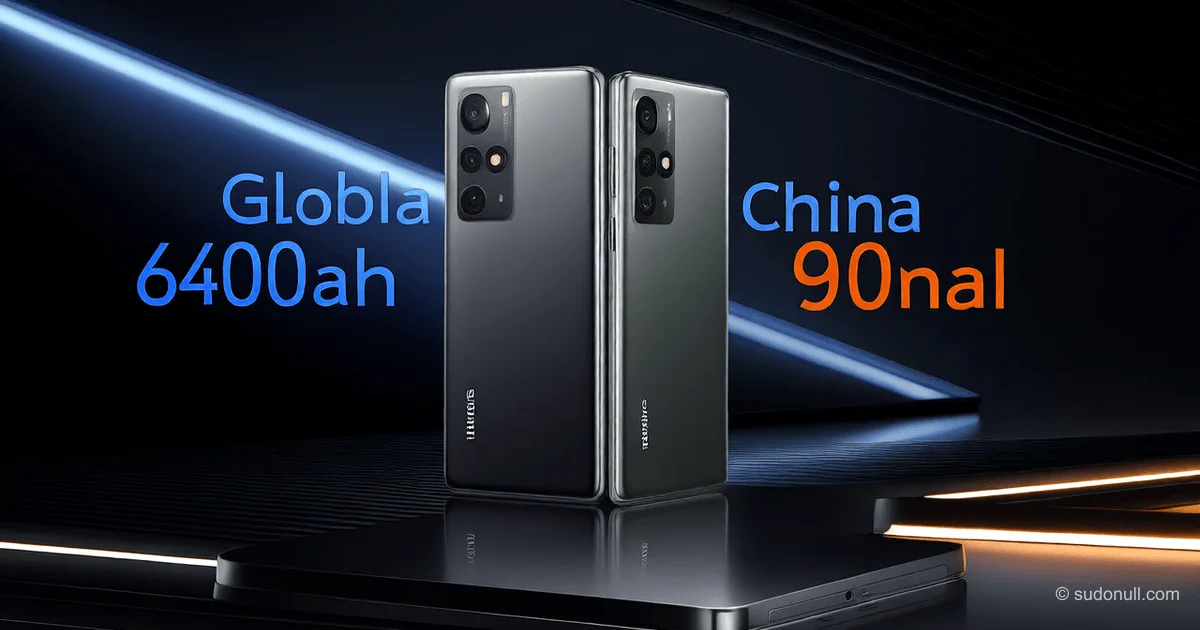
Honor 600 smartphones to get batteries up to 9000 mAh and record-breaking screen brightness of 8000 nits
The new series of Honor flagship smartphones will be equipped with huge batteries, a display with a peak brightness of 8000 nits, and a camera with 30x zoom.
The news about Honor 600 smartphones with batteries up to 9000 mAh and screen brightness of 8000 nits is a classic example of an information bubble that bursts when you look at the specs. While industry media rewrite press releases about "flagship features," I see here a finely calculated operation to split the global and Chinese markets, where the same marketing terms hide completely different products.
[The Gist]: What's Really Happening
In reality, there is no single "Honor 600." There are two parallel realities: the global version, already on sale in Europe and the UK since May 6-7, 2026, and the Chinese version (about to launch), whose specs are radically different.
The global Honor 600, sold in Germany for €649–699 and in the UK for £549.99–599.99, comes with a 6400 mAh battery (7000 mAh in some regions), not "up to 9000 mAh" as headlines scream. The processor is a Qualcomm Snapdragon 7 Gen 4, not a flagship chip. The zoom is digital 30x or optical 3.5x on the Pro version, not "30x optical."
The Chinese version (such devices are not officially available in Russia and never will be) will indeed get 8500-9000 mAh thanks to fourth-generation silicon-carbon "Qinghai" batteries with an energy density of 926 Wh/L. But the price and availability outside China are unclear. The consumer in Europe gets a completely different product with the same name. This is not a technological breakthrough—it's market segmentation disguised as a unified launch.
The starting price of the global version at €649 for the base 8/256 GB config places the Honor 600 not in the flagship killer segment, but in the tight upper mid-range niche, where it will have to compete with the Nothing Phone and Pixel A-series. Honor has deliberately avoided a price war, betting on design (metal body, IP69K certification, ultra-thin bezels at 0.98 mm).
Timeline and Context
April 21-22, 2026: Honor holds a global presentation of the 600 series in Malaysia and the Middle East. Standard specs are announced—6400 mAh, Snapdragon 7 Gen 4, 200 MP main camera. At the same time, leaks about the Chinese version with 9000 mAh appear.
April 30 - May 6, 2026: Sales start in Europe and the UK. Buyers in Germany get a €200 discount on pre-order (price drops to €499), in the UK a similar offer (£200 off). Honor reports a "150% increase in pre-orders" in Malaysia and the UAE.
May 13, 2026 (today): We are discussing news that mixes specs of two different versions. Media relay "9000 mAh and 8000 nits" as common specs, but that's not the case. The global version has 6400 mAh; the Chinese version hasn't even received an official release date yet.
Who Wins and Who Loses
Honor wins through viral marketing. The numbers "9000 mAh" and "8000 nits" are perfect hooks for YouTube titles and tech blogs. Even if the actual European buyer gets 6400 mAh, the association with a "huge battery" will already be cemented in their mind.
Samsung loses in the moment. The Galaxy S26 Ultra has a battery of around 5000 mAh and peak brightness of about 2600 nits—these numbers look pale next to 9000/8000, even if those figures belong to a different market and device class.
Paradoxically, Xiaomi wins. Chinese sub-brands (Redmi, Poco) have long played this game—huge batteries for the domestic market, cut-down versions for Europe. Honor is now playing by the same rules, legitimizing this practice.
The consumer in Europe and Russia loses. They see headlines about "9000 mAh" and expect to buy such a device. Reality: at best 6400 mAh, at worst the model won't even reach the market, and gray imports of the Chinese version will cost $300-400 more.
What the Media Aren't Saying
The most inconvenient fact you won't find in reviews: 8000 nits is peak HDR brightness on a microscopic area of the screen (likely 1% of the area) when playing special content. This is not the brightness you'll get in sunlight while reading a webpage. The real sustained brightness, according to early tests, does not exceed 1200-1500 nits. The gap between "marketing 8000" and "working 1500" is sixfold.
Second insider point: Honor's dependence on Qualcomm has become critical. Unlike Huawei, Honor does not have access to Kirin chips due to sanctions restrictions (Honor is formally independent, but the "toxicity" of the legacy remains). The Snapdragon 7 Gen 4 in the base version is a mid-range 4nm chip. The Snapdragon 8 Elite in the Pro version is flagship, but its price has increased by 20% year-on-year. Honor is squeezed between rising Qualcomm procurement costs and the inability to raise retail prices above the psychological threshold of €1000. Margins are shrinking. Every new launch is a balancing act on the brink of unprofitability if hardware cannot be offset by service revenue.
Third point: The design of the Honor 600 Pro is not just "inspired" by the iPhone 17 Pro—it's copied at the layout level. Media like Digital Trends have already dubbed this strategy "rewriting the rules of the game," but essentially it's an avoidance of legal risks: Honor copies Apple's design but sells devices in regions where patent disputes take years or are impossible (China, Malaysia, Middle East). In Europe and the US, such models either don't appear or launch with delays and altered designs.
Forecast: Next 30 Days and 90 Days
30-day forecast (by mid-June 2026):
Honor will officially unveil the Chinese version of the Honor 600 with an 8500-9000 mAh battery at an event in Shenzhen. The price will be aggressive—around 2699 yuan (approximately $370). This will create a wave of "gray imports" into Russia and the CIS. The European version will receive its first major firmware update attempting to optimize battery consumption, as real-world tests will show that 6400 mAh lasts not two days but 1.5 days of active use.
90-day forecast (by end of August 2026):
Dumping will begin. European retailers, facing competition from the Nothing Phone (3a) and Pixel 10a, will start lowering the price of the Honor 600 to €399-449 without discounts. Honor will have to choose: either maintain margins and lose market share, or sacrifice profit for volumes. Given that Counterpoint has already recorded Honor's share growth from 5% to 7% in Q1 2026, the company will choose the latter. Around the same time, we'll hear the first talks about Honor seeking ways to return to Kirin or developing its own chip—dependence on Qualcomm is becoming unbearable.
The main forecast: in August 2026, Honor will quietly update the global version's specs to "Chinese" values for select Southeast Asian markets, further confusing consumers. A single product "Honor 600" does not exist now, nor will it appear in three months. This is not a smartphone—it's a marketing construct, adaptable to each region individually.
— Editorial Team








No comments yet.