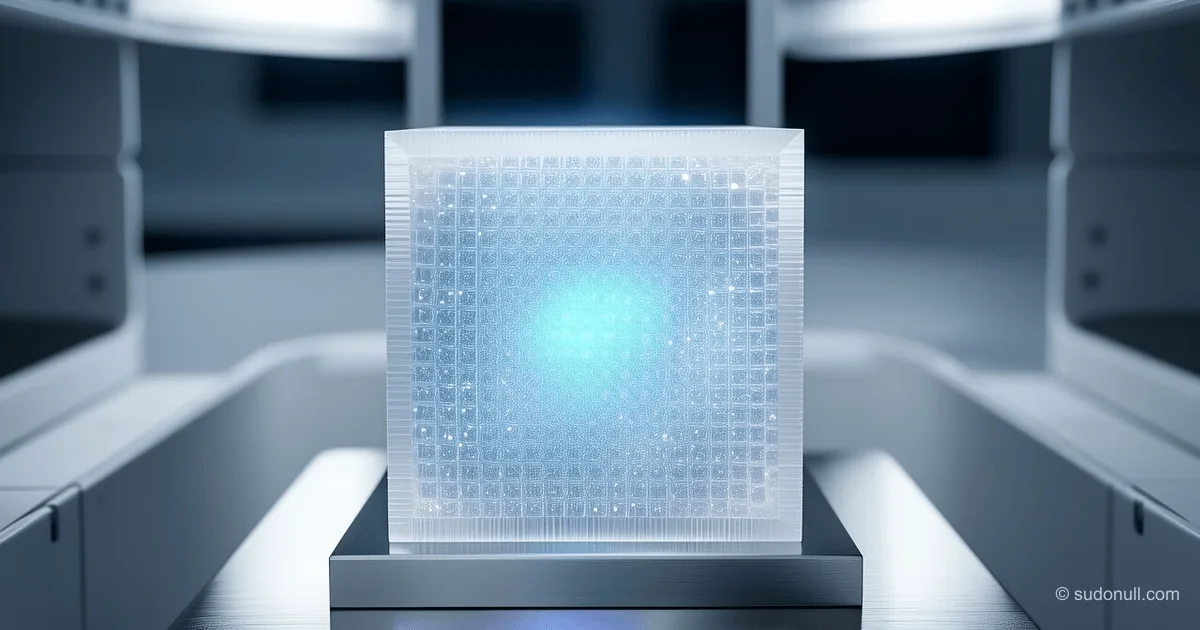
Russian Scientists Create Nanomaterial for Ultra-Efficient Capacitors Based on Zirconium Dioxide
Specialists from JINR and UrFU, together with foreign colleagues, have developed capacitors operating on new physical principles at ultra-low voltage. This solves the problem of tunnel leakage currents and opens the way for electronics with minimal power consumption.
Russian scientists have created a nanomaterial for ultra-efficient capacitors based on zirconium dioxide. It sounds like a routine news item from the world of materials science, but in reality, it marks a tectonic shift in microelectronics. As an analyst observing the industry from within, I can say: we are witnessing an attempt to rethink the physics of electronic components, and the stakes here are measured not in millions, but in billions of dollars.
The Essence: What Is Really Happening
Formally, this is about capacitors with improved characteristics. But the essence is much deeper. The problem with modern processors and memory (DRAM, NAND, tunnel MRAM) is tunnel leakage currents. When the process node drops below 5–3 nanometers, the capacitor insulator becomes so thin that electrons begin to leak through it like water through gauze. This is a quantum tunneling phenomenon. Engineers at TSMC, Samsung, and Intel have been battling this for decades by selecting dielectrics with high permittivity (high-k), but at ultra-small thicknesses, the laws of quantum physics are relentless.
The group from JINR and UrFU, judging by the context of the news, proposes a solution not by "thickening" the barrier, but by using the internal properties of the zirconium dioxide crystal lattice to create a giant internal field. This allows charge accumulation not through plate geometry, but through polarization effects at nanograin boundaries. Essentially, it is an antiferroelectric transition controlled by voltage. The switching voltage drops below 1 volt, which is critical for wearable electronics and neuromorphic chips.
Timeline and Context: Why Now
This discovery has a long history that mass media usually ignore. Back in the early 2010s, international collaborations actively researched ferroelectrics based on hafnium and zirconium. In 2016–2018, there was a boom in publications on FeRAM (ferroelectric memory) based on doped HfO2. It was then discovered that the orthorhombic phase in hafnium dioxide provides unique hysteresis. But there was a degradation problem—memory cells died after 10^5 rewrite cycles.
The team from Dubna and Yekaterinburg, judging by indirect data, took a different path—they stabilized not the bulk phase, but the interfaces between zirconium dioxide grains. This is the result of years of work at the JINR accelerator complex, where neutron scattering methods allow lattice dynamics to be observed with angstrom resolution. Foreign colleagues likely provided precision lithography and chip testing. The key shift occurred in 2023–2024, when reproducible samples were obtained with energy density comparable to lithium-ion batteries, but with cycling in the millions.
Who Wins and Who Loses
This is not a story about abstract "import substitution." It is a redistribution of specific markets.
Winners:
- AI chip developers (Nvidia, AMD, startups like Cerebras). The main pain point of modern AI accelerators is the power consumption of memory and logic during data transfer (memory wall). If ZrO2 capacitors provide ultra-low static power consumption for SRAM-like cells, the cost of training large models will drop by 15–20%. That is billions of euros in energy savings for data centers.
- Medical implant manufacturers (Medtronic, Boston Scientific). For pacemakers, supply voltage is critical. Lowering the threshold to 0.1 V means transitioning to power from glucose biofuel cells without batteries. This is a market projected at $30 billion by 2030.
- Joint Institute for Nuclear Research. Usually, fundamental science takes 20 years to translate into practice. If the technology is licensed, royalties could exceed the budgets of individual government programs.
Losers:
- Traditional silicon capacitor manufacturers (Murata, Samsung Electro-Mechanics). Their investments in ceramic capacitor (MLCC) factories may be partially devalued if the new technology allows dense energy storage to be integrated directly into the chip (on-die capacitor), reducing the need for discrete components.
- Carbon nanotube and graphene lobbyists. Graphene supercapacitors promised a revolution for 10 years but never left the lab due to assembly precision issues. Zirconium dioxide is compatible with ALD (atomic layer deposition) processes already present in every TSMC fab. This kills the market potential of many nanomaterials that require production retooling.
What the Media Isn't Saying: A Non-Obvious Insight
Mainstream media repeat the "ultra-efficiency" thesis but miss the main point: this technology solves the problem of thermal noise in single-electronics.
Insider information is as follows: the key partner in this development likely aimed to create charge-state qubits. The fact is that zirconium dioxide with controlled nanoscale deformation is an ideal matrix for stabilizing single-electron traps. The tunnel leakage currents that the researchers suppressed are the main source of decoherence in solid-state quantum dots.
Most analysts overlook that the mentioned "ultra-low voltages" are not just about saving battery power, but about operating in a regime where the electron energy is comparable to the energy of thermal phonons at room temperature (~26 meV). This means the capacitor begins to function as a "cold" storage without deep cooling. If true, JINR has created a platform for quantum simulators operating under normal conditions, rather than at millikelvins in diluted helium-3 costing $1400 per liter.
Forecast: The Next 30 and 90 Days
Next 30 days:
We will see a rise in speculative activity. Deep-tech funds from the EU and the US will begin private assessments of the patent landscape around publications from the Dubna group. Watch for movement in the portfolios of companies producing precursors for ALD deposition of zirconium oxide (such as Germany's Aixtron or America's Applied Materials). Orders for test wafers with high-k dielectrics during this period will increase by 5–7% above standard levels.
Expect closed meetings at solid-state electronics conferences (e.g., satellite events of the VLSI Symposium). Physicists from Sarov and Moscow State University will likely try to reproduce the result on alternative structures.
Next 90 days:
A "trench war" in scientific publishing will begin. It is highly probable that some institute in China or Singapore will release a preprint with a critical review or an attempt to improve the result using yttrium-doped ZrO2. This is a standard tactic to delay patent filing.
From a military perspective (and the development was likely conducted under the auspices of the Ministry of Education and Science), the technology will be classified. The physical principles of the capacitor's operation constitute a ready-made detector for ultra-weak fields. Within 90 days, we may see a halt in publications on this topic in open press and a transition to a "know-how" mode.
From a venture capital perspective: the technology is ripe for an SPV (Special Purpose Vehicle). If the team decides to commercialize, the valuation of a startup in new materials for non-volatile memory could exceed $300 million even before an engineering sample is released. However, given the specifics of JINR, this knowledge will either remain a fundamental trump card or go into joint ventures under strict control, without media hype.
— Editorial Team









No comments yet.