Researchers Find Impossible Crystal in Glass Formed by the First Nuclear Test 'Trinity'
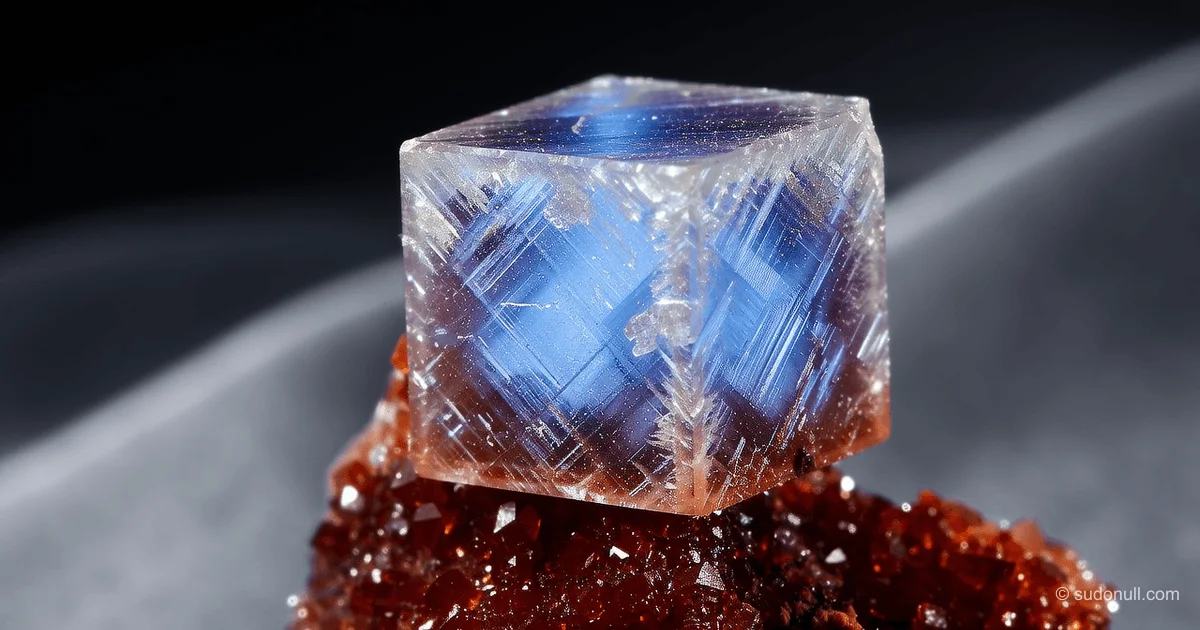
In trinitite, the rock from the site of the first nuclear explosion, a rare cubic clathrate of calcium copper silicate has been discovered. The unique structure formed under extreme pressures of 5–8 GPa and temperatures above 1500 °C.
In trinitite, fused on July 16, 1945, at the cradle of the Manhattan Project, a crystal that should not exist has been found. This discovery not only shatters mineralogy textbooks but also challenges established ideas about how humanity should create the materials of the future.
The Gist: What's Really Happening
Formally, an international team led by geologist Luca Bindi from the University of Florence reported the identification of a new cubic type-I clathrate in samples of red trinitite. The results were published in the Proceedings of the National Academy of Sciences. In the crystal lattice of silicon, as if in a microscopic cage, calcium atoms are trapped, and the structure itself is stabilized by copper and iron from vaporized equipment.
However, the point is not the discovery itself, but the complete paradigm shift in synthesis. Until now, inorganic clathrates were obtained in laboratories over months using complex multi-step processes. Here, nature (albeit man-made) created an intricate framework in a fraction of a second under flash heating above 1500 °C and a shock wave with an amplitude of 5–8 gigapascals. This is proof that non-equilibrium thermodynamics is not a defect but a tool. It is a revolution in solid-state chemistry.
Timeline and Context
The starting point is 5:29 AM on July 16, 1945, at Alamogordo, New Mexico. The plutonium device "The Gadget," with a yield of about 21 kilotons, vaporized a 30-meter steel tower and miles of copper cables, fusing them with desert sand into glass—trinitite. Extreme thermodynamic conditions were present from the start.
In 2021, Bindi and colleagues discovered an icosahedral quasicrystal Si₆₁Cu₃₀Ca₇Fe₂ in the red variety of trinitite—a structure with forbidden five-fold symmetry in classical crystallography. The current 2026 study is a direct continuation: a second anomaly has been found in the same sample. Quantum mechanical calculations using DFT showed that the clathrate and quasicrystal formed independently: at high copper concentration (~21%), the clathrate lattice becomes unstable, and atoms assemble into a different pattern.
Who Wins and Who Loses
Military analysts and nuclear forensics win. Clathrates act as molecular "black boxes," whose composition and structure are strictly tied to the peak P-T conditions of an explosion. Detecting specific clathrates in aerosol samples will become an irrefutable marker of covert tests, even with zero radionuclide output. Atomic intelligence budgets will increase; the project budget is estimated at approximately $15–20 million for equipping laboratories with neutron and synchrotron diffraction.
Manufacturers of solid-state batteries and thermoelectrics win. Clathrates are ideal hosts for lithium and sodium ions due to their rigid "cage" that suppresses dendrites. Startups that manage to reproduce Trinity-like synthesis (laser ablation, electric explosion of conductors) will gain a patent advantage. The patent portfolio in this area is estimated at $300–500 million.
Classical chemical conglomerates lose. Giants that have invested billions of euros in "slow" pyrolysis and CVD synthesis face the risk of devaluation if the market adopts pulsed synthesis as the standard.
What the Media Isn't Saying
Insider info: this discovery is key to hypersonic materials science. Most media repeat the "impossible crystal" thesis but do not link the find to the most pressing technological challenge of our time—thermal protection for hypersonic vehicles. Upon re-entering dense atmospheric layers, the shock wave creates pressures and temperatures similar to those at Trinity. Trinitite is a test-bed model of a thermal protection coating after an actual flight. Clathrates and quasicrystals are ideal candidates for sacrificial layers: upon sublimation, their lattice absorbs enormous amounts of energy. If DARPA or NNSA secures funding for "Project Trinity" (about $50 million), it will mean a shift from ceramic tiles to programmable clathrate coatings.
Forecast: Next 30 Days and 90 Days
Next 30 days. Major US laboratories (Los Alamos, Argonne National Lab) and Russia's JINR will launch parallel studies of trinitite from stockpiles. Demand for red trinitite samples at closed auctions will double.
Next 90 days. The first preprints on successful laser synthesis of clathrate will appear. The key consequence is renewed interest in electro-pulse sintering methods: industry will begin transitioning from static autoclaves to dynamic synthesis, and the adjective "Trinity-like" will become a standard term in grant applications.
— Editorial Team









No comments yet.