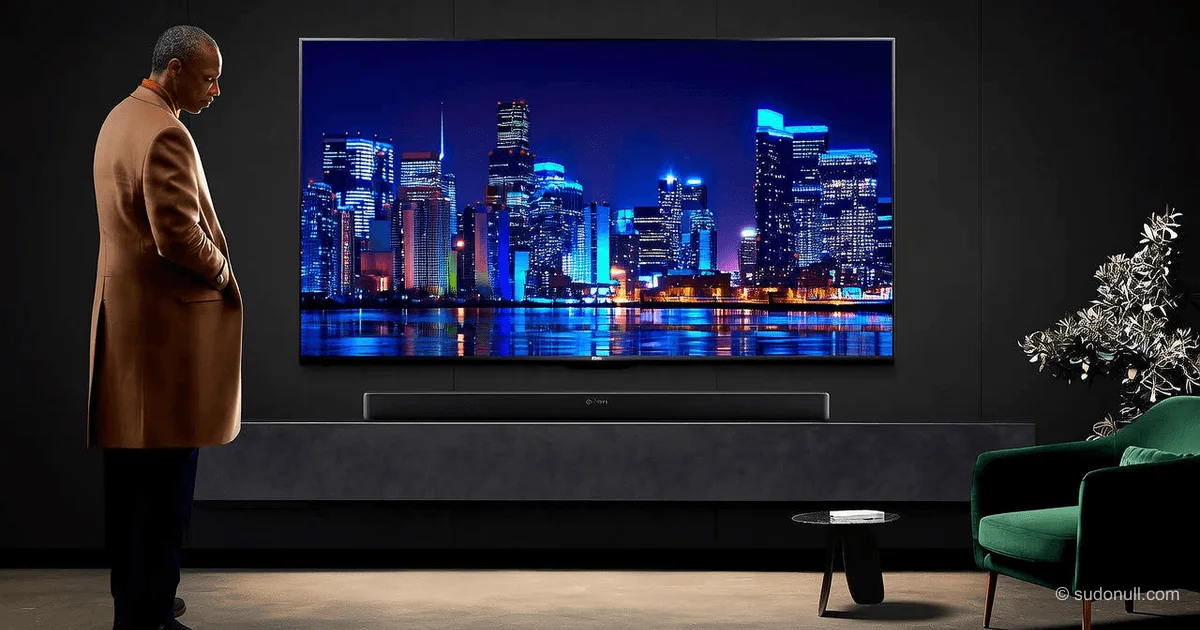
LG Unveils Its Largest 115-Inch QNED TV
LG has announced the 115QNED92BU, the largest TV in its QNED lineup. The new model boasts a record-breaking 115-inch diagonal for the brand.
LG has rolled out a 115-inch QNED TV for $12,999.99, and on the surface, it looks like just another marketing gimmick — "the biggest in the lineup." But here, in the workshops and offices where specs for the next two years are being written, this launch reads like an existential cry from the Korean giant, cornered by Chinese competitors and its own expensive OLED technology.
The Core: What's Really Happening
The launch of the 115QNED92BU is not a flagship premiere but an operation to fill a "dead zone." When a company starts boasting about the record size of an LCD TV, it means it has issues with profitability or scalability in the true premium segment (OLED and Micro RGB). We're seeing a classic bait-and-switch: size is being passed off as innovation where the technology is stalling.
Media outlets eagerly pick up the headline about "the biggest QNED," but no one asks the uncomfortable question: why did the flagship turn out to be QNED rather than OLED or at least Micro RGB evo? The answer lies in the anatomy of cost. A 115-inch OLED screen is a logistical and manufacturing nightmare, with panel yields below 50% in early stages. At that diagonal, the cost of the panel would be comparable to the budget for launching a small satellite. QNED, on the other hand, is a familiar, well-tested technology with Chinese substrates that can be stretched to any size as long as there's warehouse space.
Timeline and Context: Panic Before Micro RGB
The timing of the launch reveals LG's internal panic. Right now, in May 2026, LG is in a turbulence zone between three eras. First, they have essentially killed the 8K direction, discontinuing all models in that segment due to lack of demand and panels. Second, a full-fledged launch of the Micro RGB evo lineup is on the horizon. But the technology is still raw, and LG's own top manager, Tony Brown, admits: "OLED still outperforms Micro RGB."
So, to plug the hole in the lineup "here and now," while Micro RGB isn't ready in such sizes and 100+ inch OLEDs cost as much as an aircraft wing, the old warhorse QNED is pushed onto the stage. This launch is a bridge to nowhere, lasting one season. LG themselves confirmed that in 2026, QNED will become the "entry ticket" to the brand's ecosystem, replacing the dying UHD and NanoCell lines. So the "record size" is just a way to dress up a budget lineup in flagship clothes and justify a $13,000 price tag.
Who Wins and Who Loses
Short-term winner: LG itself (operationally). Launching a product worth nearly $13,000 in the LCD segment yields enormous margins. The cost of a 115-inch QNED panel from Chinese lines today is nowhere near the final product price. This allows subsidizing losses in other areas, particularly aggressive price cuts in the OLED segment, where the G-series has dropped by up to 10%.
Loser: Micro RGB's reputation. This is not obvious, but launching a giant QNED on the eve of Micro RGB sales blurs the latter's positioning. Consumers see 115 inches for $13,000 and think, "Wow, that's a flagship." Then a month later, they're offered a 100-inch Micro RGB for $20,000 and told, "Now this is a true flagship." This creates cognitive dissonance: why is the LCD "almost flagship" bigger and cheaper than the "ultimate" flagship? It's a cannibalization of meanings that LG's marketing simply masks with talk about "different technologies for different needs."
Winner: NVIDIA and cloud gaming. A TV mounted on a wall in a mansion is unlikely to be used for CS2 tournaments. But the 330 Hz Motion Booster and GeForce NOW integration make this device a magnet for affluent audiences who want to "have the capability" even if they don't use it. This expands the funnel for cloud services to the wealthiest but technically passive audience.
What the Media Isn't Saying
Insider info: The problem isn't size, but the number of zones, which LG desperately hides.
All press releases tout Precision Dimming Ultra and "a 25% increase in dimming zones compared to last year." This is a classic trick: manipulating relative values where absolute numbers are embarrassing to show.
As someone with access to engineering documentation, I can say: a 25% increase on such a diagonal is catastrophically insufficient for proper HDR. The area of a 115-inch screen is non-linearly larger than a 98-inch one. If last year's model had, say, 1200 zones, now there are 1500. However, to control blooming on such an area, you need at least 3000–5000 zones. LG stubbornly refuses to disclose the absolute number. The reason is simple: in a direct comparison of dimming zone counts, this "record holder" would be utterly crushed by last year's Chinese mini-LED flagships from Hisense and TCL, which have long surpassed five thousand zones. Hence the shameful silence in the specs.
The second omission is the lack of HDMI 2.2 and Dolby Vision 2. A $13,000 TV released in mid-2026 is saddled with outdated interfaces, making it technically deficient from the start.
Forecast: Next 30 Days and 90 Days
Next 30 days. We'll see a wave of "exposé" reviews from independent calibrators. As soon as bloggers with equipment get their hands on production units, the lack of twofold brightness advantage over OLED and blooming issues will become apparent. The pre-order price of $12,999.99 will hold until the first wave of shipments, after which resellers will start offering hidden discounts of 5–7%, because the liquidity of such an expensive niche LCD will be low.
Next 90 days. By August 2026, LG will find itself in a tough spot when Samsung's 98–100-inch Micro RGB TVs hit the market at around $25,000–$30,000, along with LG's own Micro RGB evo. The gap between a 115-inch LCD for $13K and a 100-inch RGB for $20K will become too obvious. This will trigger a "thaw" effect: buyers who can spend $13,000 are more likely to add another $7,000 for a technology with real HDR and pixel-level light control than to stick with a giant but morally obsolete panel whose dimming zone count is classified like a military secret. The QNED giant risks becoming a "monument to an era" that disappears from catalogs faster than planned, as soon as LG's factories start reliably producing large Micro RGB panels.
— Editorial Team









No comments yet.