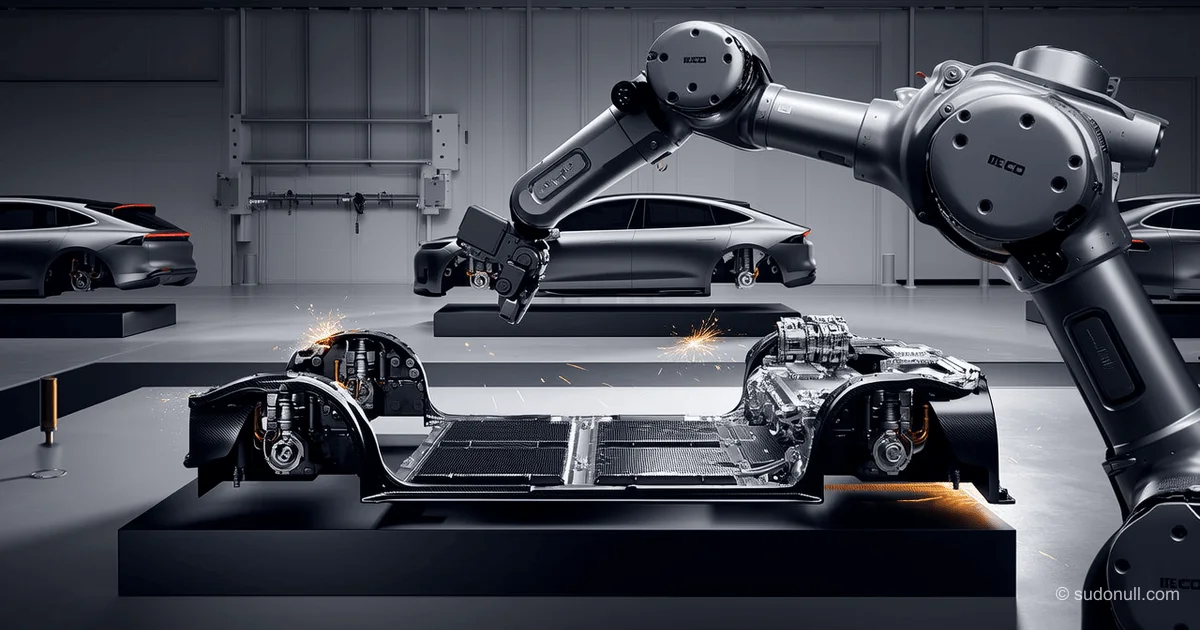
Mind Robotics Raises $400M for Industrial Robots
The company develops physical AI solutions for factory automation. The deal underscores high demand for AI integration in industry and real-world manufacturing.
Mind Robotics and $400M: Why This Isn't a Startup, but Rivian's Backup Airfield
The Gist: Not Robots Building Cars, but an Automaker Building Robots
On May 13, 2026, Mind Robotics announced it raised $400M led by Kleiner Perkins. The round closed just two months after a $500M Series A in March. Including a $115M seed round in late 2025, total investment exceeds $1B, and the company's valuation reached $3.4B. On paper, it's another round in the hot physical AI sector. In reality, this story isn't about robots—it's about Rivian.
Mind Robotics' founder is not your typical serial entrepreneur from Silicon Valley, but RJ Scaringe, CEO and founder of Rivian. He didn't "leave a corporation for a startup"—he spun out the robotics division into a separate legal entity, keeping Rivian as a key partner and shareholder. This isn't a spin-off in the classic sense. It's a strategic maneuver where Rivian solves three problems at once: securing external funding for a risky venture, retaining control over critical technology, and creating an asset with an independent valuation.
Mind Robotics isn't about factory automation in general. It's about solving a specific, existential problem for Rivian: producing more cars with fewer people. Rivian's second-generation model, the R2—a midsize SUV—has tens of thousands of pre-orders, and mass production starts in 2026. The company is entering the same "production valley of death" that Tesla went through with the Model 3: scaling production, labor shortages, margin pressure. The difference is that Musk slept at the factory, while Scaringe created a robotics company.
Timeline: A Billion in Six Months—Not Speed, but a Signal
The timeline is impressive and alarming at the same time. November 2025: $115M seed from Eclipse. March 2026: $500M Series A from Accel and Andreessen Horowitz, valuation $2B. May 2026: another $400M from Kleiner Perkins, valuation $3.4B. Less than six months, three rounds, over $1B.
This pace is unusual for hardware startups. Robotics involves physical assets, R&D cycles, time for prototyping and integration. Two rounds of half a billion in two months mean the money isn't for product development—that was already done inside Rivian before the formal spin-off. The money goes to hiring, deployment, and scaling.
RJ Scaringe doesn't hide that the project started as an internal one—under the codename Project Synapse—aiming to create "robots with near-human skills." Initially, it was an attempt to solve Rivian's chronic labor shortage at its factories. The project grew out of frustration: Scaringe talked to existing robotics startups and concluded none met his requirements. So he decided to build it himself.
Who Wins and Who Loses
Rivian wins. In two ways. First, financially: the company is a shareholder in Mind Robotics, and the startup's rising valuation inflates its balance sheet. For an EV maker with typical cash burn, this is a decent way to generate value. Second, strategically: Rivian gets priority access to robots not available on the market. While competitors negotiate with external suppliers, Rivian is already deploying hundreds of machines at its plant in Normal, Illinois.
Silicon Valley VCs win. Kleiner Perkins, Accel, a16z, Eclipse—the round's participant list reads like a who's who of venture capital. They get not just a stake in a robotics startup. They get a stake in a company with a guaranteed first customer, a live production environment for training models, and a founder who has already built a multi-billion-dollar business. For investors, this hedges against the main risk of hardware startups: lack of a deployment channel.
Physical AI competitors lose. Figure AI, Agility Robotics, Amazon—all are vying for industrial contracts. But Mind Robotics starts from a position they lack: exclusive access to an active auto plant as a proving ground. Real production data is something you can't buy or simulate. Hundreds of robots working on the assembly line generate training material that competitors will take years to collect.
Workers lose. Scaringe doesn't hide the motivation—solving "chronic labor shortages." Robots don't strike, don't get sick, don't demand raises. Every deployed robot is a job that won't be filled by a human.
What the Media Isn't Saying
First insight: Mind Robotics likely isn't building humanoid robots.
All the rhetoric around "physical AI" and "general-purpose robots" makes journalists automatically picture androids with arms and legs. But when Scaringe talks about Mind Robotics, he talks about something else. The priority is the "hand," not the whole body. He states directly: a mobile platform is only needed to deliver the manipulator to the right spot. His argument is soberingly practical: factories have no stairs, carpets, or cats to step over. The environment is controlled, the map is known, conditions are stable. In such an environment, human legs are unnecessary complexity. A robotic arm with advanced sensors and a foundation model for perception and decision-making is sufficient.
This is a fundamental split from the industry mainstream, which is obsessed with humanoids. Scaringe bets on functionality, not form factor.
Second insight: Volkswagen enters the cap table not just as an investor.
Among the round's participants is Incharge Capital, a venture fund affiliated with Volkswagen, as well as Salesforce Ventures. VW isn't just a portfolio investor. It's a strategic partner of Rivian in a joint venture for transportation technology. Participation in Mind Robotics' capital is a bet that the platform will be deployed not only at Rivian's factories but also at VW's production facilities. If that happens, Mind Robotics will transform from a startup with one factory into a supplier for two of the world's largest automakers.
Third insight: $3.4B is the valuation of a company without a public product.
Mind Robotics' website has no photos of robots. None. The company talks about architecture, foundation models, deployment infrastructure—and is already worth more than many public industrial-tech companies. This is a pure bet on the founder's persona and his access to a production environment. Either it's brilliant financial engineering, or a sign of an inflating bubble in the physical AI market.
Forecast: Next 30 Days and 90 Days
30 days (by mid-June 2026). Key event: the Robotics Summit & Expo in Boston at the end of May. Physical AI is billed as the main theme. Mind Robotics will either make substantive announcements or continue to stay in the shadows. The former will signal platform readiness; the latter will fuel suspicions of an inflated valuation. I also expect hiring of top executives for the operations team—$400M in the bank requires aggressive deployment.
90 days (by mid-August 2026). During this period, Rivian begins mass deliveries of the R2. The Normal plant must hit target production volumes. That's when it will become clear whether Mind Robotics' robots work in real conditions or remain experimental prototypes. If the factory shows increased output with a simultaneous reduction in manual labor for dexterous tasks, that validates the platform. If production stalls, the $3.4B valuation will start to look unjustified. Also likely: the first public appearance of Mind Robotics' "hand"—no legs, but with clear industrial specifications.
Bottom line. Mind Robotics is not just another robotics startup. It's a strategic tool in Rivian's hands to navigate the production valley of death, wrapped in the form of an independent company to access external capital. The question isn't whether they'll build robots—they will, too many resources have been committed. The question is whether the platform will become truly universal and extend beyond Rivian-VW factories, or remain an expensive internal solution with an inflated valuation. We'll know the answer by the end of summer 2026.
— Editorial Team









No comments yet.