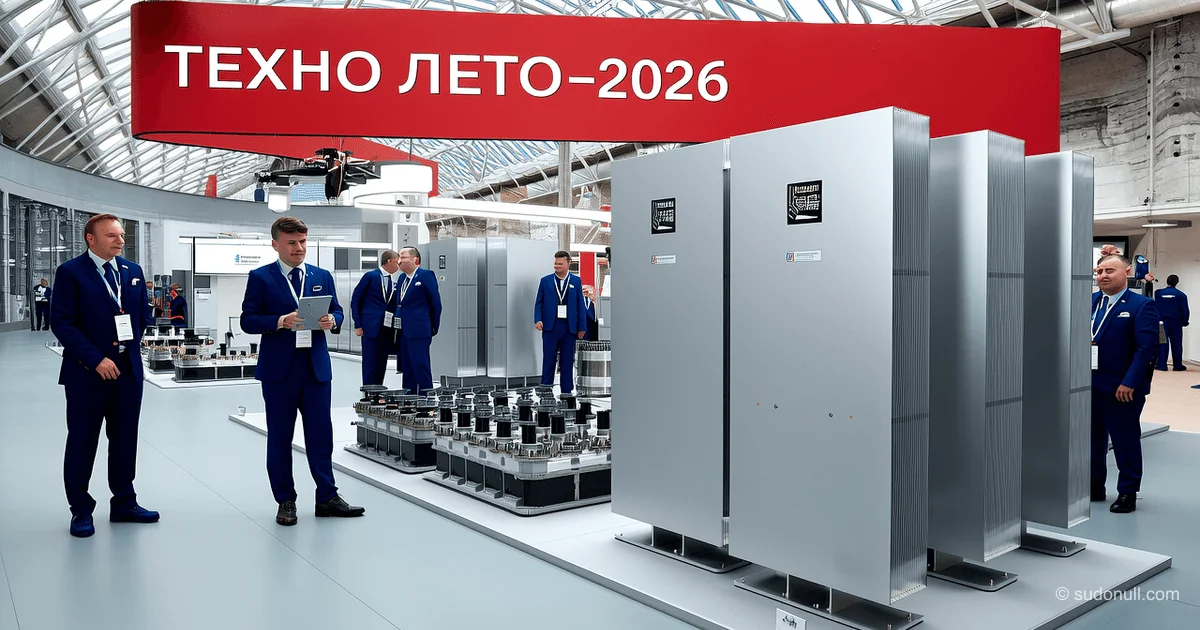
TECHNO SUMMER-2026 Forum Opens in Khabarovsk with New Energy Technologies
The exhibition features new-type industrial batteries and smart metering devices. The exposition area, with participation of over 30 enterprises, totaled 12,000 sq. m.
TECHNO SUMMER-2026 in Khabarovsk: Why the Energy Forum in the Far East Is Not an Exhibition but a Bet on a Technological Bridgehead
The Essence: Not a Showcase of Achievements, but a Real-Time Import Substitution Operation
From May 14 to 16, 2026, Khabarovsk hosts the industrial forum TECHNO SUMMER-2026 at the Arena Erofei venue. At first glance, it is a classic industry event: the 24th exhibition "Energy. Energy Saving," over 30 enterprises, 12,000 square meters of exposition. Officials say the right words about "dialogue between local enterprises and leading domestic manufacturers." Journalists list exhibits: new-type industrial batteries, smart metering devices, high-voltage transformers.
But the real significance of the forum is fundamentally different. TECHNO SUMMER-2026 is not an exhibition. It is a testing ground for technological sovereignty in a region located 6,000 kilometers from Moscow and 200 kilometers from the Chinese border. And the choice of venue is not a coincidence but a strategic calculation.
Chronology and Context: 24 Years of Evolution from a Fair to an Eastern Tech Hub
The forum's history dates back to the early 2000s, when the "Energy of the Far Eastern Region" exhibition was a modest regional platform for local power engineers. Over 24 years, it transformed into the cross-industry industrial forum TECHNO SUMMER, which in 2026 brought together several specialized exhibitions: energy, mining, architecture, transport. The scale grew, but the essence changed much deeper.
The key turning point was 2022 and the subsequent sanctions regime. The Russian energy sector faced a mass exodus of Western suppliers: Siemens, ABB, Schneider Electric either left or froze contracts. The Far Eastern region, home to strategic projects of Transneft, Rosseti, and Far Eastern Generating Company, found itself in a situation where replacing imported equipment became a matter not of savings but of infrastructure survival.
By 2026, the forum's focus shifted from demonstration to a contact exchange. As indicated in materials from previous years, the venue hosted an "Import Substitution Exchange" with participation of customers from Khabarovsk River Construction Company JSC, Far Eastern Generating Company JSC, Federal Grid Company of the Unified Energy System, and Transneft—Far East. These are not tick-the-box presentations. They are direct negotiations between those whose Western systems have broken down and those offering domestic replacements.
Who Wins and Who Loses
Far Eastern energy companies win—and here's why. Historically, the Far East was last in line for innovations. Equipment was shipped from Moscow and Europe, timelines dragged, logistics inflated project costs by 30-40% relative to European Russia. Now, when Russian manufacturers from Yekaterinburg, Novosibirsk, Barnaul, and Omsk bring products directly to Khabarovsk, Far Eastern power engineers for the first time gain access to technologies without European markup and without Moscow intermediation. In USD terms, this saves tens of millions of dollars on logistics and service maintenance.
Regional universities and young engineers win. Concurrently with the forum, regional career guidance festivals "Mining" and "Power Engineer" are held. Schoolchildren aged 7 to 18 compete in solving engineering cases, piloting drones, and technical modeling. Partners include Polymetal, Amur Minerals, Polyus, and Far Eastern Generating Company—real employers who scout future employees right on the venue. This is not a "tick-the-box festival" but a talent selection during a demographic trough. As noted by Sabina Mirzatova, a student at the College of Industrial Technologies, the profession of environmental lab technician is among the top 30 most in-demand professions in the region, and graduates are snapped up by thermal power plants, Transneft, and mining companies.
Small enterprises under the "Made in Khabarovsk Krai" brand win. 20 companies participate in the forum for free—expenses were covered by the regional center "My Business" under the national project. For small manufacturers that could never afford to rent 12,000 square meters of exhibition space, this is a unique chance to get noticed by major customers—from Rosseti to mining holdings.
Western suppliers that left lose. Every contract signed at the Import Substitution Exchange is not just lost revenue for Siemens or ABB. It is a point of no return. When a Far Eastern plant switches to Russian transformers and smart metering systems, reintegrating Western equipment becomes economically pointless. The Far Eastern market closes to them forever.
Regions that did not create their own "Techno Summer" lose. The concentration of manufacturers in Khabarovsk means that Khabarovsk becomes the decision-making center for procurement across the entire Far Eastern energy system. Regions that do not hold similar forums lose influence over supply chains.
What the Media Are Not Saying
First insight: 12,000 square meters in Khabarovsk is a geopolitical signal to China.
No media writes this, but the geographic logic is transparent. Khabarovsk is on the border with China. Chinese manufacturers are actively trying to fill the niche vacated by Western companies, especially in electrical equipment and industrial automation. A forum where 30+ enterprises from central Russia and Siberia present domestic developments is a demonstration that Russia does not intend to cede the Far Eastern energy market to Chinese suppliers. It is a claim for technological independence, backed by specific equipment samples, not just political declarations.
Second insight: The forum in May is preparation for the autumn-winter period.
Why does TECHNO SUMMER take place in May? Because May in the Far East is the last month before the repair and heating season preparation. Procurement decisions for equipment tenders are made in June-July. A forum in May is perfect timing for manufacturers to showcase products and for customers to include them in tender documentation before the procurement cycle begins. This is not a coincidence but a deliberate engineering of the business calendar.
Third insight: "New-generation smart metering devices" are not about convenience; they are about digital control.
When press releases mention "smart metering devices," the average person imagines convenient meters with automatic data transmission. In reality, these are industrial IoT class systems that monitor energy consumption in real time, detect anomalies and unauthorized connections, forecast peak loads, and integrate with billing systems. For energy companies, this is not convenience but a tool to reduce commercial losses, which in some Far Eastern networks reach 15-20%. Each percentage point reduction in losses means millions of dollars in additional revenue per year.
Forecast: Next 30 Days and 90 Days
Next 30 days (until mid-June 2026).
The forum ends today, May 16. Within two weeks after closing, the main phase begins: contracting. Major customers—Rosseti, Far Eastern Generating Company, Transneft-Far East—will analyze the presented samples and decide on including new suppliers in procurement procedures. If at least 5-7 of the 30+ enterprises receive contracts worth $1 million each, the total economic effect of the forum will exceed $50-70 million in direct orders.
Also during this period, regional authorities will start using the forum as an argument in negotiations with the federal center for additional funding of energy infrastructure. A successful demonstration of import substitution is a trump card when requesting subsidies.
Next 90 days (until mid-August 2026).
The key process is the deployment of pilot projects based on contracts concluded at the forum. New-type industrial batteries, high-voltage transformers, and smart metering systems will begin installation at facilities in the Far Eastern Federal District. By August, first data on their performance in real conditions will emerge.
If pilots show comparable or superior reliability relative to Western counterparts, this will trigger a second wave of contracts—not pilot but full-scale, with sums an order of magnitude higher. If pilots reveal issues (normal for new developments), manufacturers will receive feedback and time for refinement before the next procurement cycle.
The festivals "Mining" and "Power Engineer" will yield a second effect by August: top participants will go to the specialized session "Mining School" at the regional center "Sozvezdie" and to the all-Russian competition "#TogetherBrighter." These are elements of a long-term funnel—from today's schoolchildren solving cases at TECHNO SUMMER, in 5-7 years will grow engineers who will design the next generation of Far Eastern energy systems.
Bottom line. TECHNO SUMMER-2026 is not a regional exhibition but an assembly point for technological sovereignty on the country's eastern flank. For decades, the Far East was a periphery dependent on equipment supplies from European Russia and abroad. The forum in Khabarovsk marks a new alignment: manufacturers themselves come to the Far East, compete for contracts, and build direct relationships with customers. This is not just "business-government dialogue." It is a reshaping of the logistics map of Russian energy, and it happens 200 kilometers from the Chinese border—which in itself speaks louder than any political statements.
— Editorial Team










No comments yet.