Caterpillar bets on 'physical AI': construction goes digital
At CES 2026, the heavy equipment giant showed how excavators and bulldozers are learning to think on the go. Caterpillar has plowed cloud technology into hardware using Nvidia Thor chips, enabling machines to work autonomously where there's no connectivity, and a new AI assistant understands speech, text, and video.
Brains for a bulldozer: How Caterpillar turns heavy machinery into 'thinking' machines
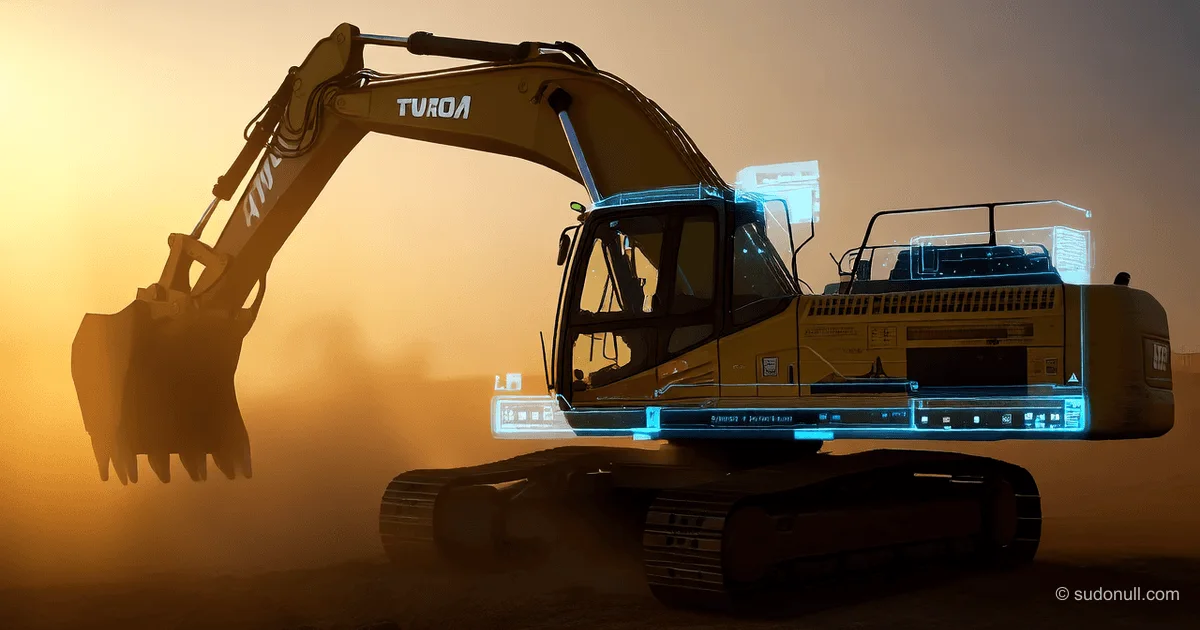
An excavator that understands human speech and gives safety tips — this isn't a sci-fi episode but the centerpiece of Caterpillar's booth at CES 2026. The industrial giant brought a six-ton Cat 306 CR to Las Vegas to show that the construction site is becoming the next arena for the AI revolution. The partnership with Nvidia elevates the hardware to a level where the machine itself warns the operator about danger without waiting for a cloud command.
Construction that talks: What was shown in Vegas
On January 7, 2026, Caterpillar CEO Joe Creed took the CES stage with an admission: people wonder why a bulldozer manufacturer belongs at a consumer electronics show. He answered with a live demo.
Cat AI Assistant — a multimodal chatbot that understands voice, text, images, and video — worked right inside the mini-excavator's cab. The operator set a boom height limit by voice to avoid power lines. No cloud. No latency. Just an Nvidia Jetson Thor chip inside the machine and the Riva voice engine processing commands locally.
"Our customers don't live in front of a laptop — they live in the dirt," explained Brandon Hootman, Vice President of Data and AI at Caterpillar. That's why the entire architecture is designed for offline operation in places where cellular service simply doesn't exist.
At the same time, the company announced five autonomous machines — excavators, bulldozers, wheel loaders, haul trucks, and compactors. They can dig, load, grade, haul, and compact without an operator in the cab.
A $30 billion bet: What's behind the announcement
Caterpillar isn't improvising on AI. Over the past 20 years, the company has invested about $30 billion in R&D, and by 2030 it plans to increase digital technology investments by 2.5 times.
Autonomous Cat machines aren't a recent invention. The company has been hauling ore with autonomous trucks in mines for over 30 years. Its fleet now includes 1.5 million connected assets worldwide. Every second, these machines send back about 2,000 data messages.
The difference is that AI is now moving from quarries to ordinary construction sites. The complexity is higher: a mine is a controlled environment, while an urban construction site is chaotic and unpredictable. That's exactly why Jetson Thor is needed — a real-time platform capable of processing billions of data points in milliseconds.
The technical setup looks like this: onboard, Qwen3 4B runs via vLLM — a language model that understands the operator's intent and generates responses without an internet connection. Machine data is pulled from Helios, Caterpillar's unified digital platform that stores verified information about every component and assembly.
Digital twins and factory simulations
A separate track of the Nvidia partnership involves digital twins of factories on the Omniverse and OpenUSD platform. Caterpillar is already testing virtual copies of its manufacturing sites in the US. Engineers design, simulate, and optimize shop floor processes before anything is built in the real world.
This isn't just a pretty 3D picture. Nvidia AI Factory — an integrated hardware-software stack — enables training, deploying, and improving AI models across the entire production line. Spare parts demand forecasting, automatic maintenance scheduling, machine load optimization — all of this is moving under algorithm control.
As Nvidia CEO Jensen Huang noted: "For a century, Caterpillar has built machines that shaped the world. In the AI era, Nvidia and Caterpillar are joining forces across the spectrum — from autonomous construction fleets to data centers powering the next industrial revolution."
Who benefits and who needs to retrain
The benefit for Caterpillar itself is clear: the construction industry suffers from a chronic shortage of skilled operators. Autonomous and semi-autonomous machines fill that gap. They also promise to reduce accidents — human error remains the leading cause of incidents on construction sites.
Nvidia gains a proving ground for its 'physical AI' strategy. Deepu Talla, Vice President of Robotics and Edge AI, puts it bluntly: "Physical AI is the next wave. We're building computers that train models, simulate them, and deploy them in robots — whether it's an autonomous vehicle or a Caterpillar machine."
Competitors like Komatsu and Volvo CE are also investing in autonomy, but the Cat-Nvidia alliance sets the bar for integration depth: from the chip in the cab to the factory's digital twin.
The most sensitive issue is people. Joe Creed took the stage to announce $25 million for a five-year retraining program. The funds will go to grants for schools, colleges, and local partner organizations that train specialists for digital construction. "The people who build and manage the invisible layer of the technology stack don't disappear — they become more visible," Creed assured the applauding audience.
Exactly which professions will emerge is not yet fully clear. It's about operators of autonomous fleets, technicians for AI system maintenance, and digital twin specialists. Mass layoffs won't happen immediately: the lifecycle of a construction machine is decades, and Cat has already stated that the AI Assistant will be available in retrofit kits for existing fleets.
What's next: From assistant to full autonomy
The commercial launch of the first five machines with integrated Cat AI Assistant will happen "soon" — Caterpillar hasn't given exact dates, but at the March ConExpo-Con/Agg 2026, the company showed an expanded lineup of autonomous equipment. After that, a phased market rollout will begin.
An important nuance: Cat AI Assistant will first appear in office applications for equipment owners and on the website, then move into the cab. This is a deliberate strategy — first give construction managers a planning tool, then let AI engage in direct dialogue with the operator.
The main technological direction is set. Edge computing allows machines to think on-site, without the cloud. Digital twins make it possible to simulate scenarios before going to the site. And voice control lowers the entry barrier to zero — the driver doesn't need to be an IT specialist to work with advanced automation.
If Caterpillar's bet pays off, in five years the construction site will look different: fewer people in cabs, more at fleet control consoles. And the yellow excavator will become as common a carrier of AI as the smartphone in your pocket today.
— Editorial Team








No comments yet.