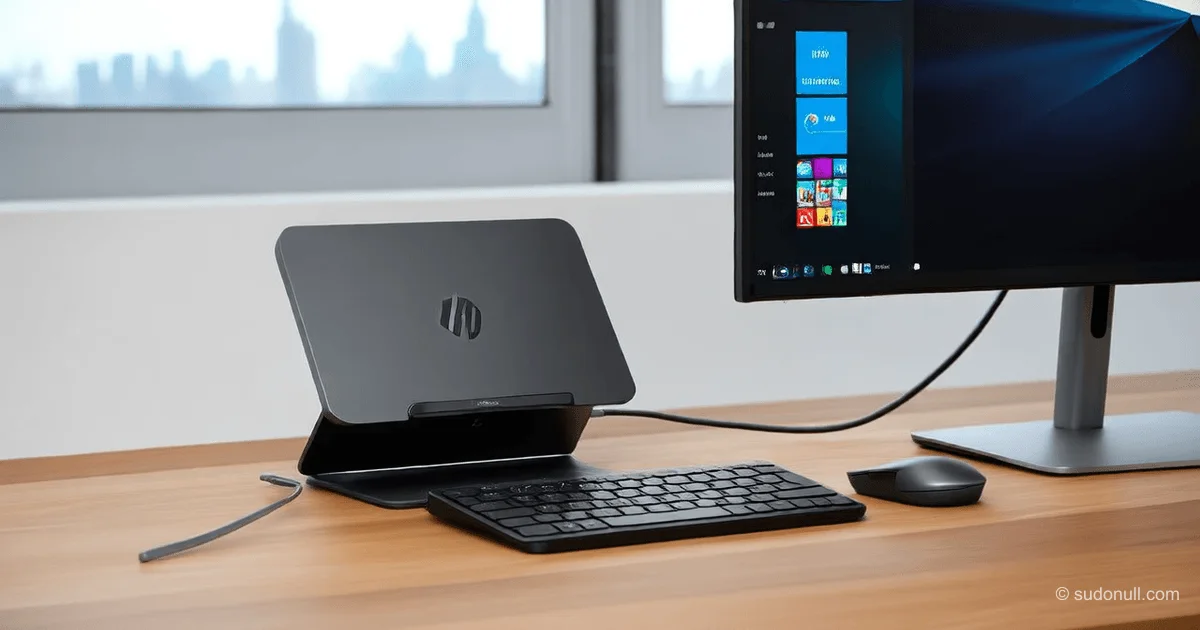
Laptop Without a Body: HP Turns a Keyboard into a Full-Fledged PC
Imagine a desktop thinner than a phone that sits right under your hands—the HP EliteBoard G1a packs a full AMD Ryzen with a neural processing unit into a keyboard chassis. With this modular "board," the system unit is history, and the office can go anywhere.
HP gutted a laptop and stuffed it into a keyboard. The system unit is officially dead
The system unit is no longer needed. On January 6, 2026, at CES in Las Vegas, HP unveiled a device that redefines the very concept of a "desktop computer": the EliteBoard G1a is a full-fledged PC embedded directly into a keyboard. No separate case. No box under the desk. Just a board 12 mm thick and weighing 750 grams—lighter than half the laptops on the market.
Under the keycaps hides an AMD Ryzen AI 300 series with a 50 TOPS neural processing unit, enough for Copilot+ PC status and local execution of all AI features in Windows 11 Pro. Simply connect the keyboard to any monitor via USB-C, and you have a ready-to-use workstation. HP calls this the answer to the "hybrid reality" where the office is here today and there tomorrow.
On May 10, 2026, the device reached India with a starting price of 89,900 rupees—about $1,080. Sales go through the official HP online store. Alongside it on the shelf is the OmniPad 12 for 48,999 rupees—a tablet for students and first-time computer buyers.
Key insight: who needs a keyboard with brains?
The EliteBoard G1a form factor is not a crazy experiment by designers bored of drawing rectangular cases. It is a cold, pragmatic calculation targeting a specific market gap. HP cites its own 2025 Work Relationship Index: only 44% of workers believe their technology matches their work style. Nearly 60% of people struggle daily with the tools they are given.
Guayente Sanmartin, HP's Senior Vice President of Commercial Systems, diagnoses the issue: "Work is being redesigned in real time—where it happens, how it happens, and what tools employees need to stay productive." The EliteBoard is a bet on a scenario analysts call "hot-desking with portable computing power." An employee comes to the office, plugs the keyboard into a shared monitor, and works. In the evening, they take it home, plug it into their home screen, and continue.
The system supports two 4K monitors via daisy-chain over a single cable. The built-in 35 Wh battery lasts 3.5 hours without a power outlet. Inside are two SODIMM slots for DDR5-5600 up to 64 GB, an M.2 NVMe SSD up to 2 TB, and a MediaTek MT7925 chip with Wi-Fi 7 and Bluetooth 6.0. HP Smart Sense and AMD Auto State Management technologies dynamically adjust performance, cooling, and battery usage based on the current task.
Classification collapse: why IT pros are panicking
The EliteBoard G1a announcement exposed a problem no one thought about while PCs were obviously PC-like. Sanchit Vir Gogia, Chief Analyst at Greyhound Research, called it "blurring of established asset accounting boundaries." IT departments have classified keyboards as peripherals for decades—cheap, replaceable, not worth strict tracking. Now the keyboard is the primary computing device. An inventory error becomes a security hole and an audit failure.
It gets worse. A broken key used to mean replacing a $30 consumable. A broken key on the EliteBoard means downtime for an entire computer. Spilled coffee destroys not a peripheral but a work tool with corporate data. Support teams will have to learn new disassembly procedures and stock unique spare parts.
HP counters with built-in protection mechanisms: HP Wolf Security for Business with hardware-level firmware attack protection, a physical security cable, and an optional lock. The device has EPEAT Gold certification using recycled plastic. But analyst Gogia concludes: "The keyboard PC is a tactical solution for specific roles, not a replacement for the entire device fleet."
Who gets the throne: the form factor war
HP is playing on multiple fronts. The EliteBoard G1a targets call centers, service bureaus, and regulated environments where workstations are standardized and employees move between exactly two points. No docking stations, fewer cables, cleaner desks.
At the same time, the company showed the EliteDesk 8 Mini (G1a)—a classic mini-PC with a one-liter volume using the same AMD Ryzen AI PRO processor with a 50 TOPS NPU. The rear panel is modular: you can add Thunderbolt 4, 2.5GbE Ethernet, or additional video outputs. The price starts at $759. This is a direct jab at Apple's Mac Mini—HP is building a Windows alternative for those who need compactness but not the radicalism of a keyboard PC.
A comparison of the three approaches looks like this: the EliteBoard G1a eliminates the system unit as a category, the EliteDesk 8 Mini preserves traditional architecture in an ultra-compact case, and laptops lose their monopoly on mobility.
The Verge sums up the situation best: "HP stuffed an entire desktop computer into this keyboard." Reviewer Antonio Di Benedetto dubbed the device "The Keyputer" and lamented only the lack of mechanical switches and hot-swap—but admitted that for office use, a membrane keyboard with 2 mm travel is tolerable. A teardown revealed that HP made the keyboard module replaceable and spill-resistant.
What will change after March
Commercial launch of the EliteBoard G1a took place in March 2026; the Indian market got the device in May. HP has not yet disclosed exact prices for the US and Europe, but the Japanese price tag—from 392,300 yen for the base configuration—indicates a premium segment.
Analyst forecast: a mass shift to keyboard PCs will not happen. But in the niche of hot desks, temporary workstations, admin counters, and classrooms, the EliteBoard can capture a significant share. Scaling numbers will depend on price: if it matches a business laptop of comparable power, IT directors will start calculating seriously.
The main takeaway from CES 2026 for the PC market is simple: HP proved that a computer can look like anything. The system unit dissolved into the periphery. Tomorrow it may dissolve into the monitor, the day after into the desk. The era of big boxes under the desk is over. It remains to be seen which vendor will first embed a desktop into a mouse pad.
— Editorial Team






No comments yet.