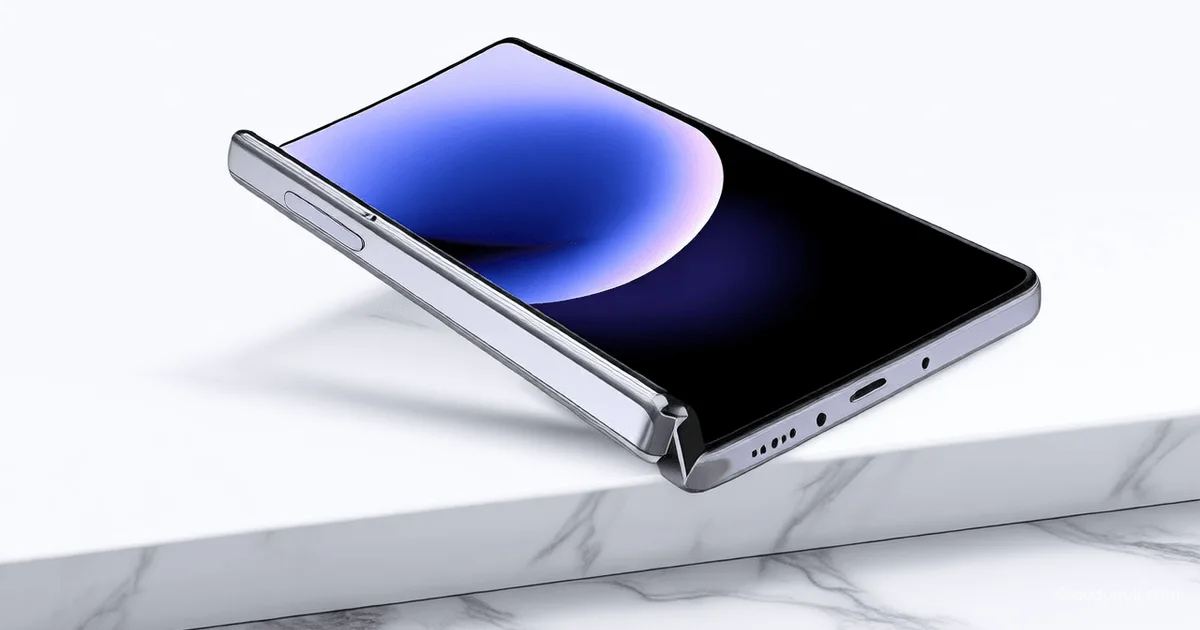
Samsung Kills the Crease: Galaxy Fold Display No Longer Wrinkles
At CES 2026, the South Korean giant showcased a prototype of a flexible display with no visible seam, which also hides the selfie camera under the matrix. If rumors are true, this perfectly smooth sheet will become the screen for the first foldable iPhone and a new wide Galaxy, putting an end to design compromises in clamshells.
For seven years, Samsung bent glass, and we winced at the crease in the middle of the screen. January 2026 put an end to that. At CES in Las Vegas, Samsung Display showed a prototype of a flexible OLED display with no visible seam — absolutely smooth, even when light hits at the most awkward angle. Next to it, for contrast, lay the Galaxy Z Fold 7: its crease was still noticeable, while on the new device, text flowed across the fold without the slightest distortion.
Insider Ice Universe posted macro photos of the prototype with the description "excellent." Under the matrix hid a selfie camera, and that was the second bombshell: no cutouts, no holes, no islands — seamless glass from edge to edge. SamMobile, whose journalists managed to see the booth before Samsung suddenly removed it, confirmed: "there is no crease at all." The company later explained that it was showing an R&D concept without a fixed commercialization timeline. But the chain of events has already been set in motion.
Laser Instead of Chemistry: How the Crease Is Killed
The secret of the new display is a metal substrate plate processed with a laser. The technology is supplied by Korean Fine M-Tec, and TF International analyst Ming-Chi Kuo predicted back in July 2025 that it would form the basis of both the Galaxy Z Fold 8 and the first foldable iPhone. Instead of traditional chemical etching, the laser drills dozens of microscopic holes. When the phone is folded, stress is distributed evenly across the entire hinge area, rather than concentrated along a single line. The result: no plastic deformation, no permanent groove.
Samsung Display calls this technology MONT FLEX and combines it with LEAD — a polarizer-free design that reduces power consumption by 37% while simultaneously increasing brightness. The numbers: the crease depth decreased by about 20% compared to the previous generation, and according to the visual impression of those present, it disappeared entirely.
A separate story is the sudden disappearance of the booth. Samsung Display removed the prototype from public display shortly after CES started. A company representative told MacRumors that the dismantling coincided with the press tour schedule, and the booth was shown to several groups throughout the day. But the impression remained: a technology capable of turning the market upside down was shown — and then immediately hidden.
Three Paths to One Goal
Samsung is not alone in the hunt for a crease-free fold. The industry has split into three camps.
BOE at MWC 2026 in Barcelona showed its approach — a multi-neutral layer architecture with a gradient elasticity module. Instead of drilling the substrate, the Chinese redistribute stress within the panel itself. Result: a reduction in crease visibility by more than 40%. The technology is cheaper because it requires no additional components, and has already passed mass production validation in the Honor Magic V6.
Visionox at ICDT 2026 took a third path — replacing the PET film that has served as internal support in flexible modules for decades with a high-rigidity non-plastic material. PET is the root of evil: plastic deformation accumulates with each bend. The new material plus a highly restorative optical adhesive gives a 1.6x acceleration in shape recovery. The measured height difference between the bending zone and the flat part is less than 30 microns, and the change in crease depth after 200,000 cycles is less than 20 microns. All this in a module 0.4 mm thick, 20% thinner than standard.
Strategies diverge: Samsung drills the substrate, BOE reconfigures layers, Visionox changes material chemistry. But the goal is the same — a display that bends without a trace.
Who Wins, Who Falls Off the Board
The main beneficiary is Apple. The company has delayed the foldable iPhone for years precisely because of the crease. Tim Cook and his team demanded seamless glass, and now Samsung Display is ready to deliver. Rumors point to September 2026 for the iPhone Fold announcement: a 5.5-inch external display, a 7.8-inch internal display when unfolded, thickness of 4.5–4.8 mm, a battery up to 5,800 mAh, a 24 MP under-display camera, and a price tag of around $2,400.
Samsung Display has already signed a three-year exclusive contract to supply foldable OLED panels for three generations of the iPhone Fold. The first batch is 3 million panels in 2026, although initial figures were 13-15 million. Apple reduced the order but maintained exclusivity. BOE tried to break into the supply chain but failed qualification — Apple deemed the Chinese manufacturer unable to meet quality or volume requirements.
For Samsung Mobile, the situation is paradoxical. On one hand, the display division will profit from three generations of iPhone Fold. On the other, the mobile division will face a direct competitor using its own technology. The answer is the Galaxy Wide Fold, which, according to SamMobile, will launch simultaneously with the Galaxy Z Fold 8 in summer 2026 and feature a wider format close to the proportions of the iPhone Fold.
Who loses: BOE and Chinese brands. BOE grew its share to 34% of the foldable panel market in 2025, compared to 43% for Samsung Display. But the missed Apple contract means Samsung will cement its dominance. Honor, Vivo, Oppo, and Huawei will get BOE's technology late, while the premium segment goes to Samsung and Apple.
Smooth Future: When to Expect and at What Price
Samsung Display called the prototype an R&D concept, but analysts have no doubt: commercial launch will occur in the second half of 2026. The Galaxy Z Fold 8 and Galaxy Wide Fold are expected in July-August, the iPhone Fold in September, although there is a risk of delay to December or early 2027 due to production challenges at Apple.
The three-way race for a crease-free fold means that by 2027-2028, any foldable phone over $1,000 will have a seamless display. The technology will quickly become cheaper: BOE already offers a solution without additional components, Visionox plays on material replacement, Samsung optimizes laser drilling.
For the user, it all comes down to a simple test: open the phone — and you don't see where it folds. We've waited seven years for this moment. Less than a year to go.
— Editorial Team










No comments yet.