Nvidia Alpamayo teaches self-driving cars to 'think out loud' like humans
Nvidia unveiled an open model that doesn't just see pedestrians—it builds reasoning chains for driving, just like an experienced taxi driver. It's been called the 'ChatGPT moment for physical AI'—from now on, autopilots learn to handle edge cases without panic or brute-force enumeration.
Your fridge already thinks. But Nvidia just taught a car to reason out loud on the road
On January 6, 2026, Jensen Huang took the stage at CES and uttered a phrase no one expected from a graphics card maker: 'The ChatGPT moment for physical AI has arrived.' He wasn't talking about yet another chatbot. Nvidia unveiled Alpamayo—an open family of models, simulators, and datasets that makes a car not just see a pedestrian, but build a chain of reasoning: 'A ball on the road means a child might run out next.'
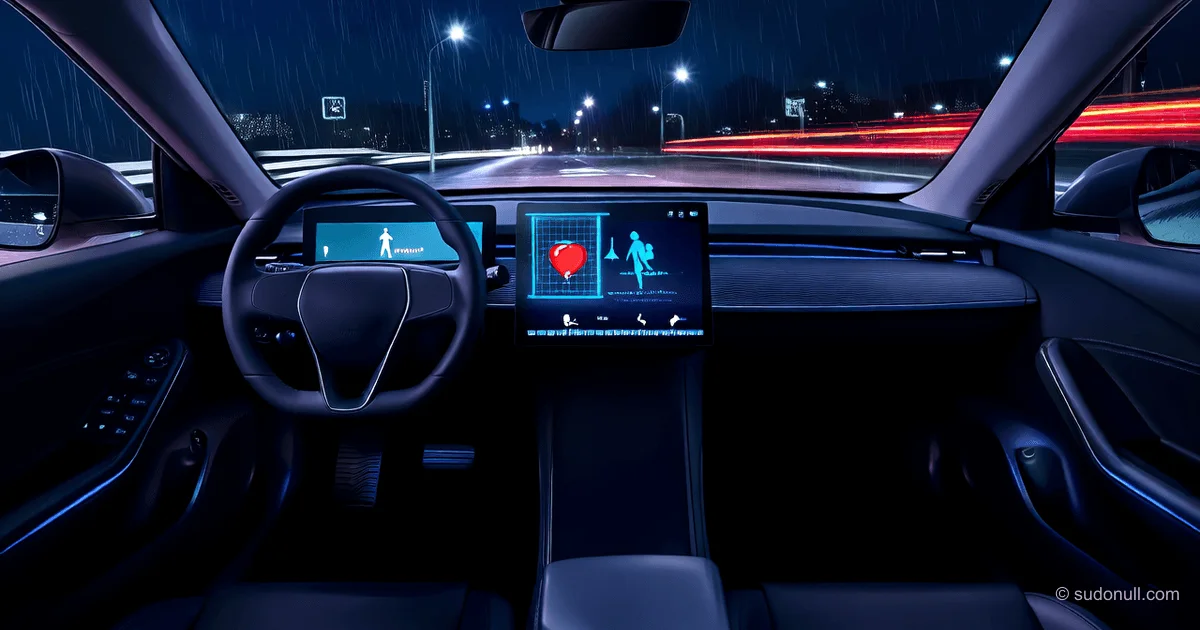
This isn't a metaphor. Alpamayo 1 is a 10-billion-parameter vision-language-action model that takes a video stream from cameras, generates a driving trajectory, and simultaneously writes a textual explanation for every maneuver. The car literally 'thinks out loud,' like a taxi driver commenting on their actions to a trainee.
Causal chain instead of a black box
Traditional autopilots suffer from one fatal problem: when a scenario falls outside the training distribution, the system either panics or freezes. Engineers call this the 'long tail'—an infinite set of rare and strange situations that cannot be anticipated in advance.
Alpamayo solves the problem differently. Instead of relying on separate perception and planning modules, the model uses chain-of-thought reasoning. It breaks down a complex scene into steps, traces cause-and-effect relationships, and only then makes a decision.
The key innovation lies in the training method. Nvidia engineers applied 'causal chain-of-thought labeling'—an algorithm that ties reasoning to the specific moment of decision-making. For example, when the light turns green, the model records: 'Traffic light switched, opposite lane is clear, no pedestrians, starting motion.' No information leakage from the future, no magic.
Result: reasoning accuracy improved by 121% compared to standard textual chain-of-thought. Average trajectory deviation on complex scenarios decreased by about 12%.
Three pillars of Alpamayo
Nvidia didn't lock the technology in a proprietary garage. Alpamayo is a fully open platform consisting of three components.
Model. Alpamayo 1 is available on Hugging Face with open weights and inference scripts. Developers can use it as a 'teacher'—distill knowledge into compact models that can actually run on onboard hardware.
Simulator. AlpaSim is an open-source environment for closed-loop testing. Realistic sensors, configurable traffic, millions of virtual kilometers before hitting real asphalt.
Data. 1,700+ hours of driving collected in dozens of cities and weather conditions—specifically focused on those 'long-tail' edge cases.
The trio works as a self-sustaining loop: the model generates reasoning, the simulator tests it in virtual miles, data is enriched with rare scenarios, and the model is fine-tuned.
By March 2026, the platform had grown. Alpamayo 1.5 was released with support for text navigation commands ('turn left in 200 meters'), variable camera counts, and real-time user questions. Scripts for supervised fine-tuning and reinforcement learning post-training appeared—developers can adapt the model to their data and desired behavior.
Why automakers are lining up
Industry reaction was immediate. Lucid Motors, Jaguar Land Rover, and Uber publicly expressed interest in Alpamayo for developing Level 4 stacks.
Kai Stepper, VP of ADAS at Lucid, put it plainly: 'The shift toward physical AI underscores the growing need for systems that can reason about real-world behavior, not just process data.'
JLR bet on openness. Thomas Müller, Executive Director of Product Engineering, noted: 'By opening models like Alpamayo, Nvidia accelerates innovation across the entire autonomous driving ecosystem.'
Uber sees the technology as a solution to the rare-scenario problem—Sarfraz Maredia, head of autonomous mobility, called the 'long tail' the defining challenge of autonomy.
The interest is backed by concrete timelines. Mercedes-Benz announced plans to launch the CLA model with Nvidia DRIVE AV in the US by the end of 2026. And according to Counterpoint Research, Hyperion—Nvidia's reference architecture for Level 4—has already attracted Tier 1 suppliers Magna, Bosch, Denso, ZF, and Continental.
Musk isn't worried. Yet
Elon Musk reacted to the announcement with characteristic bravado. 'Not worried, sincerely hope they succeed,' he wrote on X, adding that traditional automakers would need 5-6 years to integrate cameras and AI computers into mass-market cars.
The market, however, isn't so calm. Tesla shares fell 4.14% on the day of the Alpamayo announcement, while Uber rose 5.95%. S&P Global analysts called the open-source model an accelerator of cross-industry innovation.
The numbers support optimism. Fortune Business Insights estimates the autonomous driving market at $13.6 trillion by 2030. Waymo already performs 450,000 paid rides per week, and Tesla is building its own robotaxi business with a Morgan Stanley valuation of $1.5 trillion.
Hardware matters
Behind the software breakthrough lies a hardware strategy. Alpamayo isn't just Nvidia's charity. Counterpoint Research puts it bluntly: by opening the software layer, the company expands demand for data center GPUs and simulation platforms, even among customers who don't put Nvidia chips in production vehicles.
DRIVE Thor—the central computer of the Hyperion platform—is designed to run distilled versions of Alpamayo onboard. A classic rules-based safety stack runs in parallel, and a real-time policy arbiter chooses between heuristic and AI-based decisions.
This is a pragmatic hybrid: the end-to-end model offers human-like behavior, while deterministic rules back it up in critical situations. Regulators prefer this approach over a pure 'black box.'
What will change in two years
Alpamayo 1.5 can already answer passenger questions in real time. 'Why did you slow down?' asks the human. 'There's a crosswalk ahead, a cyclist is approaching from the right,' the car explains.
This solves the trust problem. It's one thing to sit in a self-driving cabin that silently turns the wheel. It's quite another to hear a rational explanation for every maneuver.
Nvidia is also experimenting with transferring reasoning from textual space to latent space. The result is a 2-4x inference speedup and the model's ability to 'think longer' in complex situations and faster in simple ones. Something like human intuition implemented in vector spaces.
The near-term goal is 100 milliseconds per planning cycle. Engineers are already applying speculative decoding and sparse attention to cut latency by four times without quality loss.
When these optimizations reach production cars, robotaxis will cease to be a 'five years away' technology. Alpamayo bet that safe driving is not about reaction, but about reasoning. And that bet now looks damn serious.
— Editorial Team










No comments yet.