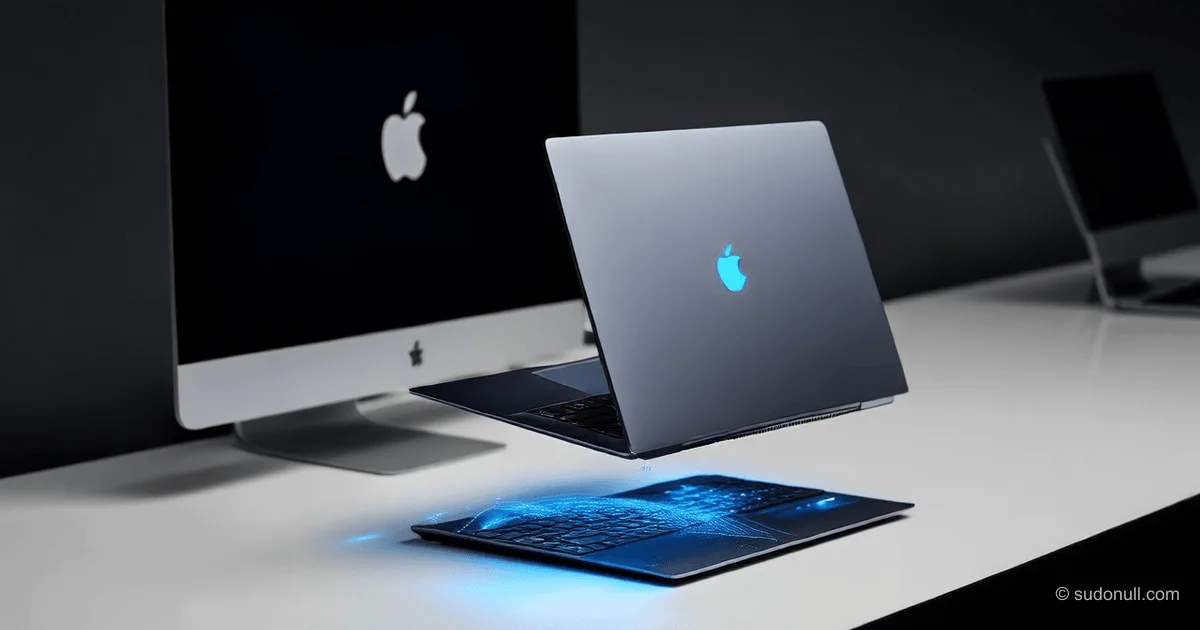
MacBook Neo Rumors: Apple Sets Trends in the AI Laptop Segment
Discussion of Apple's unconfirmed MacBook Neo is gaining momentum, forcing Google and Microsoft to respond. The device is expected to be AI-focused.
MacBook Neo: How Apple Made Google and Microsoft Play Catch-Up
What's been happening around the MacBook Neo over the past week is a classic case of collective panic disguised as strategic response. Google announces "Googlebook," Microsoft publishes an official whitepaper analyzing a competitor's product, and the entire PC industry simultaneously tries to prove that the device is both groundbreaking and not worth attention. Headlines are rife with phrases like "MacBook Neo has kept the PC industry up at night." But the real story runs deeper than a battle for the $600 laptop segment.
The Core: What's Really Happening
The MacBook Neo isn't just a budget Mac. It's a Trojan horse for capturing the AI audience. Apple has brought to market a device with a 16-core Neural Engine for $590, forcing competitors into a position where they have to justify themselves.
Events of the last 48 hours are telling. Microsoft released a whitepaper—an official document aimed at proving the MacBook Neo "isn't as good as it seems" and recommending more expensive alternatives. Google presented the "Googlebook" concept—an AI-focused device with Gemini that suspiciously resembles Apple's brainchild in design philosophy.
This can't be a coincidence. When a tech giant commissions a formal study of a competitor's product, it's an act of acknowledging a threat. No one writes whitepapers about products that don't matter.
Timeline and Context
Let's reconstruct the sequence:
- March 11, 2026 — MacBook Neo goes on sale. A18 Pro, 16-core Neural Engine, 8 GB unified memory, $590.
- April–May 2026 — Sales skyrocket. Apple doubles its production plan to 10 million units. Deliveries stretch to 2–3 weeks.
- May 17–18, 2026 — Google and Microsoft react almost simultaneously. Googlebook as a concept and Microsoft's whitepaper create "Neo week" in the media.
This isn't a reaction to a one-time event. It's the cumulative effect of two months of sales that exceeded even Apple's own forecasts. According to analysts, the company initially planned to sell about 5 million units in the first year—actual demand turned out to be twice that.
A telling detail: Apple used "defective" A18 Pro chips with one GPU core disabled. This binning practice is a standard way to reduce the cost of budget models. Ironically, defective chips ran out faster than expected, and Apple now has to order full A18 Pro chips from TSMC, artificially disabling the sixth core. This is more expensive and raises questions about maintaining the $590 price.
Who Wins and Who Loses
Apple wins—but not in an obvious way. The main asset here isn't revenue from hardware sales (margins on a $590 device with bin chips are minimal), but expanding the macOS user base. Every new Neo user is a potential subscriber to iCloud, Apple Music, Apple TV+. Apple's services segment has a margin of about 75%. With an installed base of 2.5 billion devices, each new percentage point of penetration means billions of USD in recurring revenue.
Google loses. The announcement of Googlebook as an "AI-first Chromebook" reveals a lack of its own strategy. Googlebook is a clone of the Neo concept, but on Chrome OS with Gemini. The fundamental problem: Chrome OS lacks a native AI ecosystem on par with Apple Intelligence. Without its own silicon, without a Neural Engine, without Private Cloud Compute architecture, Googlebook remains a cloud terminal. It's not a competitor to Neo, but an attempt to replicate its aesthetics without the technological underpinnings.
Microsoft loses—but as a symptom, not the disease. The whitepaper against the MacBook Neo signals deep insecurity. A company controlling 70% of the desktop OS market spends resources analyzing a $590 device. Microsoft's problem isn't that Neo is taking market share, but that the Windows ecosystem can't offer a similar AI experience in this price segment. The Qualcomm Snapdragon X costs more to procure than the A18 Pro, and Copilot+ PCs start at $999.
Consumers win—temporarily. A price war on AI laptops is inevitable. But this window of opportunity will close as soon as Apple raises the Neo's price or removes the base 256 GB model, as analysts predict.
What the Media Isn't Saying
The insight I consider key: The MacBook Neo is a testing ground for the "AI as a basic function, not a premium add-on" model.
Notice: Apple doesn't position the Neural Engine as an option. The 16-core Neural Engine is present even in the base $590 model. This is a fundamentally different approach from Microsoft with Copilot+ (only on new PCs with NPU 40+ TOPS) or Google with Gemini (cloud dependency).
What this means for Apple's strategy: the company is preparing infrastructure for the launch of a radically updated Siri on iOS 26.4 with Google Gemini integration on Private Cloud Compute. Millions of Neo users with Neural Engine on board form a distributed AI network ready for on-device inference. Apple doesn't need to rent as much server capacity as its competitors—part of the computation is offloaded to user devices.
Apple's costs for licensing Gemini are about $1 billion per year. Compare that to Microsoft and Google's capital expenditures on AI data centers—tens of billions of USD annually. Apple has chosen the path of "someone else's model, our own hardware"—and the MacBook Neo is a strategic investment in a distributed computing network, not just a budget laptop.
The second hidden plot: Supplies of binned A18 Pro chips have run out. Apple is ordering new ones from TSMC at full cost. This makes the current $590 price economically unsustainable. The decision will be telling: if Apple raises the price to $699, it means growing the AI device base was the true goal. If it keeps $590 and sacrifices margin, then market share capture is the priority. I'm betting on the former.
Forecast: Next 30 Days and 90 Days
30 days (by mid-June 2026):
Apple will adjust the MacBook Neo lineup. Either the base 256 GB model will disappear, or the price will rise to $649–699. The education discount will remain at $499–599 to retain the student audience.
Google will release Googlebook specifications. If the device actually hits the market at around $599, it will signal a price war for the AI audience.
Microsoft will continue "denial"—but instead of whitepapers, it will start subsidizing prices on entry-level Copilot+ PCs. Without this, they lose to Neo in a pure price/performance comparison.
90 days (by August 2026):
Apple may introduce the Neo on the A19 Pro—a next-generation chip that solves the binned silicon shortage. This would extend the lineup's lifecycle and strengthen its position ahead of the updated Siri launch.
iOS 26.4 will be released with Gemini integration. Then the MacBook Neo will transform from just a "good budget laptop" into "the most affordable AI computer with a full on-device Neural Engine." This will be a second wave of sales, and competitors will find themselves in an even tougher position.
A key signal for the entire industry: if Apple starts selling the MacBook Neo in China and India at adapted prices (below $500), it will mean the "AI for a billion" strategy is not a marketing slogan but a business plan. The Googlebook as an idea will then die before it's born—replicating Neo's success on Chrome OS without its own silicon is impossible.
In conclusion: The MacBook Neo is less about laptops and more about who will own the AI audience three years from now. Apple is betting on "every device a Neural Engine, every user local AI." Google and Microsoft are still reacting, not leading. That's the whole difference.
— Editorial Team










No comments yet.