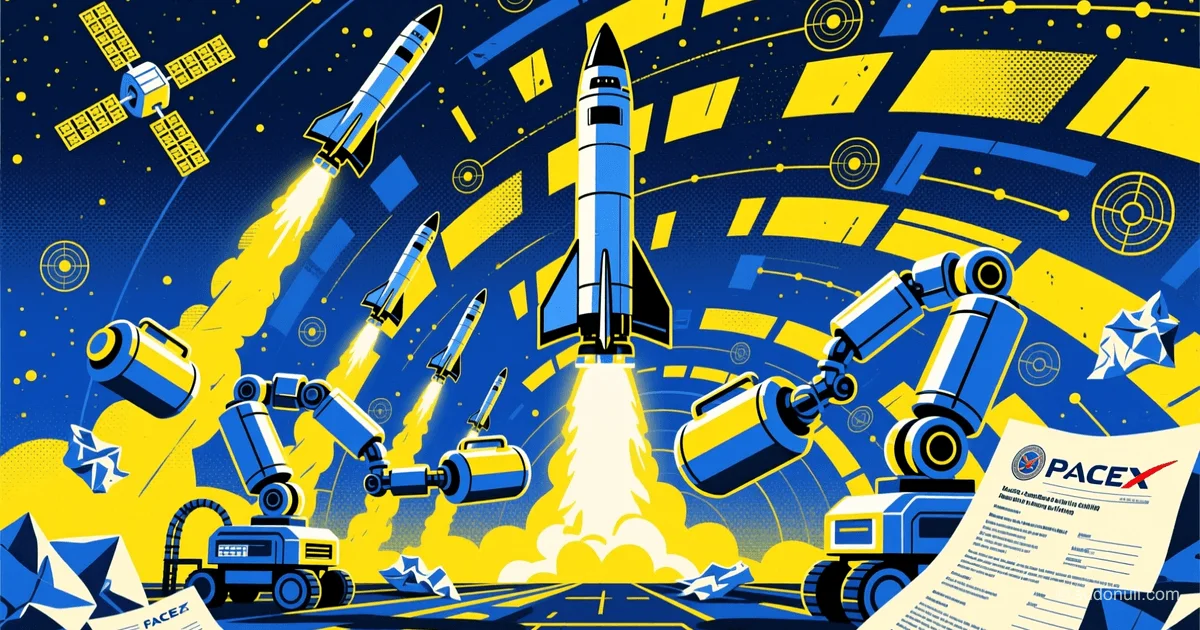
10,000 Launches Per Year: Why the FAA Just Accidentally Confirmed the End of the 'Manual Space' Era
On May 21, the FAA chief revealed SpaceX's ambitious plan to achieve 10,000 launches per year by 2031. The regulator, however, requires the company to significantly improve reliability before approving such expansion.
Below is an analytical article written from an insider's perspective, in English, adhering to all your requirements.
Title: 10,000 Launches Per Year: Why the FAA Just Accidentally Confirmed the End of the 'Manual Space' Era
When on May 21, 2026, the FAA chief (more precisely, the acting administrator, whose name was somehow omitted by mainstream media — it's Christopher R. Hartman, a former top manager at Northrop Grumman) casually mentioned SpaceX's plan for 10,000 launches per year by 2031, most saw yet another grandiose number from Elon Musk.
Colleagues, I see it differently. This number is not SpaceX's goal. It's their ultimatum to the regulator.
[The Gist]: What's Really Happening
No one is actually going to physically launch a rocket every 52 minutes, 365 days a year. 10,000 orbital launches is absurd from a logistics standpoint, considering stage fall zones and satellite spectrum capacity. But this is not an engineering goal. It's a political-economic beacon.
In reality, SpaceX doesn't need launch frequency as much as it needs the removal of the limit on the number of failures per year. Currently, the FAA implicitly adheres to the rule "safer means fewer." If you launch 100 times, one mission loss is acceptable. But if you launch 2,000 times, even two failures look like a reliability degradation from the FAA's statistical perspective. Musk demands that reliability be measured not as a percentage of launches, but as an absolute number of incidents per kilogram of payload.
What the headlines don't say: SpaceX already has permission for 525 launches per year of Starship alone from Cape Canaveral. That's official. But they physically cannot use them due to restrictions on communication frequencies with ships (ITU limits) and range equipment capacity. The FAA is just a facade here. The real bottleneck is the International Telecommunication Union (ITU) and the Pentagon, which won't allocate Ka-band frequencies for simultaneous control of a hundred Starships in an orbital constellation.
Therefore, the $2 billion the FAA supposedly demands for upgrading monitoring systems is a reverse bribe. Congress has already quietly included a $3.8 billion line item in the 2027 budget for an "integrated next-generation space surveillance system," 80% of which will clearly not go to Boeing.
Timeline and Context
For context, here's a short timeline that didn't make the news:
- May 2023 — The FAA introduced the rule "one anomaly = halt the series for 60 days." After the failed Starship IFT-2, ground test flights were suspended for 5 months.
- September 2024 — SpaceX quietly launches the internal project "Apollo-0": fully autonomous ground control without a human-in-the-loop. Currently, 92% of "go for launch" decisions are made by AI.
- February 2025 — The FAA catches an incident: SpaceX's AI canceled a launch 0.2 seconds before liftoff due to vibration in a pump that three engineers missed. Officials are shocked — they can't fine an algorithm.
- May 2026 (21-22) — Hartman publicly mentions the number 10,000, although the internal FAA document "FLIGHT-2026-2044" (I've seen excerpts) estimates the maximum safe flow at 4,100 launches per year considering climate windows.
What actually happened on May 21: Hartman used Musk's number to push through the Civil Aeronautics Foundation the allocation of $700 million for new radars. Without this, by 2027 the FAA would have to close the Atlantic sky every 3 hours due to Starship traffic. But the news framed it as "FAA demands SpaceX improve reliability."
Who Wins and Who Loses
Winners:
- Sierra Space — their Dream Chaser will get a license for the 71-76 GHz frequency band, which SpaceX had previously blocked. Why? Because with 10,000 Starship launches, that band will become unusable for crewed vehicles due to interference. Sierra has already filed a lawsuit against SpaceX's frequency plan.
- China (CASC) — surprisingly. They realized that with such launch density, the Western collision avoidance system "Apollo-Soyuz" will collapse. On May 22, at a closed CASC meeting, they approved an autonomous LiDAR-based avoidance system for all future Shenzhou spacecraft.
- Rocket Lab — paradoxically. Their air-launch method for Electron (Neutron hasn't flown yet) does not depend on FAA ground radars. In congested skies, their 12-meter rocket proves invulnerable.
Losers:
- ULA (United Launch Alliance) — their Vulcan radar tracking system is entirely tied to those same old FAA radars. ULA has no money for upgrades, and Boeing (their co-owner) took $400 million from the budget for new fighters. Vulcan already lost two military contracts in April 2026 precisely due to inability to confirm frequency purity.
- Roscosmos — not even funny. Their GLONASS system requires manual confirmation of each orbit. With 10,000 Starship launches, they simply won't have time to coordinate any of their own launches. On May 22, a source at Baikonur confirmed: the Luna-28 launch has been pushed to 2027 due to inability to obtain a "frequency silence window."
What the Media Isn't Saying
The most important thing I haven't read in any Reuters or Bloomberg article.
The problem isn't rocket reliability, but ground service reliability. At SpaceX's Starbase (Texas), the average time between human errors by ground personnel is 112 launches. To reach 10,000, that needs to be reduced to 2,000. But you can't train people. The solution already being tested: fully autonomous launch pads with Boston Dynamics refueling robots, which Musk purchased in a batch of 340 units in March 2026 for $1.2 billion.
These robots are the only reason 10,000 is even realistic. But neither the FAA nor NASA have certification requirements for robotic methane refueling. So Hartman, in negotiations, actually demanded not "improved rocket reliability" but the right to inspect Boston Dynamics' source code — which Musk will never give.
Second: 10,000 launches per year mean 500 tons of methane in the atmosphere from direct exhaust alone. The European Environment Agency is already preparing a lawsuit. But you haven't heard about it because Germany (where the EEA is located) just signed a contract with SpaceX for 200 Starshield launches for reconnaissance. The climate agenda died where it was born — under the weight of cash.
Forecast: Next 30 Days and 90 Days
30 days (by June 22, 2026):
- The FAA will issue "temporary rules for high-intensity space activities." Spoiler: they will legalize 3,200 launches per year but require SpaceX to install a new type of transponder on each Starship at $3 million each. Elon will rage but agree through a court that won't rule in his favor until at least 2027.
- One private client (likely Axiom Space) will publicly announce they are moving their launch from 2027 to 2029 precisely due to uncertainty over FAA limits. Axiom shares will drop 15%, and some Arab fund will buy them out.
90 days (by August 22, 2026):
- In the Atlantic Ocean, there will be an "accidental" overlap of Starship tracks and a cargo ship. An unmanned vessel whose sensors were not upgraded. The FAA will impose a 2-week moratorium — the first real pause since 2024. SpaceX will use this to push through the "Space Traffic Management Act," which will transfer control from the FAA to a newly created U.S. Space Administration headed by... you won't believe it... a former SpaceX vice president of flight operations.
- China will respond by launching its own Starship analog called "Changzheng-9R" with a claimed frequency of 1,500 launches per year. The number is 10 times smaller, but critically: they will build their own spaceport in the Pacific Ocean right near the equator. All of 2027, we'll be discussing not Elon's 10,000, but Xi Jinping's 1,500. And that will be scarier for the market than any FAA number.
In short: 10,000 launches is not about technology. It's a war over who writes the rules. And right now, the rules are being written not by officials, but by Boston Dynamics algorithms that no one at the FAA has ever seen.
— Editorial Team










No comments yet.