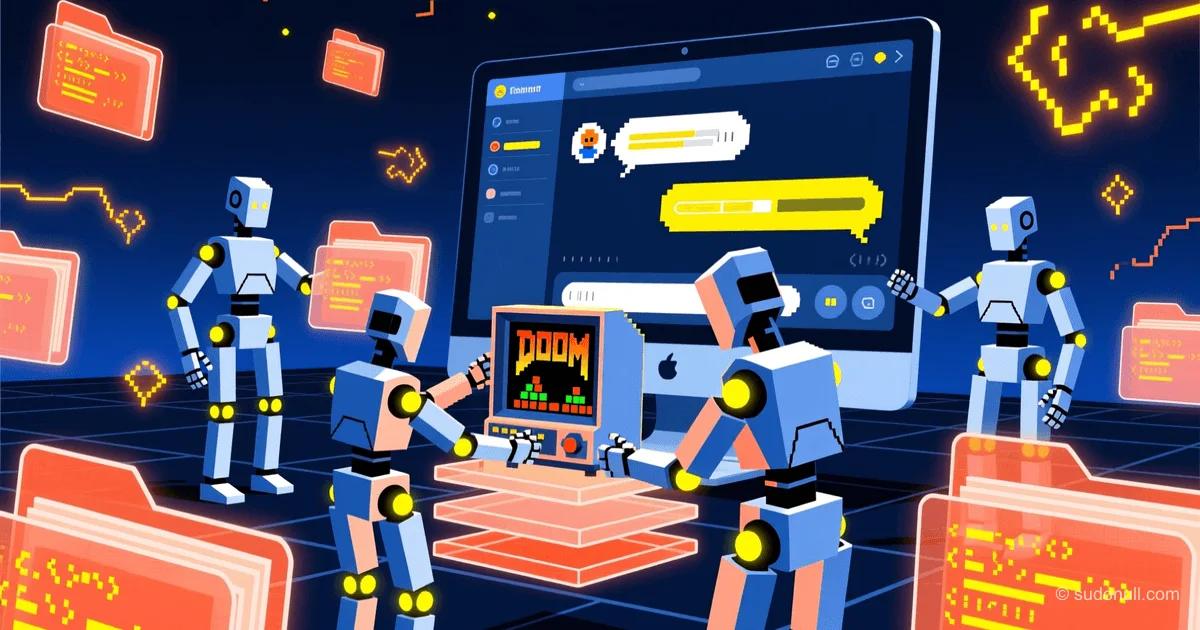
Google Releases Antigravity 2.0 Coding Platform
In response to Anthropic's growing market share, Google has launched Antigravity 2.0 — an agent-based development environment as a standalone desktop application. Parallel operation of multiple agents speeds up processing by 12x, and the AI Ultra subscription price has been reduced to $200 per month.
Antigravity 2.0: Why Google Ditched the IDE and What a Quantum Leap in Tokens Has to Do With It
[The Gist]: What's Really Happening
Google has just redefined the concept of a development environment. Antigravity 2.0 is not an improved code editor or yet another attempt to catch up with Cursor. It is a complete rejection of the IDE concept in favor of what the company itself calls an "unabashedly agent first" platform.
The key architectural shift: the interface center is no longer a code editor but a dialogue with an agent. The user states a goal, the agent plans steps, requests permissions, modifies files, runs commands, and reports results. The developer transforms from a keyboard operator into a task setter and quality controller.
This is a mirror response to Anthropic's Claude Code, which captured 54% of the AI programming tools market in a year and generated $440 billion in annual revenue for the company — going from zero to that figure in under 18 months. Google realized it was losing not in model quality but in interaction paradigm, and is now trying to seize the initiative with a radical product architecture change.
Timeline and Context
2024. The AI coding market is fragmented: Cursor, Windsurf, Trae compete for a share in the "AI-IDE" niche. But the real breakthrough happens outside the IDE. Anthropic launches Claude Code as a terminal tool without a graphical interface — and it becomes the main growth driver.
Early 2025. Claude Code goes public. Explosive growth: from zero to $10 billion in annual revenue in 9 months, then to $25 billion by February 2026. No SaaS product in history has shown such growth. Venture analysts admit they've "never seen anything like it."
Late 2025. Google launches Antigravity 1.0 — positioning it as an "Agent-First IDE." But it's still an IDE, albeit with an agent at its center. The market reacts cautiously: developers have already tasted Claude Code, which has no editor at all, and the IDE approach seems outdated.
May 2026. At Google I/O, the company unveils Antigravity 2.0 — a completely redesigned product. No more IDE. A standalone desktop app, CLI, and SDK. Under the hood: Gemini 3.5 Flash, a model created with Antigravity's own involvement. Google shows a demo that will go down in history: agents create a full-fledged operating system with a scheduler, memory management, and file system in 12 hours — and immediately run Doom on it. API call cost: under $1,000.
Who Wins and Who Loses
Winners:
Developers tired of routine. Antigravity 2.0 introduces a system of sub-agents working in parallel: one writes the frontend, another generates design assets, a third designs the database architecture — simultaneously. The /goal command launches an agent in autonomous mode until full task completion without intermediate approvals. For the first time, a developer can delegate not just a line of code but an entire task.
Google Cloud. The Antigravity SDK opens programmatic access to the same agent platform that Google's own products run on. This means enterprise clients will deploy agents on Google Cloud infrastructure, generating a steady stream of compute resource revenue.
Open-source community. Unlike Codex (only OpenAI models) and Claude Code (only Anthropic models), Antigravity 2.0 supports third-party models — Claude Opus 4.6, GPT-OSS-120B, Sonnet 4.6. This is "openness by necessity": Google understands developers won't swap proven models for Gemini out of loyalty alone, so it offers choice.
Losers:
Traditional IDEs. When an agent can read the entire project, plan changes, and execute them — is a code editor even needed in the traditional sense? Antigravity 2.0 shows the center of gravity shifting from the editor to the dialogue with the agent.
Startups in the AI-IDE niche. Cursor, Windsurf, Trae, and dozens of other projects building businesses around "IDE with AI assistant" face an existential crisis. Giants — Google, Anthropic, OpenAI — are moving to an agent-first architecture where the IDE as such disappears. This is not evolution but category replacement.
OpenAI Codex. With 400 million ChatGPT users, Codex is used by only about 40% of Claude Code's audience. And now Google adds support for third-party models — a developer can use Antigravity 2.0 as a platform and choose a model for the task. This makes OpenAI's position even more vulnerable.
What the Media Isn't Saying
Most publications focus on the Doom demo and 12x speedup. But the key insight is hidden in the platform's architecture — and it concerns not so much programming as Google's entire strategy.
Antigravity 2.0 is a Trojan horse for the enterprise market. The SDK allows enterprise clients to create custom agents tailored to their business processes. This is not a tool for writing code — it's a platform for building a digital workforce.
Proof: integration with Google AI Studio and Firebase. An agent created in Antigravity can be immediately deployed in a Google Cloud production environment. This closes the loop: development → testing → deployment — all within the Google ecosystem. Competitors offer tools; Google offers a factory.
The second underestimated factor is the price war. Google lowered the top-tier AI Ultra plan from $250 to $200 per month and introduced an intermediate plan for $100. At the same time, the company claims that moving 80% of workloads to Gemini 3.5 Flash will save large clients over $1 billion annually. This is a blow not to competitors' products but to their business models. With a 10x price difference compared to Claude Opus, corporate clients will be forced to at least reconsider budgets.
And finally, the most intriguing part: Gemini 3.5 Flash was partially developed using Antigravity. Google uses its own tool to create models that make that tool even more powerful. This is a recursive loop: agents improving agents. And it has already closed.
Forecast: Next 30 Days and 90 Days
30 days (through end of June 2026).
The first weeks after I/O are a critical adaptation period. Developers will start mass-testing Antigravity 2.0, comparing it with Claude Code and Codex. The main metric to watch is not installs but two-week retention. If users return after the first experience, the product is a success.
Expect a wave of content from tech bloggers: comparisons of the three platforms, benchmarks on real tasks, analysis of strengths and weaknesses. The results of these tests will define the narrative for the coming months.
Simultaneously, Google Cloud will begin active sales to enterprise clients, offering the Antigravity SDK as part of the package. The first major contracts will be announced within 4–6 weeks.
90 days (through end of August 2026).
By fall, the AI coding market will finally split into three ecosystems: Anthropic (Claude Code), Google (Antigravity), and OpenAI (Codex). There will be no fourth — the niche of traditional AI-IDEs will collapse, and their audience will migrate to the leading platforms.
The key battle will revolve around enterprise contracts. Fortune 500 companies will choose not a tool but a platform — considering cloud infrastructure, security, and regulatory compliance. Here Google has an advantage: Google Cloud certifications, integration with Workspace and Android, global infrastructure.
As for monetization: at $100–200 per month for the professional tier and millions of active developers, Google's annual revenue from Antigravity alone could reach several billion dollars. But the main value is not even direct subscription revenue, but locking enterprise clients into the Google Cloud ecosystem for years to come.
And the biggest question that remains unanswered: when will agents start writing agents that write code? The 12-hour OS demo is just the tip of the iceberg. The next step is when a human writes not a single line of code but only formulates business requirements. And that step is not far off.
— Editorial Team










No comments yet.