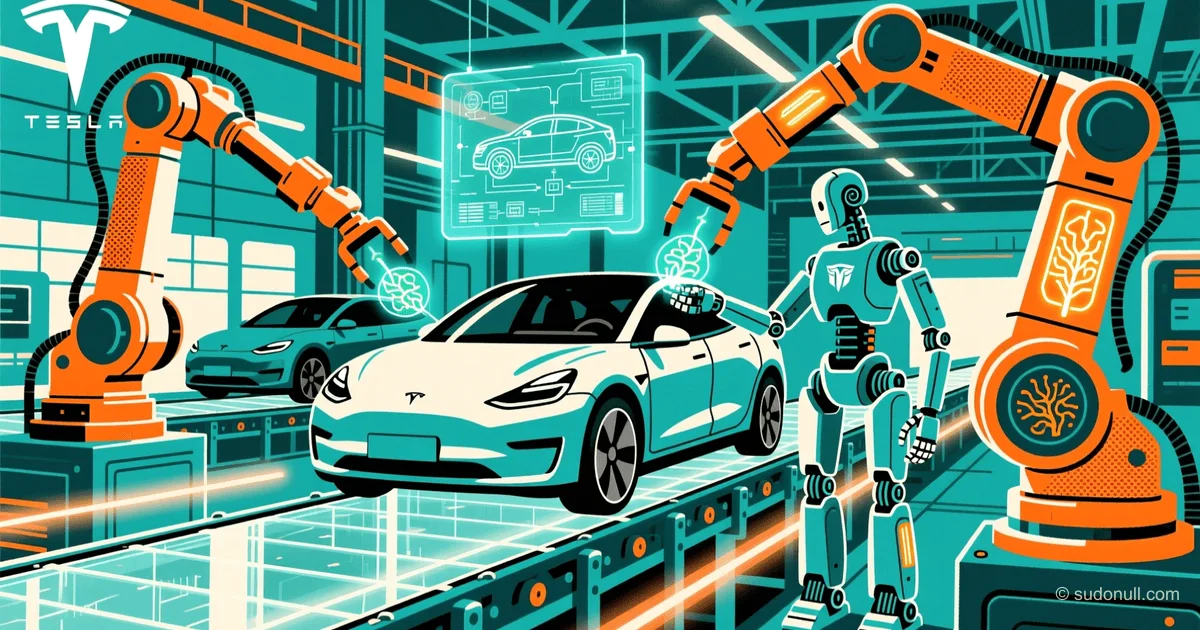
Tesla Model S and X Factories Retooled for Humanoid Robot Production
Tesla Vice President Tom Zhu confirmed on May 21 that the last Model S and Model X have been produced at the Fremont factory. Production lines will be retooled to manufacture Optimus humanoid robots.
Headline: Death of Model S and Birth of 100 Million Optimus: Why Tesla Just Destroyed Its Own Parts Market
On May 21, 2026, Tesla Vice President Tom Zhu (often referred to as Tom Zhu in Russian media, though her original name is Grace Tao, but that's beside the point) confirmed what had been whispered for six months: the flagship Model S and Model X are no longer in production. The Fremont line, where electric vehicles costing over $100,000 were once assembled, will start stamping out humanoid Optimus robots in four months.
Mainstream analysts have already written standard pieces: "end of an era," "shift to AI," "Musk shocks again." All nonsense. What really happened on May 21 is the quiet launch of the largest restructuring of the global component supply chain in history.
[The Gist]: What's Really Happening
You're all looking in the wrong place. The question isn't why Tesla killed the Model S. The question is HOW they did it and what it means for suppliers.
Model S and Model X were Tesla's only products that used exclusive, expensive, bespoke components: unique ventilated seats, specific cast aluminum body panels, custom falcon-wing door hinges on the Model X. Demand for these parts from third-party manufacturers (Tier 1 and Tier 2 suppliers) has just plummeted to zero.
And in their place comes Optimus. Look at the numbers from Tesla's internal briefing that leaked to industry media back in April. One Optimus robot has:
- 28 actuators
- About 20 brushless motors just for the hand
- Approximately 14 reverse planetary roller screws
And these aren't just different parts. This is fundamentally different physics. The Model S needed thin-walled aluminum profiles and soft plastic. Optimus needs high-hardness alloy steels, rare-earth magnets for motors, and ultra-precision mechanics with micron tolerances.
One Optimus robot in its current BOM (Bill of Materials) configuration costs about $20,000 in target mass production. Now multiply that by 1 million robots per year, which Tesla plans to produce on just one line in Fremont. That's a $20 billion per year market in direct material costs alone. The old Model S, with its $100,000 per unit and tiny volumes (about 50,000 per year at its peak), is a grain of sand compared to this.
Timeline and Context
Behind this decision is a clear, cold calculation that Musk started making a year ago.
- January 2026: Musk first loudly declares on the quarterly conference that Model S and X will die in Q2. Around the same time, Jefferies publishes a report stating that Tesla is increasing CAPEX to $20 billion across several areas, but priority number one is Optimus and robotaxis.
- April 2026: Tesla stops accepting custom orders for Model S/X. This was a "red flag" for parts warehouses. At the same time, closed supplier audits for Optimus Gen-3 take place. Chinese giants like HDS Harmonic and Inovance receive technical specifications for tons of components.
- May 21, 2026 (the event): The last 350 "farewell" Signature Series versions (250 Model S and 100 Model X) roll off the assembly line in Musk's presence. But note: they are not sold openly—only by special invitation. Why? Because Tesla no longer has contracts with suppliers for unique trim for these cars. They were made from what was left on the shelves.
Who Wins and Who Loses
Winners:
- Chinese robot component manufacturers (HDS Harmonic, Inovance, Estun): They've been waiting for this moment for years. Previously, their market was industrial CNC machines—volumes were in the thousands, not millions. Tesla comes and says, "Give us 28 million actuators per year (for a million robots)." This increases their TAM (Total Addressable Market) 100-fold. These companies, once overshadowed by Bosch or Continental, will become new giants.
- Lucid, Rivian, and Mercedes (in big letters): The vacated niche of ultra-expensive electric vehicles is their lifeblood. Everyone who wanted to buy a $150,000 "hot" sedan and signed up for a 10-month queue for a Model S Plaid will now turn to competitors. Lucid Air, which technically outperforms the old Model S in efficiency but couldn't beat its Tesla marketing muscle, will benefit especially.
- Current Model S/X owners (on the secondary market): Paradoxically, it's true. Production halt instantly freezes the model. Once a car becomes a "classic," its parts start to appreciate, and the vehicles themselves turn from utilitarian tools into collectible assets. Prices for used Model S with large batteries could jump 15-20% in the next six months.
Losers:
- Bosch, Continental, ZF (the old guard): They've built their business for decades on the fact that their "transmission" or "air conditioning system" fits BMW, Audi, and Tesla alike. The modular design of Optimus breaks this approach. Musk designed the robot's hand with 20 tiny motors of its own—Bosch doesn't have such a line.
- US machine shops and foundries that worked for Tesla: Producing exclusive aluminum panels for Model S/X required specific press molds. Now these orders are going to China or to Tesla's own robotic lines.
What the Media Isn't Saying
The least obvious insight is that the parts market for Model S/X has just turned into a "minefield" for the next 5 years.
Everyone celebrates the "green transition," but no one talks about the legal trap. In California and the EU, laws require manufacturers to supply parts for a model for 10 years after discontinuation. Tesla formally must continue producing unique parts for Model S/X until 2036. However, their production line has been retooled for robots. Spare capacity is zero.
What will they do? They will outsource production of these parts to small firms. But these small firms will have to charge exorbitant prices because they don't have original dies, and 3D metal printing for a falcon wing costs a fortune. Model X owners involved in accidents in 2027 could receive repair bills amounting to 60-80% of the car's original value. Tesla doesn't care right now—they've already cashed in on new cars.
Second point: Where will the thousands of tons of specialized equipment for Model S/X assembly go? Machines, welding robots, conveyors. They can't be thrown away. This equipment will be resold at auctions. Who will buy it? Startups like Rivian or Farasis? No. Indian companies. This will mark the beginning of cheap electric vehicle production in India, which Tata Motors is currently trying to build. Literally, Musk is laying the foundation for his future competitor from Mumbai, simply because he can't be bothered with outdated hardware.
Forecast: Next 30 Days and 90 Days
30 days (by June 22, 2026):
- Several small Tesla suppliers will sue the company. Contracts for supplying seats or cast wheels for Model X were signed for 3-5 years ahead. Unilateral termination will hit them hard. Lawsuits will be for £10-15 million, but Tesla will simply pay severance to speed up the transition.
- In China, another "Optimus clone" will be announced. This time a serious one—from Xiaomi or Baidu. They will unveil a robot that looks indistinguishable from Optimus Gen-3 but costs 30% less thanks to local subsidies.
90 days (by August 22, 2026):
- The Fremont line will be launched in test mode. This will happen faster than the promised 4 months. Tesla engineers will get bonuses for speed but will pay with quality. The first batch of Optimus (about 5,000 units) will have manufacturing defects. Videos will appear online showing a robot's finger falling off or a knee jamming due to coupling overheating. Tesla's stock will drop 7-10%, and Musk will make a brilliant move—he will fire half the quality control department, replacing them with AI cameras that scan every seam.
- Most importantly: by August, the names of the first Optimus buyers will be known. They won't be individuals. Tesla will sign contracts to supply 200,000 robots to three logistics corporations: Amazon, FedEx, and... guess? China's JD.com. Yes, the US will subsidize robots that, in 18 months, will start working in the warehouses of Amazon's direct competitor in Asia. And no one can stop it because robots aren't tanks—export bans are nearly impossible.
— Editorial Team









No comments yet.